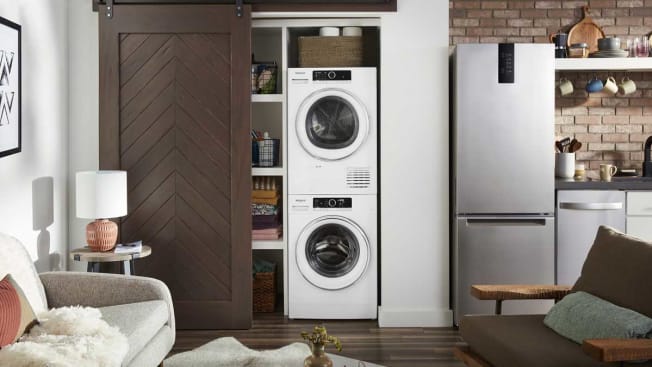
These stackable machines have their quirks, but they may be the best choice for a small space
A paired compact washer and dryer unit has a small footprint when stacked, but you might have to pay extra for the stacking kit.
By Keith Flamer
There’s no magic wand for making huge piles of laundry disappear. If you own a large-capacity washer and dryer, the task will go faster; you can bag those big loads in a few hours. But if you rely on a smaller compact washer and dryer, buckle up. It’s officially laundry day—potentially all day.
Love ’em or hate ’em, stackable compact washers and dryers may be your only choice if your laundry area can’t accommodate full-sized machines. They can still get the job done if you invest in a good-quality pair. These space-saving machines represent a tiny market share, but they’re gaining in popularity among downsizing retirees as well as younger urban/suburban dwellers organizing their townhouses and condos. Apartment dwellers usually don’t have as much say in their washer-dryer choices, but if they do, compact models are typically a good option.
All of the compact washers we’ve tested are stackable front-loaders, and most perform well. They’re slightly pricier than their full-sized cousins and about twice as expensive as top-load agitators. They tend to be gentle on clothes, and many are water- and energy-efficient.
Most compact washers rate extremely well on water and energy efficiency in CR’s tests, which will save you money in the long term. They also offer many of the same features as full-sized machines, including faster cycles and specialty options like automatic detergent dispensers and WiFi, which lets you operate them remotely.
In recent years, manufacturers have upgraded compacts with more stylish designs and larger door openings for easier access. But there are a few quirks particular to compact models that you should be aware of before you shop.
Compact Washers Vibrate
Like all front-loaders, compact washers spin fast to extract as much water as possible from clothes, cutting dryer time. That high spin speed in a smallish frame typically causes vibration. And stacking a dryer on top of the washer (a typical setup for compacts) doesn’t help in that regard. To reduce vibration, make sure your compact washer is properly leveled when installed. If vibration becomes a problem, using a lower spin speed may help. Among the compact washers we tested, one achieved the highest score and another received a very good score for vibration. Here they are.
Electrolux ELFW4222AW
The Electrolux ELFW4222AW earns an excellent score for washing performance and a very good score for vibration and gentleness (meaning less wear and tear on your clothing). It also offers excellent and very good ratings for water efficiency and energy efficiency, respectively. In our member survey, respondents gave the brand a top rating for predicted reliability and a middling rating for owner satisfaction.
GE GNW128SSMWW
For a 2.8-cubic-foot compact washing machine, the GE GNW128SSMWW does a decent job of cleaning laundry. This stainless steel model uses less water and less electricity per load than many machines, and vibration is minimal during operation. Running the most aggressive normal cycle with a midsized load takes 45 minutes. It earns an adequate score for gentleness in our tests, causing some wear and tear to laundry during washing. It’s also fairly noisy, which can be annoying if the laundry area is near living spaces. This washing machine comes with a one-year warranty.
Stacking Kits May Not Be Included
Some compact washer-dryer sets include stacking hardware, while others require you to order the kits at an extra cost. Stacking kit prices can be $50 to $250, so it’s something to keep in mind when shopping. All of the compact machines in our ratings are stackable.
Using Bleach Can Be a No-No
Chlorine bleach can negatively affect internal rubber and plastic parts of front-load compact washers. So some compacts don’t offer bleach dispensers. But the availability of safer bleaching agents means more bleach-dispensing compacts are coming to market than ever before. Fourteen of the compact washers we’ve tested include a bleach dispenser. Those that have dispensers are identified in our ratings chart.
Detergents and bleaching agents that claim to be Oxi- or Oxy-based (a color-safe bleach made from sodium percarbonate) are typically safer for machines. Before buying a compact washer, check the manual to see whether bleach can be used.
Most of the compact machines in our ratings, particularly the higher-rated ones, have automatic bleach dispensers. Here are two of those highly rated models.
Miele WXI860WCS
The Miele WXI860WCS ranks at the top of our compact-washer ratings as an energy- and water-efficient model, offering superior washing performance with minimal environmental impact. It also has an automatic bleach dispenser if that feature is important to you. This is a pricey machine, but CR members gave Miele compact washers top scores for owner satisfaction and reliability. If you’re looking to save a few dollars, consider Miele’s WXF660WCS, which we expect to perform similarly.
Miele WWH660WCS
The Miele WWH660WCS retails for a bit less than the tested WWH860WCS, but we expect it to perform similarly. That model passed our tests with flying colors, demonstrating stellar washing performance, energy efficiency, and water efficiency. Our survey results indicate that Miele compact washers earn high marks for reliability and owner satisfaction. Our tests have found that it’s also pretty quiet and gentle on clothes and has an automatic bleach dispenser. But bring a book: Cycle time for this model is a plodding 105 minutes.
Compact Dryers Are Only Electric
Gas compact dryers are rare finds. That’s why you’ll see only electric dryers in our compact dryer ratings. Keep in mind that all require a 240-volt connection. Some compact washing machines can plug into their companion dryers, which is helpful if you have only one outlet. You’ll notice a wide range in the yearly operating costs of compact dryers, from $32 to $145 in our ratings.
Photo: Courtesy of Whirlpool
Ventless Dryers Usually Take Longer
Our tests found that vented dryers—the kind that exhaust air outside—often dry clothes faster than nonvented models. But only five of the 18 compact dryers in our ratings are vented. A majority are ventless dryers, which require a drain for moisture removal or a reservoir that must be emptied manually after each dryer cycle.
In our tests, vented compact dryers took, on average, a little over 1 hour to dry a 6-pound mixed laundry load, while ventless dryers took 1⅓ to 2½ hours. Variables such as load size, moisture, clothing type, and dryer type can also affect drying time. If you must choose a ventless dryer, it might be helpful to scan the washer cycle times in our compact-washer ratings (ranging from 45 to 125 minutes) to get a sense of the total time you’ll need to complete a load of laundry. In Europe, where compact machines are the norm, total washer-dryer cycle times can exceed 4 hours.
Compact dryers also have smaller drums, typically 4 to 5.1 cubic feet. This is much smaller than the drums of standard dryers, which generally range from 7 to 9 cubic feet. That means less air to circulate, which can extend drying times, whether your machine is vented or ventless. Below are highly rated vented compact dryers from our ratings. The bottom line: With compact dryers, patience is a virtue; they don’t work magic, but they will get your clothes dry eventually.
Samsung DV25B6900EW
The Samsung DV25B6900EW earns a very good score for drying performance, promptly drying mixed loads of cottons, polyester, and synthetic delicates. Its scores are also near top-level for noise and convenience. Samsung compact dryers, as a brand, received satisfactory ratings for reliability but a below-average score for owner satisfaction in CR’s member survey.
Samsung DV25FG60BVBEA2
Samsung compact dryers in our ratings dry clothes very well and quickly, but they use more energy to do so. So your annual usage costs can be double that of a Miele model. Costing $97 annually to operate, the Samsung DV25FG60BVBEA2 lacks an Energy Star certification and a moisture sensor that shuts off the dryer when a load is fully dry. That means this dryer could run too long, wasting energy. (It’s also not so quiet.) But it’s an effective dryer, featuring a 4-cubic-foot stainless steel drum that spins moisture out of clothes in 82 minutes, slightly faster than many other compacts. It comes with WiFi so that you can time your laundry loads remotely.
Consumer Reports is an independent, nonprofit organization that works side by side with consumers to create a fairer, safer, and healthier world. CR does not endorse products or services, and does not accept advertising. Copyright © 2026, Consumer Reports, Inc.