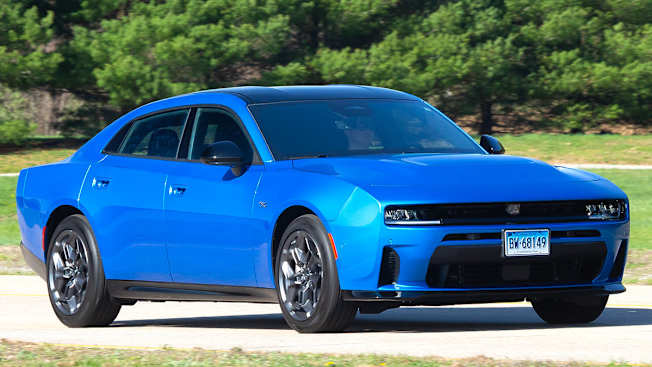
Despite innovations like a hatchback body and a potent turbocharged six-cylinder engine, our drivers have mixed feelings
Dodge’s big, brash sedan has power, personality, and more than a few compromises.
By Jeff S. Bartlett
Dodge gambled that the next muscle car era would be electric, with the aptly named Charger leading the brand’s commitment to the appeal of EV power. But they didn’t put all their money on it. In a clever move, Dodge developed a coupe and sedan that would be offered as electric vehicles and as conventional gas-only cars.
Sales thus far indicate that the current gasoline-fueled muscle-car era continues, with the regular gas version of the all-new Charger far outselling the Charger Daytona EV. So we purchased a Charger R/T sedan with the twin-turbocharged inline-six-cylinder engine to experience the latest take on an American classic.
Muscle cars were first bred in the 1960s by combining midsized cars with large engines. As the decade progressed, the cars became more flamboyant, the engines more powerful, and overall chassis, such as brakes and suspension, were increasingly fortified. By the late 1960s and into the early 1970s, cars like the Dodge Challenger and Charger were winning races, turning heads, and becoming four-wheel celebrities that adorned movie screens and bedroom posters.
Today’s Mopar muscle formula is somewhat similar: Give a car an imposing design and big power, this time with a choice of electric motors or turbocharged engines. The result is a mean machine with modern convenience and performance underneath a nostalgia-provoking appearance.
This Charger is a natural evolution from the prior-generation car: long, low, and wide. But there are some key differences, among them, its hatchback design and standard all-wheel-drive. These are nice upgrades that manage to preserve the basic packaging and character that the nameplate has exhibited for so long. And we do mean long, as the last generation dates back to 2011 without a major redesign.
The good news for enthusiasts is that there are different powertrain levels to choose from and several individual options and packages to heighten capabilities. To best reflect the experience of most Charger customers, we went with the 420-hp R/T with limited extras. (There is a 550-hp version available called Scat Pack. Safe to assume that other upgrades will bring expected enhancements, especially for track use.)
We bought a blue (which Dodge officially calls “Bludicrous”) sedan locally with the Blacktop package ($1,295), which adds a sport suspension, 20-inch all-season tires on black wheels, black exhaust tips, and dark exterior badging. Plus, it has the driver convenience group ($1,495), which added a long list of upgrades, like an eight-way power driver’s seat and a nine-speaker Alpine audio system.
Not only did our buying strategy help keep the price down, but this Charger configuration makes for a reasonable comparison against the Ford Mustang GT we previously tested. Buyers with flexible brand loyalties should consider either model.
As we log miles ahead of formal testing, our team has been taking notes, debating the virtues, and arm-wrestling over where this Charger has earned a place in the pantheon of muscle cars. And all the while, our enthusiastic drivers are resisting the temptation to do a smoky burnout, as any damage to the Nexen NFera AU7 tires would affect track performance and test results.
If you’re a Consumer Reports member, our initial expert assessment of the Dodge Charger is available to you below. Once we complete 2,000 break-in miles, we’ll put the Charger through more than 50 tests at the CR Auto Test Center, including empirical measurements of acceleration, braking, handling, car-seat fit, and usability. CR members will have access to the full road-test results as soon as they’re available.
Sign up for CR’s Cars email newsletter to be notified when we post our latest road-test results.
What we bought: 2026 Dodge Charger R/T Blacktop
Powertrain: 420-hp, 3.0-liter turbocharged inline-six engine; 8-speed automatic transmission; all-wheel drive
MSRP: $51,995
Options: Driver convenience group ($1,495), Blacktop package ($1,295), Bludicrous paint ($695), MyFlexCare Service ($225)
Destination fee: $1,995
Total cost: $57,705
Final assembly point: Windsor, Ontario, Canada
The Charger’s coupelike styling hides its hatchback design. This rear three-quarter view recalls past Charger generations.
Photo: John Powers/Consumer Reports
Consumer Reports’ Take
Dodge went bold with the Charger redesign, bringing out every engineering trick in their playbook. (This was a bit of a shock after two long Charger generations that were a straightforward sedan spun off an old Mercedes-Benz platform and stuffed with a classic V8.)
The Charger name now encompasses a coupe and sedan body styles, each with a hatchback, rather than a traditional trunk. Both versions are available with either an electric powertrain or a turbocharged inline six-cylinder engine. As an added twist, this model, long known for spinning tires with a rear-wheel-drive configuration, is now only available with all-wheel drive. (But it can be put in RWD.)
The naming is quite confusing. The EV is called Charger Daytona. The base gas-only Charger is called R/T, and the high output version is dubbed Scat Pack. It would have been simpler, in this author’s opinion, had the EV been called Charger (what a perfect name!) and the gas-only been called Challenger. I digress.
The Charger is an American icon, or more accurately, a North American icon. Dodge assembled our vehicle in Canada, and sourced 33 percent of its parts content from Mexico.
Whatever you call it, there is something uniquely American about the large proportions, extroverted styling, and brash exhaust sounds. How much those attributes warm your heart, loosen your checkbook, and tickle your nostalgia will dictate if the car is right for you.
Judged purely as a sedan, the Charger R/T has real shortcomings. The back seat is hard to enter and surprisingly snug, and the cargo area is far less functional than you might imagine. But driving the Charger is a visceral experience that makes most other cars feel appliancelike. Ultimately, therein lies its appeal.
With just $5,000 separating the R/T and Scat Pack sedans, the upgrade sure is tempting. The Scat Pack adds 130 horsepower, the performance suspension, Brembo brakes, and a few equipment upgrades, such as cloth-and-leatherette upholstery. One key appeal for the Charger is that the different trims and packages allow buyers to tailor its character to their personal tastes.
What We Like
Personality: This is a true muscle car, with its gregarious presence, big power, and soundtrack, all crafted for delinquency. It is a bad boy among civilized cars, itching for a good time. It is a throwback to another era, yet thoroughly modern in the places where you want modernity. It is an antidote for automotive blandness. Understandably, it may not be to everyone’s liking, but credit is due to Dodge for creating a car with personality.
Ride: The ride skews firm, appropriate for the sport suspension that came with the Blacktop package. We found that occasional rough surfaces and cracks do disrupt the cruising experience, particularly at lower speeds. On the highway, however, the Charger is quite poised. Overall, enthusiast buyers will likely be pleased with the balance of comfort and engagement. For those who prefer a softer ride, the base 18-inch wheels shod with taller sidewall tires should help.
The seat base is higher than many sedans, which makes access into the Charger R/T comparatively easy. Larger test drivers liked the seats’ proportions, while slender drivers were less satisfied.
Photo: John Powers/Consumer Reports
What We Don’t Like
Driving position: For a large car, the interior proportions made our test drivers feel hemmed in. The seat is also low to the floor, putting most testers’ legs at an odd angle. The foot rest (aka dead pedal) on the left is on a different plane than the other pedals, and it slopes forward more than those in most vehicles, creating an uncomfortable angle for the left foot. Some drivers also found the footrest to be too far away. The center console rubbed the knees of several drivers. The ceiling is low, as it was with the previous generation. The armrest on the door is too far away for supporting the left elbow, and even the center armrest was a stretch for some. Ultimately, the cabin is more claustrophobic than its exterior dimensions would suggest.
Rear access: Getting into the back seat is difficult due to the low roof and elevated seat height. Access is further complicated by the door’s limited sweep. Due to these and other limitations, the back seat is best suited to lithe, flexible passengers.
The Charger R/T’s back seat is snug and suited only for children and small passengers due to the low ceiling and limited legroom.
Photo: John Powers/Consumer Reports
Back seat: Once inside, the back seat is best for kids or a laptop bag. Headroom is so tight, some adults can’t sit upright, and there is limited space to tuck feet under the front seats. At that point, you might as well get the coupe. For those who are committed to using the back seat, there are a couple of vents and two USB-C ports on the back of the front center console. The seat bottom has a nice angle, but because the floor is so tall, there is little underleg support. The center fold-down armrest has the cup holders right where the inboard elbow would fall. For buyers attracted to the sedan, try the back seat with your intended passengers.
The angle of the rear hatch limits the ability to tote boxy cargo, and the depth means it can be a far reach to access small items that slide about.
Photo: John Powers/Consumer Reports
Cargo space and disappointing hatch: Making the Charger a hatchback was a clever decision. Typically, hatchbacks make it easy to load large items, especially when the back seats are folded. The hatch is stealthily integrated into the overall design. However, it doesn’t live up to the promise. The cargo area is quite shallow at the back of the vehicle, so some boxy items won’t fit under the closed hatch. The space is deep, but almost too deep. If items slide forward in the car, you may not be able to reach them without climbing into the trunk. Further, the hatch on our R/T is not powered. One would expect that when you push the release button on the back, the hatch would at least pop up slightly so you could get your fingers under it to lift. Nope. The hatch itself is heavy. This is a case where a trunk might have been roomier and more functional.
The rather plain pistol gear selector stands out with its dull plastic grip, as it is surrounded by interesting materials embellished with contrasting stitching. We like the slot between the cupholders sized for standing a phone upright.
Photo: John Powers/Consumer Reports
Inconsistent shifts: Feedback on the transmission starts with the odd flight stick that serves as the gear selector, which feels strangely cheap and stands out in the otherwise nicely finished cabin. We wish it were either swathed in similar materials as the dash or given a cool retro treatment. The real concern is that automatic gear shifts seem tuned more for drama than performance. The shifts can sometimes be slow to initiate, then hit with a vengeance. It is clear that the inline engine has a lot of power, but it isn’t delivered smoothly. This is especially noticeable during 1-2 shifts at parking lot speeds, where the transmission holds on to first gear like it is a precious treasure, then abruptly slams into second gear.
Steering wheel: Navigating tight spaces gets awkward with the square-circle steering wheel (though it is thankfully more elliptical than the squircle in the latest Jeep Cherokee). For a car built for doing donuts, it seems essential that the steering wheel should be round like one.
Noise: Some civil test drivers said that the cold-start raucous isn’t neighbor-friendly. Others thought it was cool… just not quite as sonorous as the bass-filled burble of a V8. (As the meme goes: I don’t always cold-start my muscle car and rev it, but when I do, my neighbors get to enjoy it, too.) Ultimately, the experience is a matter of personal preference, with some drivers (and likely buyers) favoring a more classic rock sound, rather than the nu metal. That said, road and wind noise are very well-controlled.
Climate system: The logbook comments on climate system performance are usually rather basic: Most cars heat and cool well, as expected. But the Charger drew criticism for responding slowly to input, requiring a practiced hand to linger a moment to make a selection, and for the leisurely pace at which the heated steering wheel and seat delivered warmth. Think more slow simmer than rapid boil.
Compromised visibility: The Charger is a car to be seen in, not a car to see out of. There is a major issue with forward visibility due to the central position of the rearview mirror and sensor assembly. Rather than being mounted high on the windshield, it is right in the middle, obstructing a significant percentage of the forward view, which is already limited by the short windshield and hood bulge. As a result, the driver can lose sight of cars and pedestrians at intersections and in parking lots. Fortunately, the windshield pillars are relatively slim and leave a gap to see around the side mirrors. Otherwise, the side mirrors are small, the beltline is tall, the side windows are chopped, the second pillars are bulky, and the rear pillars are massive. The long, wide, and bulging hood further complicates parking. The rear glass is also quite squat, with some visibility compromised by the outboard headrests. This is not an easy vehicle to see out of.
The Charger has a more artfully designed cockpit than many cars these days, with attractive details all around, including the door panel.
Photo: John Powers/Consumer Reports
What We’ll Keep an Eye On
Fit and finish: Like many recent Stellantis vehicles, the interior looks sharp. Their designers know how to make something look unique and attractive, with a range of interesting shapes and textures. The dash design has multiple levels, and even the screen configuration eschews the latest conventions of wide displays or tacked-on rectangles. However, the abundance of hard plastics makes the cabin look better than it feels. The test team was quite mixed in their feedback, with the logbook comments reading like a beer commercial parody: “Looks great! Feels cheap!”
Front seat: Larger drivers like the front seats, citing their width and low bolsters. But drivers’ hips tend to sit lower than their knees, creating an odd leg position. The floor shape is anything but flat, and then, as mentioned, there is the uncomfortable left footrest. Most felt the cushioning was a bit soft for longer drives, leading to fidgeting. The seat base is a bit higher than in most sedans, aiding access and visibility over the hood. Ultimately, designing a cushy seat for wider drivers is probably on target for the intended, older buyer.
Door trim: The interior door styling is a standout feature. They look very cool, with a geometric, three-dimensional texture and a sweeping design that doubles as a handle for closing the door or resting your hand. Yes, the trim feels plasticky to the touch and it may be a chore to clean, but it is striking.
The twin-turbocharged six-cylinder fills the engine bay to the point where we have great sympathy for mechanics who need to fit their hands around it for servicing.
Photo: John Powers/Consumer Reports
Performance: Dodge says the 420-horsepower Six Pack can race from 0 to 60 mph in 4.6 seconds. That is 1.5 seconds quicker than the V8 we tested in the previous-generation sedan, despite this weighing about 400 pounds more. Further, that claim matches the time measured in the current Ford Mustang GT. However, this new Charger doesn’t always feel as fast as that claim suggests, in part because of the nonlinear acceleration and perhaps because EVs have spoiled us with their performance. Sport mode is the key for performance driving, dialing up the powertrain response a notch. We are very interested in measuring acceleration to see how it performs on our track.
From behind the wheel, the straight-line experience is a mix of engine clatter, exhaust belching, and inelegant shifting. It feels like the car generates more noise than power at times. Just from the seat of the pants, the Mustang GT feels more potent and its acceleration more linear. Suffice to say, the Six Pack is satisfying for daily driving, making unruly sounds and delivering power when called on, but enthusiasts would no doubt appreciate the immediacy of the more potent Scat Pack.
Fuel economy: Efficiency isn’t a primary consideration with cars meant for fun, but still, it is a genuine concern when gas prices are elevated. Our Dodge Charger has an EPA rating of 20 mpg combined on regular gas, as listed on the window sticker. Of course, that figure will plummet if you drive with a heavy right foot, which is hard to resist with the feisty turbo engine being ever eager to play. But at least it doesn’t require premium gasoline. (The Charger Scat Pack is EPA-rated at 19 mpg combined on premium.) We are interested, as always, in seeing how the Charger performs in our city and highway tests.
Handling: In true muscle car fashion, handling isn’t its greatest talent. As a big, heavy vehicle (about 4,700 pounds), the Charger feels a bit out of its element when pushed. The bulk is inescapable on narrow roads and even in parking lots. Most drivers found the steering to be heavy, with more resistance than desired. Steering response is relaxed, with a distinct on-center feel that is well-suited to highway cruising. The all-wheel-drive system helps put the power down when pushing through turns, and it can be turned off for more tail-happy excitement when desired. Overall, the handling seems appropriate to the model and mission. We look forward to exploring this further on the road course at a track.
If you’re tempted to smoke the tires, remember that there is no spare on board.
Photo: John Powers/Consumer Reports
Safety and Driver Assistance Systems
Dodge’s Active Driving Assist hands-free driving system with adaptive cruise control comes standard, along with automatic emergency braking with pedestrian and cyclist detection, blind spot warning, rear cross traffic warning, and a driver attention monitor.
The optional Driver convenience group on our car brought parking sensors, along with adaptive guidelines for the backup camera display. That is standard on other trims, along with a head-up display, a surround view camera, and audible and visual alerts for potential collisions at intersections.
Consumer Reports is an independent, nonprofit organization that works side by side with consumers to create a fairer, safer, and healthier world. CR does not endorse products or services, and does not accept advertising. Copyright © 2026, Consumer Reports, Inc.