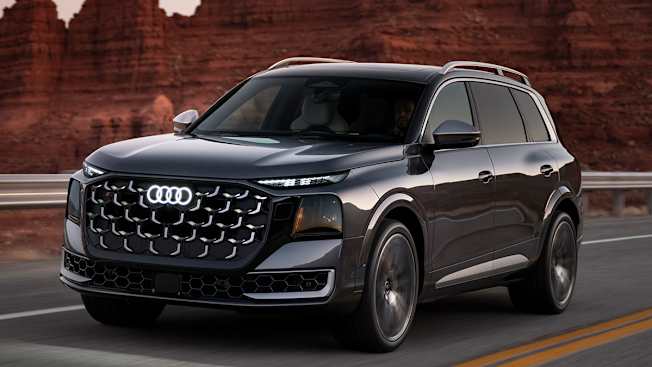
The full-sized SUV takes on the BMW X7, Cadillac Escalade, and Mercedes-Benz GLS with a standard adaptive suspension and power-adjustable second-row seats
By Jon Linkov
Following the announcement of the redesigned Q7 and SQ7 SUVs, Audi has unveiled the new 2027 Q9 and SQ9 SUVs, which will go on sale in late 2026. These are Audi’s first large three-row models and will offer seating for six or seven passengers, along with cargo space for their luggage.
Power for the two new SUVs comes from twin-turbocharged engines: a 429-hp, 2.9-liter V6 in the Q9, and a 591-hp, 4.0-liter V8 in the performance-oriented SQ9.
The new SUVs will feature Audi’s adaptive driving beam Digital Matrix headlights, which can adjust the light pattern and intensity to illuminate the road ahead while avoiding dazzling drivers in the lane ahead or oncoming drivers in the opposite lane. They can also project patterns on the ground, which helps with lane changes and alerts other drivers or cyclists that the Q9 is about to turn or change lanes. The Q9’s standard panoramic sunroof features switchable transparency. It can switch from opaque to transparent at the touch of a button, but it can still be opened to let air in, unlike other similar roofs.
Neither pricing nor fuel economy estimates have been announced for the two SUVs. Consumer Reports plans to purchase a new Q9 anonymously as soon as it goes on sale this fall, so we can put it through our vehicle testing program. Full details on pricing and specifications will be announced closer to the Q9’s late 2026 on-sale date.
Here’s what we know so far.
What it competes with: BMW X7, Cadillac Escalade, Lexus TX, Land Rover Range Rover, Lincoln Navigator, Mercedes-Benz GLS
Powertrains: 429-hp, 2.9-liter twin-turbocharged V6 engine or 591-hp, 4.0-liter twin-turbocharged V8 engine; 8-speed automatic transmission; all-wheel drive
Price: $87,700-$118,000
On sale: Fall/Winter 2026
The 2027 Audi Q9 is easily distinguished from its slightly smaller sibling, the Q7, by the location of the license plate on the rear bumper.
Photo: Audi
Consumer Reports’ Take
Until now, Audi has never had an SUV that competed with the biggest, most spacious luxury SUVs. The Q7 is a midsized model with a snug third-row seat and limited cargo room when carrying seven passengers. With the Q9, Audi has a true large SUV to carry seven passengers and their bags. When comparing Audi’s specifications with the redesigned Q7, which also goes on sale later this year, the Q9’s wheelbase is 5 inches longer, its overall length is 10 inches longer, and there are 4 more cubic feet of cargo space behind the raised third row.
Audi highlights the Q9’s automatic doors that can be operated with a phone app, the brand’s largest-ever panoramic sunroof, curved digital taillights, power-adjustable second-row seats, and various settings for the interior lights.
While the standard twin-turbo V6 makes a not-too-shabby 429 hp, the SQ9 performance version features a 591-hp twin-turbo V8, rear-biased AWD system, staggered-width wheels, and an air suspension.
But given the Q9’s and SQ9’s curb weight (5,302 and 5,556 pounds, respectively), it’s hard to see either of these SUVs carving up corners, let alone racetracks. At least their 7,700-pound towing capacity will help with trailering owners’ track cars.
The Q9 follows the path set by the new and redesigned Audis introduced over the past few years. While German automakers historically focused on the driving experience—even eschewing cup holders because eating and driving didn’t mix—the in-car experience is now the main focus. This is from the automaker that adopted “Vorsprung durch Technik” (advancement through technology) as a moniker, used all-wheel drive to dominate road and rally racing in the 1980s and 1990s, and won the 24 Hours of LeMans 13 times. “For many of our customers, [cars] are becoming mobile living spaces,” says Audi CEO, Gernot Döllner. For some of us, it’s a little sad that screens and unique lighting signatures are now key selling points.
The SUV will be available with 21-, 22-, and 23-inch wheel packages, and all-season and summer performance tires.
Photo: Audi
Outside
Take the redesigned Q7, select the “constrain proportion” tool, and increase its size by about 7 percent, and you have the new Q9. That’s how similar the SUVs look.
There are subtle differences between the two SUVs, such as the position of some of the secondary lighting, the treatments for Audi’s “Singleframe” grille, and how the rear license plate is in the Q9’s bumper compared with the tailgate on the Q7.
Like the Q7, the Q9 has slim digital daytime running lights and larger pods for the adaptive driving beam headlights. Large air intakes are behind and below the single-frame grille.
In profile, the windowline is nearly identical to that of the Q7, just a bit longer and taller, with a squarer-looking third window at the rear. Large fender flares, sculpted sheet metal on the doors and lower trim, and defined wheel arches also stand out. Again, like the Q7, the Q9’s rear roof pillar and rear window are upright to better accommodate third-row passengers.
Standard equipment includes aluminum roof rails and window surrounds, a roof spoiler, exterior mirror housings, body-color bumpers, a standard 16-square-foot panoramic sunroof that can open fully or tilt for venting, and 20-inch wheels with standard all-season run-flat tires. There are packages for the exterior, and wheel choices range from 21 to 23 inches. The 21- and 22-inch wheels come with all-season tires, while the 23-inch wheels come fitted with summer performance tires. The Q9 also comes standard with an adaptive air suspension that automatically adjusts to speed, load, and driving conditions, and can also be manually adjusted by the driver.
The SQ9 is differentiated by front and rear bumpers, a unique grille, and aluminum-look window surrounds and mirror housings. It comes standard with staggered-width 22-inch wheels and all-season tires, an adaptive air suspension system, rear-wheel steering, and S-model-specific quad exhaust openings. The standard adaptive air suspension has 3.5 inches of range adjustment between the highest and lowest settings. The S sport package adds different suspension tuning and red brake calipers, while two other packages add 23-inch wheels with summer performance tires.
In additon to the driver’s gauge screen and the center infotainment screen, the 2027 Audi Q9 and SQ9 come standard with a 12.3-inch touchscreen for the front-seat passenger.
Photo: Audi
Inside
Much of the Q9’s interior has already been shown in the redesigned Q7. Like other new and recently redesigned Audis, the interior is dominated by the large curved screen that encompasses the driver’s gauges (11.9 inches) and the center infotainment system (14.5-inch screen). The operating system is an updated version of Audi’s multimedia interface (MMI) system, with larger, more clearly defined icons and better contrast between the background and text colors. The front-seat passenger gets a standard 12.3-inch screen of their own, allowing them to watch movies or play games. The dynamic privacy mode prevents the driver from seeing this screen while the Q9 is driving.
But Audi has joined the trend of putting airflow control on the center screen. Our testers have found that adjusting the airflow via the screen can range from mostly annoying to outright distracting.
The steering wheel uses pads on either side of the horn/airbag cover for some controls. The controls at each corner of the pads are part of the same pad and must be pressed to engage. The only separation between the “buttons” is small raised lines. And because the controls are on a single plane, they can’t easily be operated by feel. Fortunately, the Q9’s steering wheel gets physical scroll wheels for volume and feature selection rather than touch-sensitive sliders.
The Q9 also gets Audi’s new control pod that sits behind the steering wheel. It incorporates the turn signals, front and rear wipers, high-beam light controls, and gear selector into a single unit. Some elements move up and down, some move forward and backward, and one incorporates a knurled dial.
The center console includes two magnetic wireless phone charging pads under the infotainment screen with targeted airflow for cooling, along with two USB-C ports above. These MagSafe chargers work with newer iPhones that have MagSafe built in, as well as Android phones and older iPhones in MagSafe-compatible cases. With the removal of the gear selector, the center console has fewer controls, and two large cup holders sit under a cover that rotates out of the way.
Seven-passenger models come with a three-person second-row bench seat, while six-passenger models feature two captain’s chairs in place of the bench. Audi says that three child car seats can be installed side by side in the seven-passenger version, and the outer seats can tilt and slide forward even when an unoccupied child seat is installed.
In both configurations, the second row has power operation for sliding fore and aft, and the third-row seatbacks can be individually power-folded. The bench seat backrest can power-fold in a 65/35 split. Manually lowering the center position allows the backrest to fold in a 35/30/35 split, and buttons on the C-pillar or inside the cargo area slide the seats, making it easier for third-row passengers to get into or out of their seats. According to Audi, there are 19.3 cubic feet of storage behind the raised third-row seat. Dropping that row expands cargo room to 50 cubic feet; lowering both rows expands storage room to as much as 87.7 cubic feet.
The panoramic sunroof has switchable transparency and can be fully opened or raised for venting. Because the glass automatically turns opaque when the Q9 is parked, there’s no need for a sunshade.
Finally, occupants enter and exit the Q9 and SQ9 through automatic doors that open up to 90 degrees and incorporate obstacle detection to prevent opening if it detects traffic, pedestrians, or cyclists in the way. The doors can be operated from various control points, including from Audi’s app.
The second row comes standard with a three-passenger bench seat, with two captain’s chairs, as seen here in the 2027 Audi SQ9, optional. All second-row seats are power-adjustable.
Photo: Audi
What Drives It
The regular Q9 will go on sale later this year with a 429-hp, 2.9-liter twin-turbocharged V6 engine mated to an eight-speed automatic transmission, and driving all four wheels. This is the same powertrain that will come standard on the redesigned Q7. According to Audi, the Q9 will take 4.9 seconds to accelerate from 0 to 60 mph and has an electronically limited top speed of 130 mph.
The SQ9 features a 4.0-liter, 591-hp twin-turbo V8 engine, an eight-speed automatic transmission, and all-wheel drive, which is shared with the forthcoming SQ7. In terms of performance, the SQ9’s top speed is 130 mph with all-season tires and 155 mph with summer tires, and it can run from 0 to 60 mph in 3.8 seconds.
Both SUVs are capable of towing up to 7,700 pounds when properly equipped.
Of note, Audi says that “at launch,” the Q7 will be available with the 2.9-liter engine. This leaves open the possibility that, like the Q7, the Q9 will get the same hybrid engine that the redesigned Volkswagen Atlas will add at that SUV’s midcycle refresh.
Photo: Audi
Safety and Driver Assistance
Both the Q9 and SQ9 will come standard with a full suite of ADAS features, including automatic emergency braking (AEB) with pedestrian detection, AEB that works at highway speed, reverse AEB, blind spot warning, rear cross traffic warning, adaptive cruise control, lane departure warning (LDW), and lane keeping assistance (LKA)
The LDW system will feature two modes: reduced and normal. Audi says that the reduced mode will alert the driver with a steering-wheel vibration and a visual alert on the gauge screen if they have deviated from their lane. The system will determine whether corrective steering (LKA) is needed depending on the traffic conditions it detects. In normal mode, the system will activate LKA and provide steering corrections, visual warnings, and steering-wheel vibrations when leaving the lane.
Both SUVs will also feature “adaptive cruise assist plus with hands-free highway driving,” which is Audi’s partial automated driving system. The system is standard on the SQ9 and optional on the Q9 Premium Plus and Prestige trims, and lets drivers take their hands off the steering wheel and let the car control steering, acceleration, and braking at highway speeds up to 85 mph. Drivers can have the systems automatically change lanes by using the turn signal in the desired direction. To ensure that the driver is paying attention, a driver-monitoring camera on the steering column tracks eye position and head movement. If the system determines they aren’t paying attention, it will use visual, audible, and haptic warnings. If the driver doesn’t take over, the emergency assist brings the SUV to a controlled stop.
Another standard feature is called exit warning. When the SUV is parked, the system uses sensors in the bumpers to detect approaching vehicles, cyclists, and pedestrians. If it determines a collision will occur if a door is opened, the system will prevent the door from opening or stop a door that’s already opening. In addition, warnings are displayed on the inside of the door.
More on Car Buying
• Trade In: Check Your Car’s Value
• Consumer Reports’ Build & Buy Car Buying Service
• Which Car Brands Make the Best Vehicles?
• Who Makes the Most Reliable New Cars?
• Owner Satisfaction Ratings: Best and Worst Car Brands Revealed
• Which Car Brands Have the Highest Road-Test Scores?
• Safest Car Brands Ranked by CR’s Safety Verdict
Consumer Reports is an independent, nonprofit organization that works side by side with consumers to create a fairer, safer, and healthier world. CR does not endorse products or services, and does not accept advertising. Copyright © 2026, Consumer Reports, Inc.