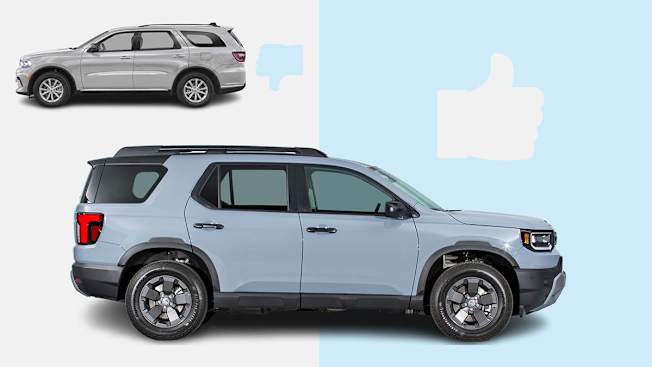
The Consumer Reports safety verdict can steer shoppers to smart alternatives that perform better in crash and dynamic tests
Using the safety verdict rating, CR’s experts name safer alternatives to popular cars and SUVs.
By Keith Barry
Just because a car is popular doesn’t mean that it’s the safest choice. In fact, a Consumer Reports analysis found that some top-selling cars and SUVs are far from the top of the pack when it comes to safety.
“Even in 2026, some cars don’t get top scores in crash tests, and some don’t come standard with technology that’s proven to prevent crashes,” says Emily A. Thomas, PhD, associate director of auto safety at Consumer Reports. “On top of that, some vehicles have much better emergency handling and braking performance, which can help drivers steer clear or stop before a crash takes place.”
In this analysis, we used Consumer Reports’ new safety verdict to compare vehicles. The single score includes crash test results, braking and handling performance in Consumer Reports’ testing, what proven crash-prevention technology comes as standard equipment, and whether the controls are distracting.
We took five popular vehicles that got the lowest Basic score in our safety verdict evaluation. Then, we found safer choices that earned the highest Best score in our safety verdict evaluation.
A Best score means they:
• Got average-or-above scores in Consumer Reports’ own tests of routine handling, emergency handling, and braking distance.
• Don’t have the lowest usability rating in Consumer Reports’ evaluation of controls and infotainment systems.
• Excelled in the latest Insurance Institute for Highway Safety crash tests.
• Come standard with automatic emergency braking that is highway-speed capable and has pedestrian detection, blind spot warning, and rear cross traffic warning.
Below are five popular vehicles, and five safer choices. Consumer Reports members can click on the model names to see our exclusive road test and reliability data, and whether a vehicle is CR Recommended. Recommended vehicles must excel in owner satisfaction, road tests, and reliability, among other factors.
All the cars listed below have met federal safety standards, but our Best choices offer additional crash prevention and protection that Basic models do not.
Popular Large SUV
Chevrolet sold 114,000 Tahoe SUVs in 2025, and it’s easy to see why. The rugged, body-on-frame hauler can tow as much as many pickups, and it has tons of room for people and their stuff. But it got a Poor score in the IIHS’ updated moderate overlap crash test, largely because rear-seat occupants are at greater risk of injury. In addition, like many large SUVs and pickup trucks, it achieved below-average scores in Consumer Reports’ own track tests of braking and emergency handling, which means drivers might find it more difficult to avoid a crash in the first place.
Safer Large SUV
The Armada is the only large SUV to achieve a Best safety verdict score. That’s partially thanks to its top crash test scores from the IIHS, but also due to its scores in Consumer Reports’ track-based tests of braking, routine handling, and emergency handling that are better than most of its peers. Nissan sold fewer than 20,000 Armada SUVs in 2025, but it’s also a rugged body-on-frame, truck-based model that can tow as much as a Tahoe. Buyers who prioritize safety should take a look.
Popular Midsized SUV
Dodge has barely changed the Durango since its last redesign in 2011. It’s stuck in the past, and so are its safety features: Newer vehicles have benefited from technology that can prevent crashes and designs that improve crashworthiness, but the Durango is one of the only vehicles on the market where buyers have to pay extra for highway-speed AEB. AEB with pedestrian detection isn’t even available! In addition, it achieved a second-from-lowest Marginal score in the IIHS’ small overlap front crash test, which simulates a collision between the front corners of vehicles, or with a tree or utility pole. It has yet to be evaluated in the IIHS’ newest, most stringent crash tests. It also has a below-average performance in Consumer Reports’ track tests of emergency handling.
Safer Midsized SUV
The Durango outsold the Honda Passport in 2025. We suspect that’s because the Durango has a lower starting price and offers higher-performance versions that the Passport does not, and because the redesigned Passport was in its first model year. But we still think the Passport is a much better choice for safety. Not only has it earned top scores in all the IIHS’ latest crash tests, earning a Top Safety Pick+ award for 2025, but it also comes standard with proven crash-avoidance technology, and it has midrange scores in Consumer Reports’ emergency handling test.
Popular Luxury SUV
The Mercedes-Benz earns top ratings in IIHS crash tests and at least average scores in Consumer Reports’ braking and handling tests. But that doesn’t tell the entire story. The standard AEB system with pedestrian detection did not perform well in IIHS tests, and the vehicle failed to slow for a dummy simulating an adult pedestrian walking along the side of the roadway. In addition, Consumer Reports gave the GLE the lowest possible score for usability due to convoluted controls spread across a large touchscreen and a touchpad that could too easily distract a driver.
Safer Luxury SUV
Like the GLE, the X5 gets top scores across IIHS tests, but it also got high marks for pedestrian crash avoidance. As with many luxury vehicles, its controls aren’t as straightforward as we would like to see, but they’re less distracting than the GLE’s. In addition, it outperformed the GLE in Consumer Reports’ evaluations of braking distance and routine handling.
Popular Subcompact SUV
Despite having been redesigned in 2025, the Taos did not achieve any Good ratings in IIHS crash tests. In addition, its AEB system did not avoid crashes with motorcycles in the IIHS tests, and it struggled to reduce impacts in off-center rear-end collisions.
Safer Subcompact SUV
The CX-30 is one of the few subcompact SUVs that earned a Best safety verdict score. It earned Good scores across all modern IIHS crash tests, and its AEB system also earned top scores. In addition, it outperformed the Taos in Consumer Reports’ emergency handling test.
Popular Sedan
The Jetta’s $23,995 starting price may seem enticing, as it’s one of the least-expensive new cars on sale. But buyers will miss out on top safety ratings. The Jetta got a second-best Acceptable rating in side crash testing, and has not been evaluated in the IIHS’ most recent and most challenging tests. In addition, the AEB system failed to slow for a dummy simulating an adult pedestrian walking along the side of the roadway.
Safer Sedan
For just a few hundred dollars more than a Jetta, buyers can get a Mazda3. It has Good ratings across all key IIHS crash tests, including the latest ones, and better pedestrian crash avoidance. It also outperformed the Jetta on braking and emergency handling in Consumer Reports’ track testing.
More on Car Safety
• CR’s Car Safety Guide
• Safest Car Brands Ranked by CR’s Safety Verdict
• Find the Safest New Car Using Consumer Reports’ Safety Verdict
• Safest New Cars Under $35,000
• Safest Small SUVs
• How to Escape Your Car if the Electronic Door Handle Fails
• CR’s Car Seat Buying Guide & Ratings
Consumer Reports is an independent, nonprofit organization that works side by side with consumers to create a fairer, safer, and healthier world. CR does not endorse products or services, and does not accept advertising. Copyright © 2026, Consumer Reports, Inc.