You can now breathe easy knowing which air purifiers are worth the money, according to CR members
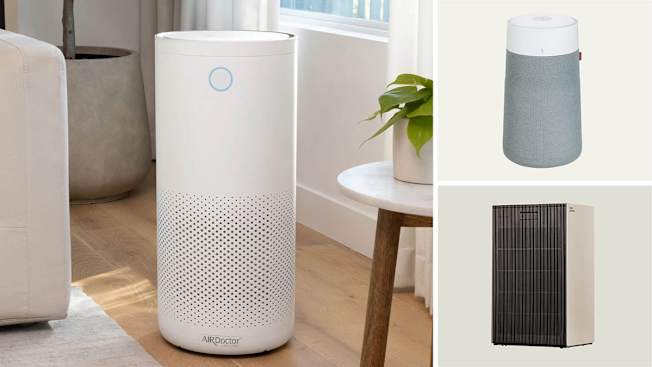
CR collected info on more than 40,000 air purifiers from 50 different brands to determine which are most reliable. (Shown, clockwise from left: AirDoctor 4000, Blueair Blue Pure 311i+ Max, and Coway Airmega ProX)
By Tanya A. Christian, Courtney Lindwall
Many air purifiers perform well out of the box—but are they a worthy investment over time? Data from CR’s air purifier survey can help answer that question.
We recently collected info on more than 40,000 air purifiers purchased between 2015 and 2025 by CR members and analyzed that data to determine how models from 50 different brands tend to perform in the years that followed. The results, which are factored into a product’s Overall Score, suggest that some air purifier brands indeed outpace others in predicted reliability and owner satisfaction.
And given that the market for these devices is rapidly expanding—with the prices in our current ratings chart ranging anywhere from $62 to $1,400—that’s valuable intel.
Beyond the typical air quality concerns driving these purchases—pollen, dust, and dander—there are mounting issues with wildfires and viruses. “People are undoubtedly thinking more about the quality of the air they breathe at home,” says Misha Kollontai, the head of air purifier testing at Consumer Reports.
Indeed, the main reason to buy an air purifier, according to our survey respondents, is to improve indoor air quality (77 percent). The second-most compelling reason is to fight allergies (55 percent). “An air purifier in your home can provide a line of defense between external irritants and your lungs,” says Kollontai, “and people are becoming more keen to the benefit that brings.”
Most Reliable Air Purifier Brands
Given an air purifier’s dependable design, it’s not surprising that a little more than half of the brands in our ratings—33 out of 50—receive favorable ratings for predicted reliability. And yet, some brands truly excel in this arena, while at least one received a reliability rating so low that we can’t recommend the models it makes. For air purifiers, our reliability scores indicate the likelihood of encountering problems with your device by the end of the fifth year of ownership.
In total, 17 air purifier brands received an excellent reliability score—making it much less likely that you have to deal with future problems. In descending order of score, the brands in this top tier are: Philips, Coway, Lasko, Miko, Rabbit Air, Sharp, Hamilton Beach, Aroeve, Comfort Zone, Blueair, PuroAir, AirDoctor, Carrier, Mooka, Pure Enrichment, Ikea, and Therapure.
The next 16 brands earned a very good reliability rating: Levoit, Holmes, Winix, Toshiba, Vornado, Honeywell, IQAir, Whirlpool, Alen, Medify Air, Envion, Hunter, Advanced Pure Air, Bissell, Samsung, and GermGuardian.
All but one of the remaining air purifier brands received a so-so score.
That leaves just Shark with an unfavorable rating.
These survey results are a helpful guide for shopping, but they also point to a reassuring truth: Few air purifiers need repairs, according to our respondents. The most common issues are tied to high-tech features. WiFi and app compatibility problems top the list, with 7 percent of machines that offer smart features experiencing malfunctions. Less frequent problems include increasing noise levels over time (experienced by 4 percent of respondents) and indicator light malfunctions (reported by 2 percent of respondents). Bigger problems, like the machine not turning on or the fan breaking, appear rare, occurring in only 1 percent of machines.
Least Reliable Air Purifier Brand
Among the 50 brands represented in our survey, Shark is the only one that received an unfavorable reliability score, although it did earn a stronger owner satisfaction score. We currently have two Shark models in our ratings—the Shark NeverChange HP302 and the Shark HP202—both of which are relatively noisy and unimpressive at removing dust, pollen, and smoke. Based on our survey reliability data and test results, we don’t currently recommend Shark air purifiers.
Brands With High Owner Satisfaction
Our survey data also quantifies owner satisfaction by brand—that is, how likely respondents are to recommend the air purifier they own to a friend or family member. These scores vary far more widely, according to our most recent survey results, which might make them a more useful factor when shopping.
Only five brands receive an excellent rating for owner satisfaction: Alen, Blueair, Coway, Air Doctor, and Rabbit Air. Meanwhile, 24 out of 50 brands received an unfavorable or poor rating.
Overall, just four standout brands aced both our predicted reliability and owner satisfaction evaluations: Air Doctor, Blueair, Coway, and Rabbit Air. We offer up high-scoring models from the first three brands below. Rabbit Air purifiers have not performed well enough in our air filtration tests to merit a recommendation.
For more help in your search, check out our air purifier buying guide and our article on the best air purifiers. CR members can also explore our comprehensive air purifier ratings, where you can sort by performance, price, brand, and other factors that address your needs.
AirDoctor 4000
This six-speed AirDoctor air purifier is a great pick for a large room (350 to 650 square feet). It removes particles impressively at both high and low speed settings, though it’s a bit noisy when the fan is turned all the way up. It comes with both a certified HEPA filter and an activated carbon filter. To keep an eye on your room’s air quality, the machine’s display offers a color indicator light, and the fan speed automatically changes based on the room’s air quality. However, there’s no paired app or display readout of the air pollutant levels.
Filter replacements and energy use will set you back around $242 per year. The machine weighs about 15 pounds, and it can sit on the floor or a tabletop.
Blueair Blue Pure 311i+ Max
The portable Blue Pure 311i+ Max features four speeds and a dirt sensor that kicks the machine into higher gear when necessary. On its higher setting, the model is terrific at removing dust, pollen, and smoke, but expect a bit of noise. Try it on low and you’ll enjoy more quiet while still getting near top-level results. Our testers report that this Blueair model is particularly easy to use. Plus, it can be controlled via an app. It also has an indicator light that alerts you when it’s time to change or clean the filter.
This model is designed for use in a large space and costs about $136 a year to maintain. Because it weighs just 8 pounds, it can be easily moved from room to room.
Coway Airmega ProX
The Coway Airmega ProX is the priciest air purifier in this roundup, but it also delivers the best performance among all air purifiers in our ratings and earns excellent reliability and owner satisfaction scores. If you want top-notch purification for an extra-large room (650 square feet or more), this Coway could be worth the expense.
On both higher and lower speeds, the model excels at clearing rooms of dust, pollen, and smoke. It’s equipped with a certified HEPA filter, an activated carbon filter, and a washable pre-filter that captures larger pollutants, such as pet hair. The Airmega ProX does not ace our noise tests, but its scores are reasonable. It has an auto-sensor that can detect when air quality dips and kick into higher gear. Maintenance isn’t cheap, though. We estimate that it costs $259 annually for filter replacements and energy costs, assuming you run the filter 24/7.
Unlike many of the other air purifiers shown here, this one doesn’t have a remote control or an app. It features three speeds and a filter indicator.
Brands With Low Owner Satisfaction
In total, 10 brands receive a poor owner satisfaction score—meaning CR members who own air purifiers from these brands were the least likely to recommend them to their friends and family members. The worst performers in terms of owner satisfaction, in alphabetical order, are Allergy Pro, Bionaire, Black+Decker, Comfort Zone, Envion, Hamilton Beach, Kenmore, Philips, Therapure, and Westinghouse.
How CR Tests Air Purifiers
In addition to analyzing survey data to predict long-term reliability and owner satisfaction, our experts rigorously test every air purifier listed in our ratings. We inject smoke and dust particles into a sealed chamber to assess how well each model removes particles between 0.1 and 1 micron in size. (Human hair has a diameter of roughly 100 microns.) Using a particle counter, we measure the change in particle concentration as the air purifier runs for 15 minutes at the highest speed and then at a lower speed. And because these machines are designed to run day and night, we measure noise levels in decibels at every speed and calculate annual operating costs for filter replacements and for the energy required to run the machine 24 hours a day. The Overall Score incorporates these test results, as well as the reliability and owner satisfaction scores derived from our survey data.
Consumer Reports is an independent, nonprofit organization that works side by side with consumers to create a fairer, safer, and healthier world. CR does not endorse products or services, and does not accept advertising. Copyright © 2026, Consumer Reports, Inc.