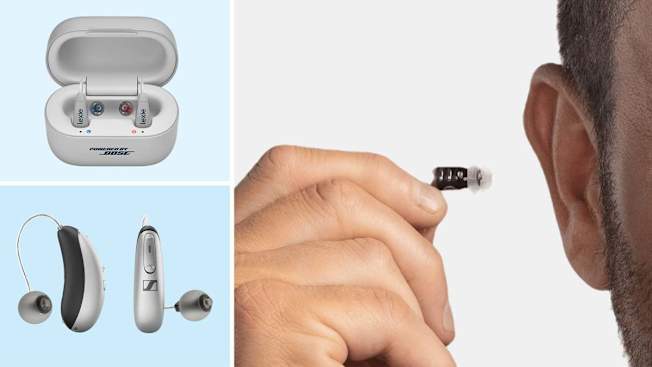
We put OTC hearing aids from brands like Apple, MDHearing, and Yeasound through rigorous tests to find out which ones work best and are easiest to use
Our tests of OTC hearing aids employed professional audiology equipment, CR’s user experience experts, and panelists with hearing loss.
By Catherine Roberts
Hearing aids have been available over the counter for a few years now. That means that for people with mild to moderate hearing loss—which is the majority of folks with any hearing loss—accessing hearing aids has gotten a lot easier.
Or at least it has in theory. The flip side of being able to get hearing aids over the counter is that you don’t necessarily have the same level of support with your aids as you would have if you’d gotten prescription aids from an audiologist or another hearing care provider. That can make it tough for people to figure out which OTC hearing aids are right for them, and which are worth buying. While OTC hearing aids are usually cheaper than prescription ones, some still carry a hefty price of $1,000 or more per pair.
That’s where CR comes in. For the first time, we’ve brought OTC hearing aids into our labs to evaluate them thoroughly for their audio performance and usability, which can help you shop with confidence. We’ve also recruited a panel of people with hearing loss to test them in various scenarios. (Read more about how we test, below.)
One important piece of advice: Take advantage of the trial period for whichever OTC hearing aid you choose, says Kathleen Havelah, who led CR’s OTC hearing aid testing. “As soon as you get them, start using them,” she says, including contacting customer support to see whether it’s responsive and helpful. Hearing aids can take time to get used to wearing—especially for first-time users—so give yourself as much of the trial period as possible to determine whether they’re a good fit. If they’re not working out, return them—that’s exactly what the trial period is for.
Here are details on three of our top-rated OTC hearing aids. For more on different types of hearing aids, see our buying guide, or access our full ratings of 14 over-the-counter hearing aids.
Soundbright Discovery
Soundbright’s Discovery model earns top marks for sound quality and performance, plus high marks for ease of use. It’s our top-rated non-self-fitting hearing aid model. Setting up and using the hearing aid is very easy with helpful directions. Users can control the volume and select from several preset programs using either a connected smartphone app or controls on the device itself. You can stream both phone calls and music directly to the hearing aids. Our panelists found wearing this device to be comfortable, and although the aid’s hardware sits behind the ear, they noted that it is still relatively discreet. It’s rechargeable, with a battery that lasts up to 17 hours. This hearing aid provides small improvements in hearing speech in noisy environments and in hearing TV audio, and the overall quality of its amplified sound is strong.
Yeasound RIC800
Yeasound’s RIC800 model earns especially high marks for performance and ease of use, and does well in our sound quality tests as well. Technically, the Yeasound is not a self-fitting hearing aid, since it hasn’t received FDA clearance to be marketed in that way. While users have the option to take a hearing test and apply the results to the device’s programming, this is not part of the required setup for the hearing aid. Users can instead decide to simply select from several preset programs. Setup is easy, though slightly less intuitive than other models we tested, and the right and left aid are somewhat difficult to distinguish. Volume can be easily controlled from the app and from the device itself, and you can stream phone calls and music directly to the hearing aids. The company touts its AI-powered noise reduction, and we found this did work well: The hearing aid provided significant improvement for hearing speech in noisy environments as well as in hearing TV audio. One downside is that this aid produced some noticeable noisy interference in loud environments. Its rechargeable battery should last up to 31 hours.
Concha Labs Sol
Concha Labs makes just one OTC hearing aid model right now, the Sol, which is CR’s top-rated self-fitting hearing aid. Its companion app, which is necessary to customize the settings to your hearing, is currently only available for iOS, though the company says an Android version is on the way. It runs on a replaceable battery rather than a rechargeable one, and the battery is estimated to last about five days. Our testers found this model easy to use, with an intuitive setup procedure that provides good directions. You can change both volume and audio programs via the app and via buttons on the hearing aid itself. The Sol also earns high marks in our tests for sound quality, producing little noisy interference. Its performance scores were good, though not great; it greatly improved panelists’ ability to hear TV dialogue, but only provided minimal improvement in hearing speech in a noisy environment. Our testers did find it comfortable to wear. One downside: This aid doesn’t offer streaming of phone calls or music. However, it does come with a two-year warranty, which is longer than many OTC hearing aids we evaluated.
What About Lexie, Eargo, and Sony Hearing Aids?
The market for over-the-counter hearing aids is still relatively new, and CR market analysts—who keep a close eye on which products are available—have noticed that it seems somewhat volatile at this stage. Several prominent OTC hearing aid models are no longer available due to companies going out of business or models being phased out—in some cases just a few years after first being introduced.
For example, Eargo and its parent company Lexie both recently went out of business. CR tested and had recommended Lexie’s B2 Plus Powered by Bose and Eargo’s 8 and SE models.
Sony also recently opted to end its OTC hearing aid line; CR tested and had recommended its CRE-C20 model.
CR also tested and had recommended Sennheiser’s All Day Clear Slim model, which Sennheiser recently stopped selling. Its All Day Clear model is still available, though CR hasn’t yet tested it.
How CR Tests OTC Hearing Aids
Our evaluation of hearing aids was designed with input from professional audiologists and included feedback from people with hearing loss. We score OTC hearing aids on three main characteristics: ease of use, performance, and sound quality.
To rate each hearing aid’s ease of use, our usability expert evaluates its ease of setup and operation, and the ease of using the smartphone app if the hearing aid connects to one. To evaluate a hearing aid’s performance, one group of panelists provides feedback on comfort. A separate panel of people with some mild to moderate hearing loss uses it to take a series of listening tests.
We also test each hearing aid’s noise-filtering capabilities using a hearing aid testing device (a standard piece of equipment used by audiologists to make sure hearing aids work as they should for their patients). We use this same device to measure each aid’s sound quality, putting it through a variety of tests designed to assess specs such as the maximum output, frequencies amplified, and the level of interference or “harmonic distortion” the hearing aid produces, which can muddy the sound you hear.
Consumer Reports is an independent, nonprofit organization that works side by side with consumers to create a fairer, safer, and healthier world. CR does not endorse products or services, and does not accept advertising. Copyright © 2026, Consumer Reports, Inc.