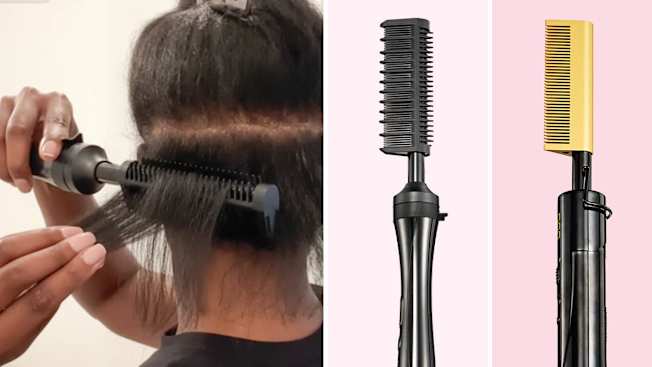
We evaluated tools from Gold ’N Hot, Paul Mitchell, and other brands to see whether their temperature claims held up and which ones produced the sleekest finish on 4C hair. Here’s what to know before you press.
Hot combs can make straightening hair a breeze, but you have to be careful to avoid burning your scalp.
By Jennifer Ford
There are levels to straightening hair. Some people love using a flat iron to achieve a silk press look, but a hot comb can take it a step further, straightening hair from root to tip in a way a flat iron usually can’t.
However, classic hot combs can be unpredictable. Because they’re heated on a stovetop, it’s impossible to control the temperature, which increases the risk of burning your hair or scalp. Electric hot combs, on the other hand, usually come with adjustable heat settings, offering more control and making them a safer, more reliable option.
I wanted to find out which hot combs could get the job done as quickly and safely as possible, so I tested five models on my 4C hair. We also sent them to our lab for temperature testing by José Amézquita to make sure the temps claimed were real. (Spoiler alert: They weren’t.)
Sneak peek: If you want an extra-hot styling tool for sleeker results, titanium is the material to look for. But the titanium model we tested by Dan Technology was problematic at best.
As with all of the products we test, Consumer Reports purchased these hot combs at retail, the same way you shop. We never accept freebies or gifts from companies; no bias here. Read on to see which products we liked and which ones we’d skip.
Paul Mitchell Texture 3-in-1 Interchangeable Curling Iron & Hot Comb
The Paul Mitchell Texture 3-in-1 Interchangeable Curling Iron & Hot Comb is a hybrid tool that comes with three ceramic attachments: a .35-inch wand barrel, a .75-inch curling barrel, and a hot comb. The hot comb smoothed out my 4C curls in only two passes when set at 380° F. That’s the maximum temperature recommended for safe heat styling, according to Sophia Emmanuel, a hair and scalp specialist in New York City that we consulted for additional safety tips below.
In our lab test, the highest setting labeled 410° F actually reached 441° F, and the lowest, marked 250° F, was 245° F. So when I used the 380° F preset, the real temperature may have varied.
While our runner-up gave me the sleekest results, it did make my scalp tingle a bit from contact. With the Paul Mitchell Texture 3-in-1, I got results completely unscathed, thanks to the removable heat shield, which the company recommends using to help protect against burns.
Of the models we tested, this one was the easiest to use despite being the heaviest. It had a fast heat-up time (the fastest of all the models we tested, at 1.23° F per second), a digital display showing the temperature, and plus and minus buttons for adjusting the heat level. This model also features a built-in stand, making it easy to protect surfaces while styling, and the longest cord. I didn’t test additional attachments. At $130, it was by far the most expensive model we tested, but it checked all the boxes.
Dan Technology Hot Comb
Price doesn’t always equal quality. While our Top Pick costs $130, the runner-up—the Dan Technology Professional Ceramic Hot Comb—delivered impressive straightening for just $15. It offers only two temperature settings (430° F or 450° F), but it made my hair silky straight in just two passes. The company claims the comb is infused with keratin, ceramic glaze, and tourmaline to help reduce static and frizz, release negative ions, and lock in moisture for smoother, softer, shinier hair.
In the grand scheme of things, this device is pretty basic, which isn’t necessarily a drawback. It’s easy to use, lightweight enough to toss into a purse, and highly effective. The cord, however, is listed by the company at just under 5 feet, and Amézquita measured it at just over that (64.5 inches), which could be limiting if your outlet isn’t close to your mirror or styling area. It’s also worth mentioning that it didn’t get as hot as the company claimed. In our lab, we found the 430° F setting averaged 401° F, and the 450° F setting reached just 408° F.
Oh, and unlike our Top Pick, it doesn’t come with a heat shield. I could definitely feel the heat on my scalp, but the sensation wore off after a few minutes.
Conair InfinitiPRO Heat Comb
The Conair InfinityPro Straightening Comb has 30 heat settings, but I found it lacking when it came to delivering a salon-quality press. In our lab test, the highest setting—#30—reached only an average of 338° F, which is below the recommended minimum of 365° F for safe heat styling. Needless to say, I wasn’t impressed with its straightening ability. Plus, the temperature dial is labeled in increments of five, not actual degrees, so you’re left guessing the real temperature. But Amézquita found an average temperature for most of the settings:
#1: 228° F
#5 231 ° F
#15: 254 ° F
#25: 295 ° F
#30: 317° F to 349° F (with turbo option)
Gold ‘N Hot Professional Pressing Comb
The Gold ’N Hot Professional Pressing Comb sports an attractive rose gold and black color scheme, but that’s where the standout features end. It offers six temperature settings, with the highest marked at 430° F, though our lab tests showed it only reached 417° F. I wasn’t impressed with its performance. I still couldn’t achieve the sleek look I wanted after four passes. But I did appreciate the built-in safety stand, which is great for protecting surfaces.
Dan Technology Titanium Pressing Comb with Clip
I was especially excited to try the Dan Technology Titanium Pressing Comb because titanium tools typically get hotter than ceramic ones, and I always reach for a titanium flat iron when straightening my hair. So a titanium straightening comb seemed like a no-brainer. Unfortunately, I was disappointed to find that this model pulled out some of my hair during testing. Upon closer inspection, I noticed several bent teeth on the comb, which made me stop using it and question the quality of the material. We reached out to the company about this problem but didn’t receive a response.
The company does offer another titanium hot comb, recommended for thick and coarse hair, that comes with a removable anti-scalding attachment, so perhaps this is a known defect that it tried to address in later models. Additionally, the design of this tool is odd: It features a clip meant to grip hair in place, but I found it more of an obstacle than a help.
How We Tested Hot Combs
I used each hot comb on my 4C hair, which is tight, coily, and kinky. I assessed them for ease of use, performance, ergonomics, and overall value.
José Amézquita, a CR project leader, measured the hot comb’s temperatures in the lab to compare them with marketing claims. He also tested how quickly each device heated up and cooled down, important factors for both convenience and safety.
Hot Comb Safety
What are some safety rules for using a hot comb? If you’re going to reach for one, Emmanuel, who is also a V&Co ambassador, says the first one is to opt for a ceramic model with adjustable temperatures. That’s because it’s safer for your hair than a traditional hot comb that requires heating on a stove. She also recommends using a silicone-based heat protectant to help the comb glide more smoothly.
What’s the safest temperature range for straightening hair with a hot comb? According to Emmanuel, that depends on your hair’s porosity. For low-porosity hair, she suggests starting at around 325° F to 375° F. Start at a lower temperature for medium-porosity hair, around 300° F to 350° F. High-porosity hair is more vulnerable to damage, so 250° F to 300° F is a safer starting point. Still, “these are guidelines, not guarantees,” Emmanuel says.
Her smart trick? Test the hot comb on a white paper towel first. If the paper turns brown, the hot comb is too hot.
How many passes with a hot comb are generally safe before you’re doing more harm than good? “One pass is recommended with all hot combs to prevent damage to your hair,” Emmanuel says.
Do ceramic and titanium hot combs work differently? Because titanium tools reach higher temperatures than ceramic, titanium hot combs may be used to achieve a very straight finish on textured hair. But “they should be used by a licensed cosmetologist who is skilled at using titanium hot tools,” Emmanuel says, “and used on lower heat settings to avoid burning or scorching your hair.”
Consumer Reports is an independent, nonprofit organization that works side by side with consumers to create a fairer, safer, and healthier world. CR does not endorse products or services, and does not accept advertising. Copyright © 2026, Consumer Reports, Inc.