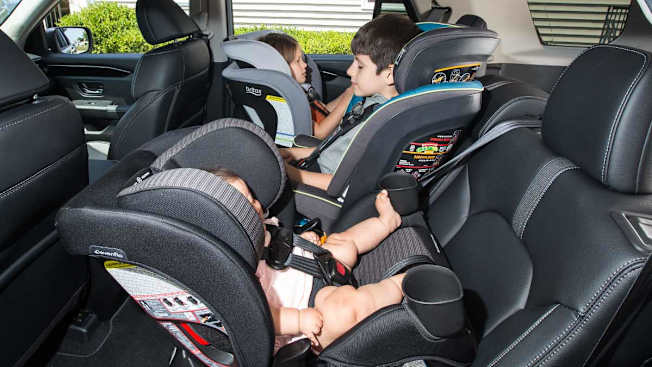
Here’s what to look for in a car that fits three kids across the back seat, and the CR Recommended vehicles with features that make it easier
Figuring out how to securely install three car seats across a rear row of any vehicle can be a challenge—but cars with the right features can make it easier.
By Alexandra Frost
I headed into the car dealership quite pregnant with my third baby. My husband was checking on safety, reliability, and performance scores. I just had one big concern—which vehicle was actually going to fit three babies? It was time to get rid of my previous car, which wouldn’t accommodate our growing family, a conundrum many families encounter when they are expecting, or just need enough room to carpool another kid to day care or sports.
But as I hauled my very pregnant self into the back seat of each car and tried to eyeball which model would fit our bulky car seats, I realized our problem was bigger than I thought—and twofold: It was a car selection issue and a car seat selection issue. And the number of possible combinations that could solve our problem seemed endless, impossible to calculate, and unreasonably complicated.
“Trying to fit three car seats across the back seat is a puzzle riddled with compatibility challenges,” says Emily A. Thomas, PhD, Consumer Reports’ associate director of auto safety. But we’ve done the research for you. If you are facing a three-across conundrum in your car shopping process, here’s what you should know.
What to Look for in a Car That Fits Three Kids Across the Back Seat
Figuring out how to securely install three car seats across a rear row of any vehicle can be a challenge. Choosing the right child car seats for a three-across installation is a big part of the puzzle, so before you go car shopping, make sure your kids are in the right car seats for their developmental stage. Then, consider the following features while vehicle shopping for a three-car-seat setup.
A wide second-row seat (which doesn’t necessarily mean the largest vehicle)
Bigger isn’t always better in this case. You don’t have to drive one of the largest SUVs in the drop-off line to have the most space in the back seat for three across. The vehicle size doesn’t necessarily correspond to the best setup in that row. Some larger vehicles may have narrower second-row benches that limit your ability to fit that third car seat.
A flat and smooth bench
Photo: John Powers/Consumer Reports
While the contours and bolsters of a rear seat cushion and seatback may be great for adult comfort, they can make securing three car seats more challenging. Seat humps, lumps, and extra features make getting an individual car seat securely installed more difficult, and when you’re lining up three across, the car seat may be tilted from the bolsters, which can affect the incline and prevent a good fit. Look for vehicles with flat rear seat cushions and seatbacks.
A functional rear center seat
A three-across installation will need to make use of the rear center seat by definition. But this is a seating position that car makers like to complicate, adding seat humps, hinges for folding seats, and narrow seat spacing in some vehicles—all of which can make installing a car seat in this spot more difficult. Here’s what you want to look for in a car in this all-important position: a wide-enough bench without a lot of bolsters (those lumps and humps in the seat), a seat belt that’s easy to access, and LATCH anchors. Speaking of which…
Dedicated or accessible lower LATCH anchors for the center seat
If you’ve installed a car seat recently, you know those small anchors located in the crease between the seatback and the seat cushion are massively convenient and can help you get a better fit, as they eliminate incompatibilities that sometimes exist when just using a seat belt. These are called LATCH (Lower Anchors and Tethers for Children) anchors—and while they are required by law for the outboard seats (the seats closest to the doors on both sides), they are not mandated for the rear center seat, so not all vehicles have them there.
But while not every vehicle has dedicated LATCH anchors for the center rear seat, some vehicles do have at least one LATCH anchor in the center, plus an outboard seat’s anchor that you can “borrow” for LATCH installs. For example, in some vehicles, there may be five lower anchors total in the back seat: two on each outboard side, with one additional anchor somewhere in the middle. More LATCH anchors means more potential flexibility when you’re installing multiple car seats—and when it comes to fitting three car seats across, it helps to adopt a puzzle mindset.
It’s also important to do your homework: Your vehicle owner’s manual will tell you if center LATCH borrowing is allowed and safe in your car, and also what the spacing is between the borrowed outboard anchors. Your car seat’s manual will tell you if LATCH borrowing is permitted for your car seat and the allowed spacing between LATCH anchors. (If your car seat has rigid LATCH connectors, for example, center borrowing won’t be an option, because rigid LATCH connectors require standard-spaced lower anchors.)
Keep in mind that two car seats cannot be attached simultaneously to the same LATCH anchor, even if your car allows for center borrowing. It’s also worth noting that LATCH anchors can only be used up to a specific weight limit of 65 pounds (meaning the combined weight of the child plus the car seat), so for heavier car seats—like some all-in-one or rotating car seats—your ability to use a LATCH installation will be limited.
Non-overlapping seat belt hardware
In some vehicles, you’ll find overlapping seat belt hardware for seating positions next to each other. You may find that the center seat belt buckle actually sits in the outboard seating positions, which can complicate a three-across car seat installation. Look for cars where the rear seat belt hardware resides within its own seating position.
Removable or adjustable head restraints
Photo: John Powers/Consumer Reports
There’s nothing worse than almost getting a car seat (or three) installed, just to learn that the head restraint is almost adjustable enough, but not quite. Before choosing a car, check the vehicle owner’s manual to see whether the head restraint can be adjusted or removed to accommodate a forward-facing car seat for an older or taller child, such as a convertible car seat or a high-backed booster.
Shopping for a Car When You Need to Install Three Car Seats in a Row
Did you know you can literally go to the car dealership with three car seats and try it out? Though it’s physically demanding, I’ve personally found this to be the best way to ensure that the car is exactly what I need.
In addition, you can get a local child car seat technician involved. They can advise you on which cars and car seat combinations might be most helpful if you visit a car seat inspection station near you.
The Best Vehicles for Three Car Seats in One Row
As part of CR’s vehicle test program, CR experts assess how car-seat-friendly each car is. As part of that process, they assess a vehicle’s ability to accommodate three child restraints in the second row. (Experts position a rear-facing-only infant seat in the center and a high-back belt positioning booster seat and forward-facing convertible seat in each of the two outboard seats.)
The list below shows the vehicles where CR experts have been successful in fitting a combination of a rear-facing-only infant seat, a forward-facing convertible seat, and a highback booster seat. Each is a CR Recommended vehicle based on its Overall Score, which factors in road-test performance, reliability, and safety features, and allows for the three-across fit. They are listed in alphabetical order.
Click the model names below to access their full road test and ratings (available to members).
CR Recommended Cars With Dedicated Center Rear Seat LATCH Anchors
CR Recommended Vehicles With Center LATCH Anchor Borrowing Allowed
Other CR Recommended Cars That Fit Car Seats 3-Across
A final note from a parent with more than three kids
Family planning can be unpredictable. As someone who thought they’d have three kids and now has five, and has had to buy and then sell my fair share of vehicles to accommodate these changes, I’d recommend buying a slightly bigger vehicle than you think you need.
This means that as your kids grow, you are able to not only accommodate three car seats in a row, but maybe a fourth (or even fifth), and you are able to have a friend join the car ride, or even just give your kids some leg room on a long car trip.
Also, prioritize what’s comfortable and easy for you. If crawling into the back of an SUV is going to put you over the edge on a busy workday morning, don’t choose that one. Kids won’t remember which vehicle was the perfect one. Instead, prioritize your own comfort and usability, in addition to what’s actually safest to fit three kids’ car seats in one row.
Consumer Reports is an independent, nonprofit organization that works side by side with consumers to create a fairer, safer, and healthier world. CR does not endorse products or services, and does not accept advertising. Copyright © 2026, Consumer Reports, Inc.