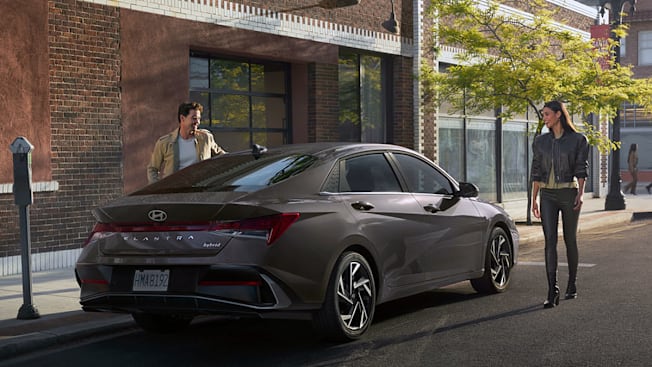
CR’s experts explain why fuel-efficient hybrids are good for many drivers and list the best of the hybrid cars and SUVs
Hyundai Elantra Hybrid
By Keith Barry
With gas prices rising, you may be wondering if a hybrid is a smart choice.
As an autos reporter at CR, I can assure you that many of the latest hybrid cars, trucks, and SUVs are more budget-friendly, versatile, and fun to drive than their gas-only counterparts. They’re more reliable than gas-only or electric vehicles, and also offer lower emissions than a gas-only car and without the charging hassles of a pure EV. In some cases, they might even save you money over going fully electric. Sound intriguing? With our expertise, we’ll help you determine whether a hybrid is right for you and share some models we really like.
How Hybrid Vehicles Work
Hybrids combine a battery pack, an electric motor that drives the car at low speeds, and a gas engine that kicks in for higher speeds, climbing hills, or recharging the battery. Regenerative braking uses the car’s momentum as it slows down or coasts to create extra electricity. “Hybrids are so fuel-efficient because they utilize energy that would otherwise be wasted,” says Jake Fisher, senior director of CR’s Auto Test Center.
On the road, the electric motor adds smooth power even when the gas engine is doing most of the work. This helps the car feel responsive, especially during around-town driving. The hybrids we’ve tested achieve higher road-test scores, on average, compared with nonhybrids.
Hybrid emissions are also up to one-third lower, according to our calculations. “That saved energy means less gasoline needs to be burned to travel the same number of miles,” says Chris Harto, senior energy policy analyst at CR.
Pure electric vehicles are more efficient, but hybrids will play a key role over the next decade as EV charging infrastructure is built. “They can be a transition technology that helps lower emissions today,” he says.
If the option exists, car buyers should pick the hybrid version, according to Fisher. “They get better fuel economy and are often quicker and quieter, too,” he says. “In nearly every case, the hybrid version is the better option.”
Hybrid Vehicle Benefits
In 2008 I bought my first hybrid—a used Toyota Prius. I drove more than 400 miles a week for my job, so I welcomed its 43 mpg overall fuel economy. I also loved its geeky charm and rock-solid reliability, so much so that I bought another, and then another.
Still, I have to admit that my Prius had a lot of drawbacks common to early hybrids. It took forever to accelerate onto the highway, cost thousands more than a comparable Corolla, and was too small for a big family.
Since those early days, hybrid technology has improved quite a bit.
Higher mpg: Most hybrid SUVs get more than 35 mpg, and most hybrid sedans get more than 45 mpg. That’s about a 40 percent improvement over nonhybrids, on average.
Easy to use: Unlike a pure electric vehicle, you don’t have to plug in a hybrid. Simply refuel at any gas station.
Better to drive: CR’s tests show that the hybrid versions of many cars have more power and smoother acceleration than the gas-only models.
The Hybrid Vehicle Affordability Factor
Hybrid technology has generally meant comparatively higher sticker prices, though fuel savings can defray costs over time. Today’s average hybrid costs about $1,700 more, but some models from Ford and Lexus cost about the same as a comparably equipped nonhybrid.
Back in 2015, CR calculated that most hybrids took eight years to pay for themselves through fuel savings, with some, including the 2015 Volkswagen Jetta Hybrid and Lexus RX450h, taking more than a decade. Today, improved technology means that most hybrids have a payback period of four years or less, with gas at $3.32 a gallon and 12,000 miles driven a year. The more miles driven, the quicker the payback.
You may also save money on repairs and maintenance. Case in point: The Prius is often in the top spot in our reliability surveys. A hybrid’s regenerative brakes create less wear and tear, so braking components can last longer, too. It’s true that replacing a hybrid battery can cost thousands, but our surveys show such replacements are rare. “Hybrid technology has been very reliable in our studies,” Fisher says.
In surveys, hybrid owners tell us that they’d buy their same car again, and 83 percent of the hybrids we’ve tested are recommended by CR compared with 57 percent for all tested models.
Finally, hybrids as a class are the most reliable kind of vehicle. Our surveys show they have 15 percent fewer problems on average than gas-only cars.
What About a Plug-In Hybrid Electric Vehicle?
Pure hybrids don’t need to be plugged in. But there are a few plug-in hybrid electric vehicles (PHEVs) that can be charged to run on mostly electric power for around 25 to 50 miles before the gas engine takes over. Examples include the Toyota Prius Plug-In, Hyundai Tucson Plug-In, Mitsubishi Outlander Plug-In, BMW X5 Plug-In, and Lexus RX Plug-In. They can be charged using a regular household outlet.
They’re ideal for drivers who take short trips and can do most of their driving on electricity, reserving the gas engine for longer trips. PHEV owners who charge every day save money because they can avoid using the gas engine. But a PHEV doesn’t make sense for long commutes.
“If you don’t plug it in, you’re better off buying a regular hybrid, which will usually cost less up front and get slightly better gas mileage than a PHEV after its electric range is depleted,” Harto says. If you’d like to learn more, check out our guide to the best PHEVs available.
The Many Sizes of Hybrid Vehicles
Those in the market for a larger vehicle will see the most savings with a hybrid. Big SUVs, pickups, and minivans tend to get the worst fuel economy among all gas-powered vehicles, so efficiency improvements can become more meaningful. “Going from 20 mpg to 25 mpg saves a lot more fuel than going from 30 mpg to 35 mpg,” Fisher says.
And there are some great options out there, such as the Toyota Sienna minivan, which seats eight people and registers 36 mpg overall.
CR’s Top-Rated Hybrid Vehicles
From SUVs to pickup trucks, these are the best hybrids in every vehicle class that will also save you the most money. They’re recommended by CR and have at least average predicted reliability.
Best Hybrid Cars
Best 2-Row Hybrid SUVs and Pickup Trucks
Best 3-Row Hybrid SUVs and Minivans
Best Luxury Hybrid SUVs
Hybrid Vehicles We Don’t Love
Mild Hybrids
You might see automakers using the term “mild hybrid” or “48-volt hybrid.” These vehicles have advanced electrical systems that may be able to power accessories, recapture energy from braking, or shut off the engine before the car comes to a stop. But they can’t be driven on just battery power. Mild hybrid systems include BMW’s eBoost, Ram’s eTorque, and similar offerings from Audi, Mercedes-Benz, and Volvo. The technology provides only minor fuel savings compared with a true hybrid. We don’t count them as hybrids in our ratings.
Lexus TX Hybrid
While we recommend the TX for its reliability and performance, it gets only 3 mpg more in hybrid form—an improvement from 21 mpg to 24 mpg. The TX 500h costs about $8,200 more than a comparable TX 350, so the payback period is about 29 years!
The Lexus TX
Photo: Consumer Reports
Safety Term Glossary
ACC: adaptive cruise control. AEB: automatic emergency braking. BSW: blind spot warning. FCW: forward collision warning. LDW: lane departure warning. LKA: lane keeping assistance. RCTW: rear cross traffic warning. (See CR’s guide to advanced car-safety feature names.)
Editor’s Note: A version of this article originally appeared in the November 2022 issue of Consumer Reports magazine. It has been updated to reflect model year updates and gas prices as of March 2026.
Consumer Reports is an independent, nonprofit organization that works side by side with consumers to create a fairer, safer, and healthier world. CR does not endorse products or services, and does not accept advertising. Copyright © 2026, Consumer Reports, Inc.