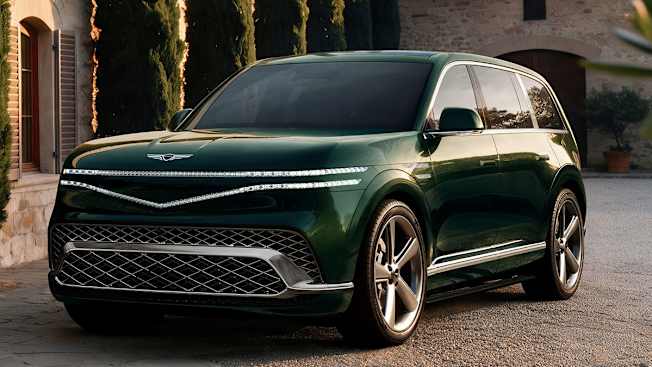
Hyundai is targeting BMW and Mercedes-Benz owners by offering coddling luxury, a long driving range, new safety features, and a novel door design
2027 Genesis GV90
By Jon Linkov
After more than a year of rumors, the Genesis GV90 three-row electric SUV debuted as the automaker’s flagship model. It comes with a bold assortment of luxury, safety, and comfort features, including optional “coach doors” and front seats that swivel 180 degrees when the SUV is parked, to facilitate meetings. The GV90 is the most well-appointed Genesis yet. It’s a long way from the small, no-frills Excel, which was the first foray of Hyundai Motor Group (the parent company of Genesis) into the U.S. market 40 years ago.
In addition to the luxury and tech features, the GV90 will have a roof airbag designed to deploy in a rollover crash, as well as extensive use of aluminum in the body structure and exterior body panels to cut the curb weight of what will undoubtedly be a heavy vehicle.
Key Takeaways
• Doors that open toward the front and rear of the SUV, exposing a B-pillar-less interior for easy entry
• 310 miles on a full charge
• A 24.6-inch touchscreen that can rise about 3.5 inches to become an in-car display for various media
• Front seats that can swivel 180 degrees to facilitate family or business meetings when the GV90 is parked
When it goes on sale, Genesis will offer two versions: the standard GV90 and the GV90 Neolun. Genesis says the GV90’s 123.5-kilowatt-hour battery will give the SUV a range of up to 310 miles on a full charge, and it will charge from 10 percent to 80 percent in 22 minutes when using a 350-kilowatt DC fast charger.
Among the tricks to initially wow owners and impress passengers is the ability to raise the 23.6-inch instrument cluster, navigation, and media screen by about 3.5 inches when the GV90 is parked, creating a display for watching movies and playing video games.
Genesis has not announced the GV90’s price, detailed kW power output for each motor, or on-sale date. Here’s what we know so far.
What it competes with: Cadillac Escalade iQ, Lexus TZ, Lucid Gravity, Mercedes-Maybach EQS 680 SUV, Rivian R1S, Volvo EX90, Porsche Cayenne Electric
Powertrains: 657 hp from dual motors (322 hp front, 335 hp rear); 123.5-kWh battery; all-wheel drive
Price: $100,000-$175,000 (estimated)
On sale: 2027
When parked, the GV90’s front seats can turn 180 degrees.
Photo: Genesis
Consumer Reports’ Take
Opulence is the name of the game with the GV90 SUV, especially for the ultra-luxurious Neolun (“new moon” in a mix of Greek and Latin) version. It has an on-paper range of 310 miles, which is fairly impressive given what is likely to be a heavy vehicle. Seating for seven is standard, but the four-seat “Executive Suite” version has everything from a wood floor with radiant heat to a partition that closes off the cargo area, lest any noise penetrate the tranquil interior.
Whatever parts it shares with the Hyundai Ioniq 9 and Kia EV9, if any, are beneath the skin and interior surfaces. This is an SUV on a whole new level, even for the Genesis luxury division.
To safely remove the B-pillar, Genesis reinforced the body structure, allowing the GV90 Neolun’s “coach” doors.
Photo: Genesis
Outside
With a slab-sided design that evokes the Land Rover Range Rover and Rolls-Royce Cullinan, the GV90 fits the understated styling trend that currently prevails among luxury SUVs.
The GV90’s nose is dominated by a dual-row lightbar that wraps around to the front fenders. A chrome, cross-hatch grille sits below the lights, which Genesis calls the Wing Face Micro Lens Array, or MLA, if the full name doesn’t roll off the tongue with ease.
At 208.1 inches long and 79.9 inches wide, the GV90 is an imposing SUV, almost a foot longer than its Kia Telluride and Genesis GV80 siblings, though shorter than the Cadillac Escalade IQ. When viewed in profile, the available 22- and 24-inch wheel and tire packages are dominant styling features that draw the eye away from the wide expanse of sheetmetal.
But the GV90 Neolun has a design and styling trick that makes the standard GV90 seem positively proletarian. Called the Neolun Arch Gate, this version has coach doors: the front doors open traditionally, while the back doors open toward the rear of the SUV. Unlike the Rolls-Royce Cullinan, the GV90 Neolun has no traditional B-pillar separating the front- and second-row seats. Genesis says that the passenger cabin is reinforced with a roll cage that is 1.5 times thicker than that in conventional vehicles, with high-strength steel tubes and structural foam. All of this provides “crash safety performance equivalent to vehicles with conventional B-pillars,” according to Genesis.
Genesis describes the rear end as eschewing “decorative elements” with a “minimalist approach … avoiding unnecessary lines and omitting the rear spoiler entirely, while incorporating flush-mounted surface-emitting taillights … to create a smooth, harmonious rear composition.” As the image at the bottom of the page shows, the result is a wide panel with thin lights that wrap around to the rear fenders. A large rear window with a wiper and a low-mounted license plate mount are the most distinctive elements, aside from the Genesis logotype.
The driver will look through a metal-coated heated windshield, which Genesis says will quickly remove frost and condensation without relying on the climate control system.
The gear selector in the Genesis GV90 moves from the top of the steering column to the side when the SUV powers up.
Photo: Genesis
Inside
Genesis’ flagship SUV seems more about being driven in it than about actually driving it.
But even if you don’t have a chauffeur, the GV90 experience starts with doors that automatically close, which signal the vehicle to start. There is no start button or on/off switch. Once the doors are closed, the gear selector moves from its rest position at the top, center of the steering column (the 12 o’clock position) to the 2 o’clock position. A Crystal Sphere Controller rotates to give access to an integrated controller, and covers for the tweeters from the 25-speaker Bang & Olufsen 3D sound system slide open. The GV90 is ready to drive when the driver presses down on the brake pedal.
Similar to other recently announced vehicles, such as the BMW X5 and iX5, the GV90 doesn’t have a screen or gauge cluster directly in front of the driver. Instead, the GV90 has a 25-inch head-up display that shows information such as speed, navigation, and driver assistance functions.
A 23.6-inch screen sits high up in the center of the dash, looking like a mounted television; it combines instruments, navigation, and media. But when parked, the screen can be raised about 3.5 inches, expanding its diagonal dimensions to 24.6 inches and serving as a “movie screen” for various multimedia content sources.
Each seat is covered in leather, with 15 air cells and a pulse vibration function, providing in-seat massages for the driver and passengers. Radiant heat warmers are integrated into the first- and second-row console armrests, side panels, and door trim.
While the standard GV90 and the Neolun come with seating for seven, the Neolun Executive Suite four-passenger version has radiant heating, a partition separating the cargo area from the passenger cabin, and a wood-veneer floor for the second row. Combined with the Neolun’s standard swiveling front seats, which can rotate 180 degrees when the GV90 is parked, the Executive Suite version is designed to be a boardroom on wheels.
And of course, there will be a First Edition version, de rigeur for all luxury and aspirational luxury brands. The GV90 Neolun First Edition will come standard with the Executive suite, two-tone exterior paint, 24-inch wheels, wool cashmere appointments, and special logos throughout the cabin.
The Genesis GV90 Neolun Executive Suite version features seating for four passengers and wood-veneer flooring for the rear seats.
Photo: Genesis
What Drives It
Genesis didn’t reveal much about the all-electric powertrain. What we do know is that it uses two electric motors, making 322 hp up front and 335 hp in the rear, to drive the big SUV. The maximum combined power output is 657 hp and 590 lb-ft of torque. Power for these motors comes from a 123.5-kWh battery, which is the largest among all of Hyundai Motor Group’s EVs. According to Genesis, the GV90 can cover an estimated 310 miles on a full charge, and go from 10 to 80 percent charged in just 22 minutes on a 350-kW DC fast charger.
The GV90 uses dual electronic limited-slip differentials (E-LDS) to split power from front to rear and side to side depending on driving conditions. This includes high-speed cornering as well as weather, such as snow or rain.
Air suspension and rear-wheel steering are standard.
The rear of the Genesis GV90 is as minimalist as the sides. The two thin light bars and Genesis logotype are the only distinguishing features.
Photo: Genesis
Safety and Driver Assistance Systems
Genesis hasn’t revealed any information on active safety or driver assistance systems, but it’s safe to assume that key systems will be standard. We expect standard systems to include automatic emergency braking with pedestrian and cyclist detection, AEB that works at highway speeds, blind spot warning, rear cross traffic warning, RCTW with active braking, lane departure warning, lane keeping assistance, and lane centering assistance. It would be shocking if the GV90 wasn’t available with a version of the Highway Driving Assist systems on the Hyundai Ioniq 9 EV, for example. These allow the SUV to change lanes on its own after the driver half-presses the turn signal.
Genesis did highlight that the GV90 will feature the “world’s first Roof Airbag,” which will deploy to cover the entire glass roof in the event of a rollover. Passenger seats will have a dual-depth airbag that deploys in two stages depending on the passenger’s posture. The curtain airbags will cover the third-row seats, and a monitoring system will identify the occupant type and seating status to optimize airbag and seat belt control during collisions.
Consumer Reports is an independent, nonprofit organization that works side by side with consumers to create a fairer, safer, and healthier world. CR does not endorse products or services, and does not accept advertising. Copyright © 2026, Consumer Reports, Inc.