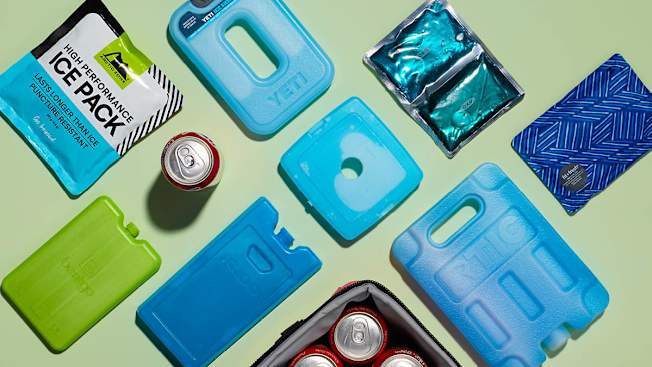
We tested eight ice packs from Yeti, Bentgo, Rtic, Arctic Zone, and more to find which ones stay coldest the longest
All ice packs are not created equal—our lab experiments revealed which can keep your lunch cool and fresh the longest.
By Lisa Fogarty
It’s almost that time of the year again: School is around the corner, which means sending the kids off with a meal they’ll actually want to eat—and one that stays cold and fresh for hours. Or maybe you’re searching for a way to save money by bringing leftovers to work. Either way, finding a high-performing ice pack is the secret to packing the perfect lunch.
Speaking as a mom and a frugal eater who loves a bagged lunch, I have to admit I’ve rarely given ice packs a second thought. On the occasion where I’ve opened my lunch to find it lukewarm—despite the presence of an ice pack—I’ve assumed I did something wrong. But after CR’s José Amézquita tested eight ice packs in our labs and found a considerable difference among them (including one model that showed no visible ice after just 90 minutes), I learned fast: Some ice packs are worlds better than others.
We don’t want you to waste your time and money on ice packs that won’t work well—so let’s cut to the chase. After José conducted numerous melt, cooling, and temperature tests on popular ice packs, including those from Yeti, Oxo, and Arctic Zone, we found four that stood out. Price-per-pack amounts below reflect the price at time of purchase.
Arctic Zone High Performance Ice Packs
This two-pack of ice packs by Arctic Zone is our Top Pick for one simple reason: It kept food cold the longest in our tests. In fact, it was the only ice pack that remained cold enough to contain visible ice at the end of our tests. This is a soft square ice pack—not as large as the Rtic below, but not compact either. Even though it’s soft, keep in mind it isn’t flexible when it’s frozen, unlike the Fit + Fresh model below.
It only comes in one size, and one drawback is that it took 5.5 hours to fully freeze this pack—the longest of all—and it develops a hump when it’s frozen. Plan accordingly by placing it in your freezer overnight.
Rtic Ice Pack
The Rtic Ice Pack was the largest model we tested, and the best for large lunch bags. The hard ice pack has a clear shell with blue gel and a handle. It comes in a pack of two, and it is also available in extra-small, small, large, and extra-large (we tested the medium). It had the second-highest melt score. It warmed the slowest, produced the lowest temperature inside a lunch bag, and retained cold gel even after 3.5 hours.
The trade-off is that it took 5 hours to fully freeze, which makes it the second slowest to freeze after Arctic Zone. It was also quite bulky, and at 1.74 pounds, the heaviest. But if you’re shopping for an ice pack that provides all-day cooling, and you have the space for it in your lunch bag, Rtic is your ideal choice.
Igloo Maxcold Medium Ice Freeze Block
Igloo is the second-largest ice pack after Rtic. It froze surprisingly quickly for its size (2.5 hours) but formed a hump upon freezing due to uneven gel distribution. However, we found that it offered a good balance of size, cooling, and freezing speed, and boasted the third-highest melt score after Arctic Zone and Rtic.
This one comes in four sizes (we tested the medium), and its price was reasonable for the value it provided.
Bentgo Chillers Reusable Ice Packs
Bentgo is small enough to fit in compact lunch boxes and bags, but the hard-shell option provides respectable cooling. It froze fast—in just 2 hours—but it also melted relatively quickly and became mostly liquid after 90 minutes. It doesn’t come in different sizes, but you can purchase it in one of four colors (green, blue, purple, or gray), and you’ll get four small ice packs at a very good price.
More Ice Packs We Tested
These ice packs all had redeeming qualities, but they failed to wow us with their freezing capabilities and longevity.
Fit + Fresh Cool Coolers Slim Ice Packs
If you’re going on a short outing and will only be gone an hour or two, this 4-pack of ice packs from Fit + Fresh may be just fine, but we wouldn’t rely on it if there’s a major gap in time between when you pack your lunch and plan to eat it. Each ice pack is lightweight, compact, and freezes quickly, in just two hours. But it also melted quickly and warmed substantially by the end of testing. We appreciated its slim size, though, and it comes in different colors.
Fit + Fresh Cool Coolers Soft Ice Packs
This is the smallest pack we tested, and it stands out as the only soft ice pack that remains flexible even after freezing. Unfortunately, it is also our lowest performer: It had the lowest melt score, warmed the fastest, and showed no visible ice after only 90 minutes. Although it freezes quickly and its flexibility is a plus, it didn’t leave us confident that it could keep food cool long enough.
Oxo Prep & Go Reusable Ice Pack Set
Oxo ice packs come in a two-pack in a thin dual-pouch design. These were the lightest ice packs we tested—they froze quickly and are soft and great for fitting in compact spaces. But that’s where our praise ends. They had a low melt score and completely lost visible ice after a little over 2 hours. So, while we found them convenient to use, they don’t offer extended cooling.
Yeti Ice Sheet
This large rectangular ice pack features a center cutout, and its size makes it a good fit for medium lunch bags or coolers. It had excellent initial cooling abilities with one of the coldest surface temperatures and a strong temperature drop during our melt tests. But its melt resistance was disappointing, and very little ice remained on it after 90 minutes. It also took 4 hours to freeze, longer than most others, except for our top picks, which stayed colder for longer.
One ice pack comes with each order, and it is available in three sizes (small, medium, and large)—we tested the medium.
How We Tested Ice Packs
We evaluated each ice pack on the following performance measures: size, weight, how long it took to freeze, how well it stayed frozen, and how effectively it kept food cold. Dimensions were measured using a tape measure and digital calipers, while weight was recorded on a laboratory scale. To determine freezing time, we placed each ice pack in a freezer and checked it every hour, pressing on its surface to assess firmness and shaking it to determine whether any liquid remained inside.
To measure cooling performance, we froze each ice pack for at least 17 hours before placing it inside a midsized insulated lunch bag with a sandwich, an apple, a can of soda, and a bag of chips. A temperature sensor inside the bag continuously recorded how well the ice pack kept the contents cool over several hours. We also evaluated how quickly each ice pack warmed after being removed from the freezer by measuring its surface temperature at 2 and 5 minutes at room temperature. Finally, we measured how long each ice pack remained frozen by placing it on a countertop and using temperature sensors beneath it to monitor its melting over time.
Consumer Reports is an independent, nonprofit organization that works side by side with consumers to create a fairer, safer, and healthier world. CR does not endorse products or services, and does not accept advertising. Copyright © 2026, Consumer Reports, Inc.