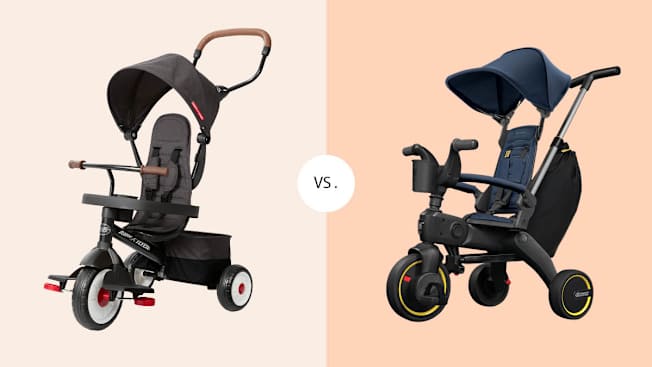
We road-tested two popular tricycles for toddlers—the Doona Liki Trike S3 and the Radio Flyer City 4-in-1 Stroll ’N Trike—and found that while neither is super-practical, one offers more features for the money
Our reporter (and her toddler) spent nine months road-testing the Radio Flyer City 4-in-1 Stroll ’N Trike, shown left, and the Doona Liki Trike S3, shown right.
By Angela Lashbrook
At a certain stage, many toddlers begin to resist the stroller. They have their reasons, I’m sure, though communicating logically isn’t the typical toddler’s strong suit. But I can imagine a few reasons a toddler might give: they’re confined, maybe they’re hot, they’re bored with the stroller, they aren’t in control. Or perhaps it’s much simpler. They just don’t feel like it, and they have a newfound delight in the word “no.”
A toddler trike can come in handy in this scenario. For the uninitiated, a toddler trike—like the Doona Liki Trike S3 and Radio Flyer City 4-in-1 Stroll ’N Trike, which I’ll compare below—is a tricycle with straps to keep the toddler (mostly) on the seat, and a handlebar for the parent to push it.
This product category, I’ve come to learn, is entirely not a necessary purchase. You do not need one. I do not need one, much less the two that currently haunt my small entryway.
But perhaps your toddler is one who resists the stroller, and you do not have the time or patience to hold their hand as they very slowly walk—or erratically run—from point A to point B. Maybe your in-laws want to spend some money on their new grandchild. Or maybe you just feel like buying one.
I tried the Doona Liki Trike S3 and the Radio Flyer City 4-in-1 Stroll ’N Trike, and though the Doona has a decent set of features and some qualities that the Radio Flyer doesn’t, ultimately, I landed on the side of Radio Flyer because you get more for a third of the price.
If you’re considering a tricycle for your toddler and wondering how the Doona trike and the Radio Flyer trike compare, here’s what to know.
At a Glance: The Doona Liki Trike S3 and Radio Flyer 4-in-1 Stroll ‘N Trike
Doona Liki Trike S3
Radio Flyer City 4-in-1 Stroll ‘N Trike
Age range
Riders 10 months – 3 years
Riders 1-5 years
Product weight, in pounds
14.77
14.99
Max capacity, in pounds
37.5
49
Dimensions (LxWxH)
19.7 x 36.8 x 40.3 inches
19.88 x 35.04 x 40.75 inches
Folds
Yes
No
Price
$280
$130
Shop
Doona, Albee Baby, Amazon, Nordstrom
Radio Flyer, Amazon, Target
Specs are according to brands.
The Doona Liki Trike S3 Is More Expensive—and Looks It
In terms of toddler trike luxury, the Doona Liki Trike S3 ($280 at Doona, Albee Baby, Amazon, and Nordstrom) has the Radio Flyer City 4-in-1 ($130 at Radio Flyer, Amazon, and Target) beat. The Doona feels sturdier and handles bumps on the road or sidewalk a bit more easily than the Radio Flyer, though I wouldn’t recommend either one for particularly bumpy terrain. The fabrics feel and appear more luxe: while the seat on the Radio Flyer is somewhat scratchy and rough, the Doona fabrics are smooth and comfortable.
Much of the advantage of the Doona materials is in sheer heft, the way a solid gold ring feels better in your hand than one that is hollow and plated. The Doona feels and, quite clearly, looks like a higher-quality, more expensive product. The colors are richer, the wheels heavier and denser compared to the Radio Flyer’s lightweight wheels.
The Doona Has an Easier Setup
The Doona barely required any assembly at all, whereas the Radio Flyer setup had IKEA-furniture vibes (I was cursing by the end). I briefly removed the plastic footrest for toddlers not yet ready to pedal, and after discovering my toddler is still not ready to pedal, I put the platform back—backward, because the product’s design does not make it clear which way it’s supposed to go. Had I referred to directions while my kid was yelling that he wanted “Playground! Playground now!” this silly mistake would not have happened. And the platform did still work, albeit crookedly. (Let it be known I do not completely count this as an example of my stupidity, as my very smart husband, whose spatial reasoning skills are much better than mine, also got this wrong.)
The Doona, on the other hand, has short instructions peppered throughout the product itself, or QR codes to scan for more information if the instructions are too lengthy to print in tiny print on a one-by-one inch sticker.
The Doona Liki Trike folds compactly to fit into a trunk or backseat (or a crowded entryway).
Photo: Angela Lashbrook/Consumer Reports
The Doona Folds
One major advantage the Doona trike has over the Radio Flyer: The Doona folds. You might need to get creative with the Radio Flyer trike if you plan to toss it in the trunk of your small SUV (I can’t imagine it fitting into the trunk of a sedan, but I didn’t try). The Doona, folded, can fit on the back seat. While the fold itself is relatively easy—and helped by the QR code mentioned above—it isn’t complete: you need to remove the handlebars and cup holder to get it truly compact.
The Doona toddler trike’s only storage component is a smallish sack that hangs from the push bar (shown left). The Radio Flyer toddler trike has a sizeable storage basket (shown right).
Photo: Angela Lashbrook/Consumer Reports
The Radio Flyer Has a Basket
That’s right. The Doona Liki Trike, despite coming in at nearly $300, has a measly sack on the parent handlebar instead of any kind of basket. You can fit two 24-ounce Yeti water bottles into the sack, but they’ll clank against each other noisily. Snacks will get crushed unless they’re carried alone. It’s a baffling design choice. What toddler parent isn’t carrying around a boatload of stuff?
The Radio Flyer has a sizable basket on the bottom back side of the stroller that’s big enough for a diaper bag, a small load of groceries, or at least one plastic toy dump truck. When deciding which of these trikes to take out, the Radio Flyer inevitably won out primarily because of the basket.
The Doona’s compact handlebar (left) makes the toddler trike more challenging to push compared to the Radio Flyer’s wide handlebar (right).
Photo: Angela Lashbrook/Consumer Reports
The Radio Flyer Is Easier to Push
The Doona trike’s handlebar is height-adjustable, so tall parents might find it easier to use.
But while the handle does extend to different heights for differently sized parents, it’s very narrow, so the adult pushing the trike essentially has their hands pressed together. This helps keep the Doona compact, but certainly does not make it easy to actually maneuver.
The Radio Flyer has a large, comfortable parent handlebar that’s more conducive to steering than the Doona. It is not height-adjustable, but both my husband (6’) and I (5’) managed well enough with the handlebar’s nearly 41-inch height.
The Radio Flyer handlebar’s primary flaw is a tiny lag between the turning of the handlebar and the turning of the wheel. It isn’t significant enough to affect the trike’s overall performance, but it is something that I (though not my husband) noticed. The Doona is smoother on bumpy terrain, but, as noted above, the difference is marginal and neither tricycle is particularly great at this.
The Radio Flyer toddler trike has a removable platform for your toddler’s feet, which works even when it’s installed backwards (as shown here) by tired, distracted parents.
Photo: Angela Lashbrook/Consumer Reports
The Radio Flyer Is More Comfortable for My Toddler
Even with the superior materials available on the Doona, my kid seems more comfortable on the Radio Flyer. He’s small for his age, and still not comfortable pedaling, and the foot platform on the Radio Flyer offers a safe, easy spot for his feet (even when the platform has been installed on the trike backward by his exhausted, distracted parent). The Doona pedals can lock in place for kids who don’t yet want to pedal, but your toddler will still have to tuck their feet into hook-and-loop pedal straps, which my toddler, at least, struggles to keep on his feet. The Radio Flyer platform, on the other hand, is a more reliable way for my child to keep his feet elevated and out of the way. The platform can be removed when the kid is ready to place their feet on the pedals.
I Wouldn’t Buy Either of These for My Own Family
I tested both of these trikes for close to nine months. What I did not anticipate was that my toddler would have very little interest in either one of them, beyond the novelty of the first couple rides—despite his passion for tricycles of various types at school. It’s hard to justify spending a few hundred dollars for a product my child had next to no interest in using—especially since it didn’t make my life or my babysitters’ lives any easier, and wasn’t as useful as my stroller.
The Radio Flyer, with its significantly lower price and arguably greater practicality (except for the Doona’s excellent folding mechanism), is a slightly better bet—with the caveat that no toddler trike is a strictly necessary purchase. Put it on your holiday gift list for the grandparents, or get it if you have money to burn and are willing to roll the dice on whether your toddler will remain interested in a trike for more than a few weeks. If all else fails, you can always resell it on Facebook Marketplace or eBay.
Consumer Reports is an independent, nonprofit organization that works side by side with consumers to create a fairer, safer, and healthier world. CR does not endorse products or services, and does not accept advertising. Copyright © 2026, Consumer Reports, Inc.