A good salad spinner is a non-negotiable for salad devotees. We tested nine from Oxo and other brands to find out which got our greens the driest, fastest
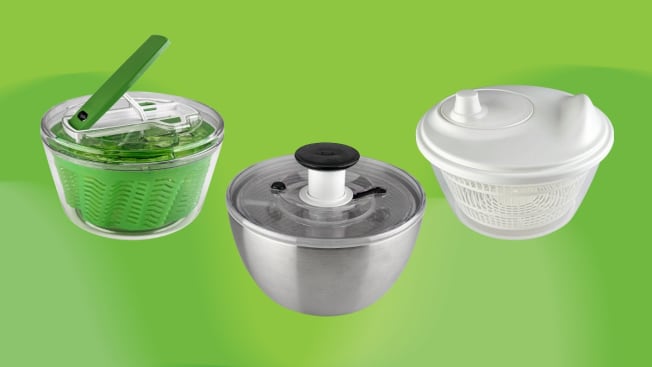
We tested nine salad spinners, including (left to right) these Zyliss, Oxo, and Ikea models.
By Ginger Cowles
Confession: I love a good salad and often eat an embarrassingly huge one for lunch and maybe even a side salad with dinner on the same day. All that salad eating adds up to a lot of veggie prep. And one tool I can’t live without is my salad spinner, which helps me clean and dry my leafy greens quickly.
I know what you’re thinking: You don’t need yet another step in your salad-prep process. Or you don’t want to dirty another item. I hear you; I felt the same way for a long time. But this gadget can help with issues that can arise. One: Sometimes dirt is not immediately visible on the greens, which gives the impression that there is no dirt.
That’s not necessarily true, says Consumer Reports nutritionist Amy Keating: “If you fill the salad spinner with water and gently move around the greens, then pull out the basket, you can often see dirt and debris before you dump the water,” she says.
Washing and thoroughly drying greens can help make them last longer in the fridge, because water can be a catalyst for food rot if food is too wet. How many times have you opened your crisper drawer to find wilted, watery greens?
“The drier the greens, the better when storing after washing,” says Sana Mujahid, CR’s manager of food safety research & testing.
Senior CR writer and salad spinner user Paul Hope agrees and takes his prep a step further to ensure his greens survive the week: “Even after spinning, I’ll often wrap them in a kitchen towel to further help dry them out,” he says.
And finally, if you’re like me, you’ve probably slacked off on the manual drying process more than once and ended up with a disappointingly watered-down salad dressing when it came time to eat.
A salad spinner can help resolve these issues. As with so many kitchen gadgets, there are a lot of models to choose from. So we scoured the internet and purchased nine of the most popular models. José Amézquita, who’s been testing products at CR for more than 30 years, tested them in our lab to find out which ones fared best at removing water. Read on to find our top picks.
Farberware Pro Pump Spinner, 6.6 Qt
If you want to ensure your greens are completely dry before tossing with your vinaigrette, then this model is for you. It removed 100 percent of the water added to our spring mix—the only model in our tests to do so—meaning not a drop of water will dilute your potent salad dressing. It’s also good to use when you ambitiously purchase a lot of veggies—this is my week to eat more greens! It has the largest capacity (257 grams) of all the models we tested. It’s among the larger spinners, so if counter space or storage space is limited, you might want to pass on this model and opt for the compact Ikea model below. The pump at the top, which you press a few times to force the spinning action, can be locked down flat, making storage a little easier. This one requires only one hand to operate and does not have a drain hole.
Oxo Steel Salad Spinner, 6.34 Qt
Oxo makes so many good kitchen utensils that it’s no surprise that this big spinner was among the top performers. It removed 97.7 percent of the water from our greens, making it the second best performer for drying behind the Farberware, above. This Oxo model can accommodate a max of 200.32 grams of dry salad mix, again, second to the winner. It’s the only stainless steel model we tested, so if you’re trying to cut down on your plastic purchases, this could be a good model for you. It landed in the middle of the pack in terms of space needed for storage, so putting it away shouldn’t be a big problem for some users. Like the winner, it’s powered by a knob on top that you pump. It does not have a drain hole and requires one hand to operate. We also tested the Oxo Salad Spinner, 6.2 Quart model, and it landed at the bottom of the water-removal rankings, having removed only 89.9 percent of the water.
Ikea Uppfylld
Tiny apartment dwellers, we’ve got the salad spinner for you. Ikea’s Uppfylld model, which features a knob that you spin to operate, is among the smallest models we tested. Despite its smaller size, it landed in the middle of the pack for water removal, extracting 94.1 percent, less than the winner above. Its size inherently makes its capacity lower—it can hold only about 105 grams of greens—so don’t expect to spin through large quantities of veggies quickly. At less than $10, it could be the right balance of compactness and affordability. It requires two hands for spinning and does not have a drain hole.
Other Salad Spinners We Tested
Cuisinart Salad Spinner, 5 Quart: This knob-operated salad spinner can hold about 137 grams of dry salad greens or just over 50 percent of the winning model’s capacity. Like the Ikea model above, it removed around 94.4 percent of the water from our salad mix. It has a drain hole, requires two hands to operate, and takes up the most room of all models when it comes to storage. The base of the bowl features a grippy material to help prevent the spinner from wobbling on the counter or sink during use.
Zyliss Swift Dry Large Salad Spinner: This pump spinner removed moisture just fine and was in the middle of the pack for the models we tested.
Progressive International Collapsible Salad Spinner: This spin-knob-style spinner landed in the middle of the pack for moisture removal and was one of the lowest-capacity models.
Mueller 5L Salad Spinner: This pull-to-spin-style model “was not too effective in removing moisture from our spring mix,” says Amézquita. It was among the lowest performers for that category.
Dolihood Salad Spinner: Amézquita says this is the worst of all the models we tried. It has a colander that is equipped with a worm handle that helps it spin. The first and second samples both broke during testing. “It also expels some white plastic residue, which can easily end up in the produce being dried,” he says.
How We Tested Salad Spinners
Lab tester José Amézquita purchased a spring salad mix and added 3 ounces (85 grams) of salad to each spinner. He spun the spinner for 1 minute to pre-dry the mix before beginning testing and then weighed the dry salad to be used in the actual test. To calculate the percent water loss, he then placed the salad in the colander part of the spinner and submerged in water for 30 seconds. He removed the colander with the salad from the water and shook the colander twice. He then replaced the colander and gave the salad spinner three full and quick turns and then let it spin freely for up to 60 seconds. He measured the weight, spun the salad spinner again three times, and let it spin freely for up to 60 seconds. He measured the weight again. He also conducted these steps with the salad spinners filled to maximum capacity to determine how they behaved with both a small amount of salad and with the max amount.
Consumer Reports is an independent, nonprofit organization that works side by side with consumers to create a fairer, safer, and healthier world. CR does not endorse products or services, and does not accept advertising. Copyright © 2026, Consumer Reports, Inc.