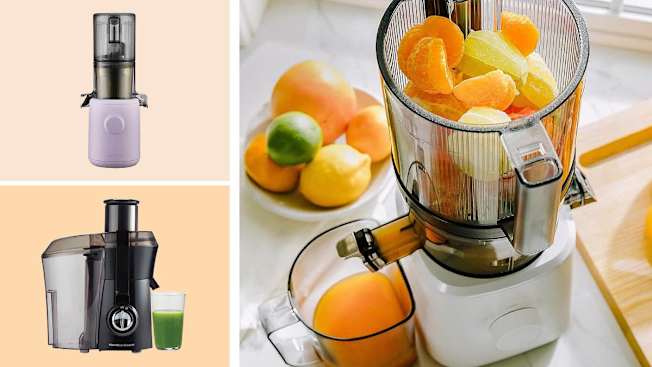
We juiced 10 pounds of fruit and veggies in eight juicer machines from Breville, Kuvings, Nama, Ninja, Nutribullet, and more to find the fastest, high-yield picks
We evaluated eight centrifugal and masticating juicers—five of them were top-notch in terms of juice production, quality, and ease of use. All were hard to clean, some worse than others.
By Lisa Fogarty
Store-bought juice is convenient, but if you’ve ever had freshly squeezed green juice or citrus juice, you probably already know they aren’t cut from the same cloth. Many bottled juices are highly processed, lack nutrients, and contain added sugars or artificial sweeteners. A few years ago, CR even tested 45 popular fruit juices and found concerning levels of heavy metals in over half of them. If you love the taste and the idea of getting a variety of vitamins and minerals from a wide array of produce, without all the sugar and other additives found in bottled juice, investing in a juicer is a solid choice.
Today’s juicers are available in several price ranges and include both centrifugal and masticating (also known as cold-press) appliances (more on the differences in a second). The right juicer for you depends on a few factors, including how much juice you’d like to make in a single batch, your available counter space and storage, and your tolerance for noise and cleanup—because some juicers can get very noisy and messy.
We tested eight popular juicers by brands, including Hamilton Beach, Hurom, Nama, and Ninja. For each juicer, we paid close attention to how easy it was to set up, how well its chute accommodated cucumbers, green apples, and spinach for green juice, how noisy it was, how much juice it produced, and the kind of cleanup you can expect. Before we reveal our top choices, how the rest fared, and videos of each, here’s a quick cheat sheet on the two major juicer types to help you decide the one that’s best for you.
Centrifugal Juicers
Centrifugal juicers are known for their speed and high juice yield. They can handle tough produce well (like carrots) and are often less expensive than masticating juicers. They are typically noisier and (sometimes, but not always) contain fewer parts that are often dishwasher-safe, making them easier to clean. However, their fast-moving blades generate more heat and can cause oxidation, leading to pulpier juice and reduced nutrient content.
Masticating Juicers
Masticating juicers, also known as cold-press or slow juicers, feature a slow-rotating metal press and extract juice without generating heat, which helps preserve vitamins and minerals. They can be more expensive and work at a slower pace, but are also quieter than centrifugal juicers. They tend to come with more parts, too, and aren’t always dishwasher-safe, so expect to spend more time cleaning them.
Is Cold-Pressed Juice Better for You?
Cold-pressed juice is all the rage, but is it really better for you? Interestingly, one study found that cold-pressed juices were not more nutritious than those made with a standard centrifugal juicer, with no significant differences in vitamin C, phenolic compounds, carotenoids, or antioxidant capacity between the methods.
The study also found that storage mattered more than the extraction method: refrigerated cold-pressed juices maintained their nutritional quality for about five days, while room-temperature storage led to noticeable declines within 48 hours, and refrigerated juices also began to lose nutrients after day five.
Juicing actually removes fiber from fruits and vegetables. The best ways to make a healthier juice at home include following the 80/20 rule by picking 80 percent veggies and 20 percent fruits to limit sugar content, watching your portion size, and not treating juice like a substitute for food.
Why Do Juicers Create Foam?
How much foam you see in your cup after juicing depends on both the juicer and the fruits and veggies you use. High-speed centrifugal juicers whip more air into the juice than slow cold-press models, so they typically create more foam. But some fruits and vegetables naturally contain proteins, pectin, and other compounds that help those tiny air bubbles stick around, resulting in an even thicker layer of foam.
To test eight juicers, we followed a typical green juice recipe: 1 cucumber, 2 green apples, and 2 cups of spinach. We weighed all ingredients on a food scale to ensure the same amount of produce was added to each juicer. Here’s what we found.
Nama J2 Cold Press Juicer
AT A GLANCE
Pros: Easiest to assemble and start juicing, no babysitting produce needed, and most delicious juice
Cons: Lower juice yield, expensive, and like all other juicers, it’s a pain to clean, but an included brush was effective
Setup: It was really easy to put together. All of its parts come organized in labeled boxes, and in each box, the parts (which aren’t plastic) are wrapped in soft drawstring bags, which is a plus. Place the hopper on top of the chamber and rotate it until it clicks into place, then position the piece over the base and plug in the juicer. That’s it! Simple.
Process: The Nama’s juice-making process was superior to all other juicers. You don’t have to continually feed the chute with produce one piece at a time. Instead, you layer its hopper with all of your produce at one time (up to the max line)—leafy veggies on the bottom, soft fruits like lemon and kiwi after that, then medium-hard fruits like cucumber, and finally, hard fruits like carrots and apples at the top. I was able to fit my entire recipe into the hopper at once.
Turn the knob to start the juicing process, and feel free to walk away and let it juice on its own. It finished juicing in about 2 to 3 minutes, which is longer than it took some of the other machines, particularly the centrifugal juicers. One side of the machine features a spout with a lid that you have to pull up—this is where the juice comes out—and the other side features a spout where pulp emerges and is collected in a container. The juice container is large (1.75 liters) and comes with a lid so you can make a lot of juice at once and store it in the fridge.
Juice yield: 415 grams—this juicer came in fifth place for juice yield.
Juice quality: Here’s why the few grams of juice less that this one produced seem to matter less: This juice emerged a vivid green, with absolutely no pulp or seeds when I ran it through a strainer. It had a thin layer of foam on top that dissipated quickly and tasted amazing.
Noise: This juicer isn’t loud at all.
Cleaning: Cleanup was a hassle with all of these juicers. The Nama is not dishwasher-safe. After disassembling it, I cleaned everything with soapy water, and there were a few sneaky parts—the filter, for one—that trapped bits of produce. The included cleaning brush was a helpful tool for these parts.
Accessories: Juice container with lid, pulp container, and cleaning brush. It’s available in black, gray, or white.
Kuvings Hands-Free Slow Juicer
AT A GLANCE
Pros: A high-quality machine that yielded the most juice.
Cons: This is the heaviest juicer—it weighs 16.5 pounds. You may not want to move it around, so make sure you have enough counter space to store it. It’s also one of the most difficult to clean, and none of its parts are dishwasher-safe.
Setup: I’m one of the least competent people you’ll ever meet when it comes to setting up gadgets, so if I say something is easy to set up, trust me. The Kuvings juicer setup took trial and error for me. You have to line up the red dots on the juicing strainer and rotating stirrer, and then make sure the screw is pushed down and the auto hopper aligns well, or the machine won’t start. It’s not difficult to do, but it took me 10 minutes to figure out why it wasn’t turning on. Once I lined everything up properly and pushed the screw down hard enough, everything clicked into place.
Process: Similar to the Nama juicer, I was able to fit all of my ingredients in the hopper at one time and simply push a button and walk away. It worked beautifully without me there.
Juice yield: 500 grams—our first-place winner when it came to juice yield.
Juice quality: Bright-green juice with zero pulp and a sliver of foam on top. It tasted fresh and delicious.
Noise: This juicer was relatively quiet.
Cleaning: Nightmare. This was one of the hardest juicers to clean. When you disassemble this juicer, there are eight parts to wash, and none of them are dishwasher-safe. There are plenty of small crevices where pulp gets trapped, and my sink was full of pulp and seeds. The included cleaning brush and additional cleaning tool help, but don’t expect cleaning to be a breeze.
Accessories: Round brush, two juice cups, juicing strainer, smoothie strainer, blank strainer (which doesn’t separate the pulp from the juice, so you get a thicker consistency), cleaning brush, and cleaning tool. This juicer is available in silver, white, or matte black.
Hamilton Beach Big Mouth Juice Extractor
AT A GLANCE
Pros: The least expensive juicer and one of the smallest and lightest we tested. It came in third place for the amount of juice it produced.
Cons: Noisy to operate and cleanup left much to be desired.
Setup: A cinch. If I can set this up in less than five minutes, so can you.
Process: This is not a juicer that you can set up and leave running while you attend to other tasks. It requires your commitment to funneling pieces of fruit into his chute—a few at a time—and then quickly replacing the chute lid before bits of produce shoot back out at you. I was able to fit 2 cups of spinach into the chute at once, but only 3 small apple slices at a time. The good news is that it worked much faster than the masticating juicers—my juice was ready in about 2 minutes.
Juice yield: 445 grams—our third-place winner after Kuvings and Hurom, below.
Juice quality: The juice quality wasn’t as good as our top masticating juicers. It produced a ton of foam at the top, and though the juice color was vibrant, it was darker in some areas than others. It tasted good—after you got through layers of foam.
Noise: This juicer is noisy and makes an even more frightening sound when you place produce inside its chute. Don’t be surprised if your young child or pet runs from the room when you push the start button.
Cleaning: Here’s where I have good and bad news. The bad: I found pulp everywhere, including the roof of the device. This was one messy machine. However, the parts are dishwasher-safe, and emerged from my dishwasher the next day looking brand new. Just make sure you scrub the filter with the included cleaning brush before placing it in the dishwasher, or pulp will keep sticking to it.
Accessories: This was the only juicer that didn’t come with a dedicated juice cup. Other than a cleaning brush, its accessory offerings are scant, but you get what you pay for. It comes in black, silver, or white.
Ninja NeverClog Cold Press Juicer
AT A GLANCE
Pros: A budget-conscious cold-press juicer with a small counter footprint and dishwasher-safe parts.
Cons: Its narrow chute doesn’t fit larger ingredients, and you have to continually feed it produce.
Setup: The setup was fairly easy: Insert the feed chute chamber into the motor base and attach the lid to the top. It came with two filters—the orange one gives you “lots of pulp,” and the black filter gives you less pulp. The feed chute chamber slides right in, and then you turn it until it clicks into place.
Process: I wish the chute were less narrow. I could not fit a piece of apple or a slice of cucumber bigger than 2 inches, so it took time to prep and process all of my ingredients. The Ninja took more patience to use than a juicer like Hamilton Beach, which rapidly crushed produce, but this is to be expected with a masticating juicer.
Juice yield: 433 grams—our fourth-place winner.
Juice quality: This juice had a layer of foam at the top and was a vibrant green. There was minimal pulp in the juice, though, including cucumber seeds that made it through the filter.
Noise: Beautifully quiet to operate.
Cleaning: I unscrewed each component of the food chute chamber and filter and found a lot of pulp stuck inside. The parts rinse and wash off easily, but there are several of them to clean. All parts except the motor base are top-rack dishwasher-safe, which is rare for masticating juicers.
Accessories: Two interchangeable pulp filters, juice jug, and pulp container. The Ninja is available in three colors: charcoal, blueberry, and gray.
Hurom H310 Easy Clean Slow Juicer
AT A GLANCE
Pros: Compact and quiet, with a cute, portable design—and it took second place for highest juice yield.
Cons: Cleaning was annoying, but luckily, there were only a few parts to wash by hand.
Setup: The Hurom was one of the easiest juicers to put together. It only comes with a few parts, including a cup and a cleaning brush, and it took me about a minute to set it up on my counter.
Process: This is another masticating juicer that does all the work for you—no need to feed produce into a chute. However, its chamber is smaller than the others, so my fruits and veggies didn’t all fit in it at the same time. I had to refill the chamber twice to make my cup of juice. It works slowly, but efficiently. One thing to note: This is the only juicer that doesn’t include a cup for pulp. Be prepared to position your own cup beneath the pump dispenser to capture skins and seeds.
Juice yield: Hurom was our second-place winner, which produced 453 grams of juice.
Juice quality: This deep-green juice produced a lot of foam on top. It also contained a small amount of pulp, but less than the Ninja.
Noise: I could barely hear this juicer running—it’s incredibly quiet.
Cleaning: What can I say? Cleaning this juicer was annoying. None of its parts are dishwasher-safe, but luckily, there are only three parts to wash by hand. Keep an eye out for pulp that gets stuck in the chamber. I had to dig some of it out by hand, and a day later, I noticed pesky pulp still jammed into the crevice of the chamber. The cleaning brush helps, but I ultimately had more success removing it with a butter knife.
Accessories: Juice container and cleaning brush. The Hurom juicer comes in four colors: lavender, beige, matte black, and white.
Other Juicers We Tested
Three of the juicers that we tested didn’t impress us much. Here’s what we think they got wrong (and right).
Breville Juice Fountain Plus
AT A GLANCE
Pros: Dishwasher-safe parts made cleaning easy.
Cons: The Breville had the largest footprint of all of the juicers we tested. The centrifugal juicer wasn’t the best for juice yield and quality, and it was very noisy and messy.
Setup: Assembly is mostly straightforward, but attaching the handle that locks onto the juicing chamber took a bit of trial and error the first time. The large pulp container can also seem awkward to position at first, but once you lift the machine slightly and place the pulp container beneath it, with the juice cup on the opposite side, everything clicks neatly into place. While the design is attractive, it isn’t the sleekest or most compact option, making it a bit less convenient to store.
Process: You’ll have to feed produce into the chute, and let me tell you, be prepared to stand back to avoid small food fragments shooting back at you. It chomped cucumber and apple slices so rapidly that I couldn’t keep up with the demands of feeding the chute. It has two settings: low for soft produce and high for hard foods. It was one of the fastest juicers and produced a cup of juice in a little over a minute.
Juice yield: Breville came in last place, producing just 340 grams of juice. This was 160 grams less juice than the Kuvings juicer made.
Juice quality: Very foamy, uneven in color, and not as dark or vivid as the juices produced by juicers like Nama.
Noise: This one takes the prize for most terrifyingly noisy juicer, especially when it’s on its highest setting. It sounds like something out of a horror film.
Cleaning: The juice cover and food pusher are not dishwasher-safe, but the filter basket, juice jug, and lid can be placed in the top rack of your dishwasher. The pulp container collected a lot of pulp, and one pro was that less pulp caked onto the underside of the machine or was trapped in crevices. Overall, this was one of the easier juicers to clean.
Accessories: Juice jug, pulp container, and cleaning brush.
Cuisinart CSJ-300 EasyClean Slow Juicer
AT A GLANCE
Pros: This relatively inexpensive masticating juicer from Cuisinart produced a delicious and smooth juice, and was one of the easier juicers to clean.
Cons: Its chute was narrow, and the juicing process was frustrating.
Setup: The juicer was very easy to set up. It features a unique vertical design, so make sure you have the counter space to accommodate a taller juicer.
Process: The juicing of fruits and leafy greens wasn’t great overall. Even though this is a masticating juicer, you can’t pile your ingredients into a chamber, push a button, and walk away. The feed chute is fairly narrow, so you can’t add much produce at once and need to keep feeding ingredients into the machine. The biggest frustration was how poorly it handled leafy greens. The spinach tended to sit in the chute without being processed, so I had to add denser ingredients, such as apples or cucumbers, and push them down to keep everything moving. It worked fairly quickly. The juice was dispensed automatically, and most of the pulp was ejected from the machine.
Juice yield: 405 grams—sixth place.
Juice quality: It came out foamy on top, with absolutely no pulp. It tasted smooth and delicious.
Noise: It wasn’t noisy enough to be bothersome.
Cleaning: A small amount of pulp remained inside the machine and had to be cleaned out, but it was considerably less than with some of the other juicers I tested. This was one of the easier juicers to clean. Its pulp container, juice container, cover, pusher, feed tube with hopper, and juice strainer were dishwasher-safe.
Accessories: Juice pitcher and pulp container.
Nutribullet Centrifugal Juicer Pro
AT A GLANCE
Pros: Included the widest variety of accessories, like two freezer trays.
Cons: Noisy, messy, and came in second to last in terms of the amount of juice it produced.
Setup: Assembly was no sweat. Even though this isn’t the biggest juicer we tested, it’s bulky.
Process: Prepare to stand there and feed produce into the chute, and don’t be surprised when it ejects spinach leaves all over your counter (true story). The controls are straightforward, though the guidance on when to use each setting is somewhat limited. There are buttons for Start, Low, High, and Turbo, with the instructions recommending Low for soft produce, High for firmer fruits such as pineapple, and Turbo for the toughest vegetables, including beets and carrots.
I found myself frequently switching between speeds and rushing to insert the food pusher after adding ingredients. If I wasn’t quick enough, leafy greens like spinach could shoot back out of the chute, creating a mess on the counter.
Juice yield: 398 grams—seventh place and second to last.
Juice quality: It wasn’t the best. It had a thick layer of foam on top, a layer of dark green beneath it, and very light green juice at the bottom. However, it was smooth and lacked pulp, which is a plus.
Noise: This juicer is very loud, even on its lowest setting.
Cleaning: All removable parts, except for the motor base and food pusher, are dishwasher-safe. Disassembly was straightforward, and loading the parts into the dishwasher was easy. However, removing the pulp from the grooves in the pulp container required a bit more effort—I had to scoop it out with a spoon because a substantial amount remained trapped.
Accessories: Two glass to-go bottles, two freezer trays, and a cleaning brush.
How We Tested Juicers
To evaluate each juicer, we put every model through the same series of tests using a standardized green juice recipe made with an 80/20 ratio of vegetables to fruit. Each batch included hard produce (168 grams of green apples), soft produce (345 grams of cucumbers), and leafy greens (61 grams of spinach) to see how well the machines handled a variety of textures. We measured how much juice each machine extracted and evaluated its quality, including flavor, texture, foam, and how well it held up after sitting for a few minutes.
Beyond performance, we noted how easy each juicer was to assemble and use, and observed whether ingredients jammed, required extra pushing, or caused a mess. We also measured operating noise, then evaluated the cleanup process, including how easy it was to disassemble the machine, clean the filter and other components, and remove leftover pulp.
Consumer Reports is an independent, nonprofit organization that works side by side with consumers to create a fairer, safer, and healthier world. CR does not endorse products or services, and does not accept advertising. Copyright © 2026, Consumer Reports, Inc.