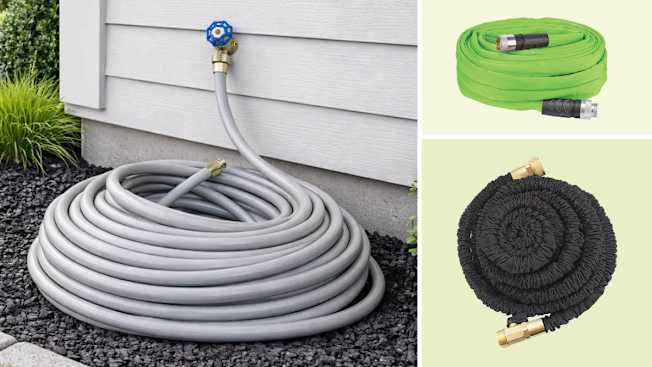
We tested standard and expandable garden hoses to find those that are strong yet floppy
Contrary to the photo above, we recommend storing your garden hose in a hose reel to increase longevity.
By Angela Lashbrook
The garden hose in my backyard is apparently an ancient model. It kinks easily and has a weak flow. Because it doesn’t fit well onto the wall-mounted hose rack, the corner of my backyard is now the Hose Zone, as the space is visually overtaken by the decrepit gray mass that brings to mind dried-out entrails.
It doesn’t have to be that way (and I’ll be purchasing a new hose for our backyard before summer is up). We recently conducted tests on garden hoses to find models that are flexible and don’t easily kink and have a strong flow (no dribble here), yet are strong enough to withstand the elements and the occasional boot or shoe. And for the most part—to my eye, at least—there’s no overt resemblance to sun-baked viscera.
To learn more about how to choose a good hose, including the importance of the appropriate diameter, info on particular materials, and storage to encourage a long life for your hose, read our buying guide here.
Standard Garden Hoses
Eley 50′ Polyurethane Garden Hose
This light-gray ⅝-inch hose aced our flow and strength tests, with the strongest fittings—made of brass—and the highest flow. It’s strong enough that you don’t have to play nice with this thing, making it a good option for folks who may tug at their fully extended hose or try to use it around sharp corners.
The Eley hose fittings are claimed to be lead-free, and it’s supposed to be safe to drink from, though we didn’t test those claims. It has brass connectors and is on the heavier side at 7 pounds. It doesn’t come with a nozzle, so you’ll need to purchase one separately. It has a 10-year warranty and is available in 10 sizes, from 6.5 to 200 feet.
Teknor Apex Zero G 50′ Flexible Hose 4001-50
This flexible ⅝-inch black vinyl hose did nearly as well in our tests as our Top Pick, and is less than half the price. It’s just as strong as the Eley, yet more flexible and resistant to kinking, making it an excellent option for people whose hoses need to snake around building corners or patio furniture. It does not, however, have a flow as impressive as the Eley’s.
At 4.2 pounds, it’s somewhat easier to cart around a yard if necessary. It has aluminum connectors with brass inserts and doesn’t come with a nozzle, so you’ll probably want to supply your own. It is claimed to be lead-safe for drinking water, and it has a five-year warranty.
Flexzilla 50′ Garden Hose
The Flexzilla 50’ has the significant advantage, in my mind, of coming in more colors than your standard black or gray. While slate gray is available, you can also get neon green, forest green, and two shades of brown that the company calls “brown mulch” and “red clay.” Its strength and flow performance in our tests mirror the excellent results of our Top Pick, the Eley. But it floundered in our kinking test, belying the lofty allusion to monstrous flexibility in its name.
This ⅝-inch hose, made of a hybrid polymer, is claimed to be lead-free and safe to drink from. It has aluminum connectors and a lifetime warranty (!), and is quite heavy at 7.2 pounds. It doesn’t come with a nozzle and comes in sizes from 3 feet to 100 feet on Amazon.
Expandable Garden Hoses
XHose Pro 50′ Expandable Garden Hose
The expandable garden hoses we tested didn’t perform nearly as well as the standard garden hoses, but the ⅝-inch XHose Pro was the best of the lot. Though it showed a middling flow rate, it made up for it with top marks in flexibility, strength, and kink-resistance. Bonus: At the time of publication, it was the least expensive hose we tested. It’s also the lightest, weighing only 2.2 pounds.
The XHose Pro is made of polypropylene, with brass connectors, an on-off valve, and a five-year warranty. It isn’t safe for drinking water from, and the company doesn’t claim that it’s lead-free. It’s available in 50-, 100-, and 150-foot lengths and doesn’t come with its own nozzle.
J&B XpandaHose 50′ Expandable Garden Hose
The latex J&B ExpandaHose is the only hose among those we recommend to come with a nozzle. Similar to the XHose, it demonstrated mediocre flow in our flow test but aced our flexibility, strength, and kink-resistance tests. You can count on this hose to manage backyard obstacles without kinking, and it should hold up well in tough outdoor conditions, too.
It comes in green or black, has brass connectors, and weighs only 2.3 pounds. It’s also wider than all our other recommended models, with a diameter of ¾ inch. It’s available in sizes from 50 to 150 feet, and it isn’t lead-free or safe for drinking water from. It has a lifetime warranty.
How We Tested
We tested garden hoses using a variety of evaluations, though our flow rate test received the greatest weight in our results. We looked at the following qualities:
Flow. We tested how much water each hose flows when connected to the same water spigot at the CR labs. A higher flow rate means a better hose.
Strength. A good hose should endure years of abuse in the form of tugging around corners and strain on adapters (they’re typically used outside, after all). We tested this by attaching each model to a horizontal spigot mounted on a wall, then hanging weights in 50-pound increments to see how much the hose could withstand before snapping or tearing. Most hoses that eventually broke snapped or deformed at the fittings rather than along the tubing itself. We didn’t test longevity for this piece, so, for example, we can’t say which hose would last the longest baking in the sun.
Kink resistance. Anyone who’s ever watered a garden knows how annoying it is when the water suddenly cuts out because the hose has kinked. We tested this by manually handling each hose and assessing how much bending and pulling the hose could withstand before it kinked.
Flexibility. A good hose should be floppy, not stiff. To test this, we measured how far the hose would extend before bending or flopping.
Drinking safety and lead-free status. We didn’t test this ourselves, instead relying on manufacturer claims. But it’s an important thing to consider when purchasing a hose. If you (or a child) plan to drink from it, you’ll absolutely need a model that is claimed to be safe to drink from. Even if you don’t plan to directly drink from it, and instead intend to primarily use it to water a vegetable garden, you’ll want to avoid the danger of imparting heavy metals or chemicals into the soil that nourishes your carrots or tomato plants.
Consumer Reports is an independent, nonprofit organization that works side by side with consumers to create a fairer, safer, and healthier world. CR does not endorse products or services, and does not accept advertising. Copyright © 2026, Consumer Reports, Inc.