We tested Kingsford, Jealous Devil, and other charcoals to find those that burn the hottest, last the longest, and emit the least smoke
We found charcoals that burn hot, burn long, or do neither (very well, anyway).
By Angela Lashbrook
There are a million reasons to prefer charcoal grilling to gas. Maybe you have a small backyard or patio and only have space for a cute little charcoal kettle. Maybe you like the smoky flavor charcoal grilling imparts. Maybe you’re a traditionalist.
You can keep the whole thing easy and get whatever charcoal you can find at your local supermarket. But depending on your reasons for charcoal grilling in the first place, you might benefit from doing a little research and finding the best charcoal—because there are some differences, as we discovered in our recent tests. And those differences could be deal breakers.
We tested seven different charcoals (two briquette charcoals and five hardwood lump charcoals) to find which burn the hottest, longest, and most evenly. Since so many of us don’t transfer our charcoal from the bag into another container, we also evaluated the bag’s moisture resistance and how easy it is to get the charcoal out.
It’s going to be a hot summer. Let’s get cooking.
Jealous Devil Chunx XL Lump Charcoal
This lump charcoal is, according to Jealous Devil, made from pure South American hardwoods, without fillers. It burned the hottest in our tests, and also heats up relatively quickly—but not as quickly as others, including Kingsford Professional Charcoal Briquets and the Good Charcoal Company Premium Hardwood Lump Charcoal. It also burns evenly over time, with only one product from our tests (Kamado Joe Big Block XL Premium 100% All-Natural Hardwood Lump Charcoal) exceeding its results for consistency. The charcoal lumps were the third-largest that we tested.
We did find, however, that we needed more paper to get this charcoal going. Our tests showed that it’ll likely take about 45 minutes from first lighting this charcoal to start grilling, which runs about the middle of the pack for the products we tested—so if you’re in a rush, you may want to look elsewhere (such as one of the two Kingsford briquets we tested). We saw a few sparks and heard some crackling during ignition.
Jealous Devil lump charcoal may produce a consistent burn, but what you get in the bag might not be. Our test bag had about 2 pounds’ worth of charcoal lumps too small to work with, so although the bag advertised 35 pounds of charcoal, we only ended up with about 33 pounds we could burn.
Kingsford Professional Charcoal Briquets
These briquets from Kingsford light more quickly than almost any other product in our test, so you’ll be on your way to grilling faster as a result. (The only other product that starts more quickly, the Kingsford Original Charcoal Briquets, comes with quite a few downsides that might make the ever-so-slightly-slower start time of the Kingsford Professional worth it.) The Kingsford Professional Briquettes burn evenly, and in our tests, we didn’t have to use too much paper to get them started—the least, in fact, of any of the products we tried.
That said, there are some downsides to these higher-end briquets, too. We saw quite a bit of smoke and some sparks when first lighting them. And while they get quite hot, two other models, the Jealous Devil lump charcoal and the Good Charcoal Company Premium Hardwood Lump Charcoal, get hotter.
The Kingsford Professional bag is well-designed: It’s simple to open, dispense, and close.
The Good Charcoal Company Premium Hardwood Lump Charcoal
You’ll need to wait around 54 minutes to go from lighting to grilling with this lump charcoal, but it’ll be worth it: These are the second-hottest burners in our tests, and they don’t smoke or spark much, either. They also require less starting paper than most of the charcoals we tested.
This charcoal is made from acacia wood, which, according to the brand, “burns hotter, cleaner, and more evenly.” We did not find that this charcoal burned especially evenly—it cooled down more quickly than about half the products in our tests, including both Kingsford charcoals and Jealous Devil.
We also got significantly less usable charcoal in the bag than was advertised. Most of the charcoal was in small pieces (among the smallest in our test), alongside uncarbonized charcoal, uncarbonized sticks, and pieces of plastic string. All in all, although the bag was supposed to contain 15.4 pounds of charcoal, we ended up with about 12.5 usable pounds.
Finally: You may want to transfer this charcoal to a waterproof container. We found that the bag can disintegrate when damp.
Kamado Joe Big Block XL Premium 100% All-Natural Hardwood Lump Charcoal
Kamado Joe advertises its “extra large” lump charcoal; we found that, indeed, after completing our burn test there were many large, heavy pieces left, indicating that this charcoal will likely last through a long, steady burn. It also burned evenly, cooling down more slowly than other charcoal in our test. It took about 45 minutes to fully ignite enough to start grilling, placing it near the middle of the pack for time to grill. It didn’t get as hot as most other products in our test.
Kamado Joe’s XL lump charcoal is made from guayaibi, aistal, and white quebracho hardwoods, according to the brand. We found it to be the densest lump charcoal in our tests, which may explain the slow, steady burn rate. Nearly all the charcoal was usable, as the bag contained few small pieces or debris. The product is one of two products we tested that comes in a bag with a moisture-protecting layer.
Other Charcoals We Tested
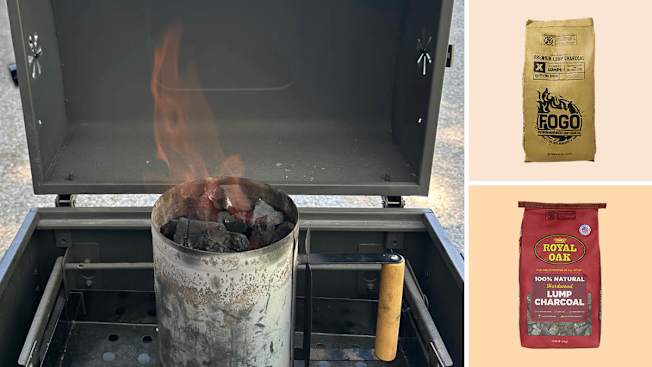
Royal Oak 100% All Natural Hardwood Lump Charcoal
This bag of charcoal, made from additive-free oak and hickory, contained more residue and uncarbonized material than nearly any other in our test, with 4.3 pounds less usable charcoal than advertised. It sparked and crackled significantly in our test, with lots of sparks flying out of the grill. It had an inconsistent and uneven burn, and cooled more quickly than any other charcoal in our tests. It took the longest to fully ignite—over an hour—but did get very hot.
Kingsford The Original Charcoal Briquets
This charcoal mainstay did not impress in our tests. It burned out almost entirely over the course of our test, so you’ll need to have a lot more on hand than you would with other charcoal. It was very smoky and sparked considerably, and had the lowest maximum heat of any charcoal we tested. On the plus side, it ignites within about half an hour, and the pieces were evenly sized; we did not find much unusable debris in the bag.
Fogo Super Premium Hardwood Lump Charcoal
This was the only charcoal we tested where pieces of charcoal and ash went cold during testing. It burned very unevenly and, obviously, cooled quickly. It reached one of the lowest maximum temps in our tests, and took 45 minutes to get there, too. There were about 5 pounds of unusable charcoal in the bag, the most of any product we tried.
How We Tested
We tested each of the seven models for heat output, burn duration, heat evenness, and moisture resistance of the bag; we also measured the amount of usable charcoal vs. debris in each bag and tested each bag’s ease of opening and closing.
To test heat output, burn duration, and evenness, we attached thermocouples to a 24-inch grill, then added about 3 pounds of charcoal to a chimney starter. We lit the charcoal with between 16 and 25 grams of paper, and recorded how long it took for the charcoal to ignite. We recorded the grill temperature after it exceeded 100° F and finally stopped the test when a few thermocouples dropped to 180° F. We did this entire test twice for each charcoal: once with charcoal grill vents fully open, then with charcoal vents opened to a gap of 0.12 inches. The lid was closed throughout the tests.
(A note: Some brands claim maximum temperatures that are significantly higher than what we found in our tests. This could be because we used thermocouples that wedged small gaps in our grill, because we used only 3 pounds of charcoal in our test that we didn’t feed, and because brands’ methods of recording temperature may differ from ours.)
To test the reliability of the bag’s contents, we counted each large piece of charcoal, weighed the total, then weighed the debris and residue left in the bag. We put aside the large charcoal pieces for later weighing and recording.
To test the absorbency of the bag—and thus its structural integrity and resistance to moisture—we submerged a 4×6-inch piece of the bag in water for 10 seconds, drained it for 5 seconds, then weighed it again to record how much water it absorbed. We did this three times per bag.
Should You Buy Lump Charcoal or Briquets?
Briquets (or briquettes, depending on whom you ask) are uniform, pillow-shaped pieces of charcoal made from coal, compressed sawdust, and binders.
Hardwood lump charcoal is made from 100 percent charred wood and comes in a variety of shapes. “Some claim it adds a natural wood flavor to food cooked with it,” says José Amézquita, who designed and conducted the charcoal testing for this piece.
According to Amézquita, in our tests, at least, lump charcoal provided higher heat, though the briquettes were more consistent and reliable. This consistency makes briquettes a better choice for low-and-slow cooking, while lump charcoal’s (general) ability to get hotter makes it better for searing or other high-heat grilling (making lump charcoal the preferred choice for my current skirt steak craving). That said, in part because lump charcoal comes in a variety of shapes and sizes, it can burn more unevenly, requiring more monitoring and responsiveness from the cook.
Consumer Reports is an independent, nonprofit organization that works side by side with consumers to create a fairer, safer, and healthier world. CR does not endorse products or services, and does not accept advertising. Copyright © 2026, Consumer Reports, Inc.