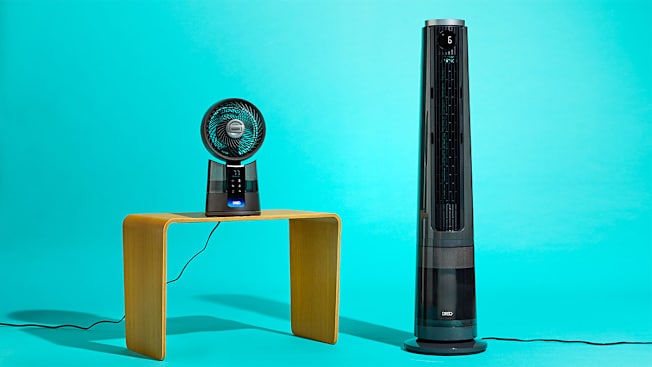
We tested the new fans—a compact desktop model and a big tower—by running them in our 90° F chamber and working in front of them at home
We tested two new Dreo misting fans in our labs and at home. From left: the Dreo TurboCool Misting Fan 516S and Dreo TurboCool Misting Fan 765S.
By Lisa Fogarty
Dreo is a trusted name in home devices, including room fans and humidifiers. So when we heard that the brand released two new misting fans—the TurboCool Misting Fan 765S and TurboCool Misting Fan 516S—we were eager to try them out.
Summer temps can be brutal, and if you work from home or spend a lot of time indoors, the last thing you want is to feel hot and sweaty in your space. A larger window air conditioner, or even a portable air conditioner, is a powerful option, but you may not want to deal with the expense or space requirements of larger units. Misting fans generally consume far less electricity than compressor-based air conditioners and can provide lower-cost cooling, though they do not provide the same level of temperature control or whole-room cooling as air conditioning.
Dreo’s latest options include a tower misting fan (the 765S) that Dreo claims can deliver up to a 10° F temperature drop, and a much more compact tabletop misting fan (516S) that the company claims can reduce heat by up to 5° F. We tested those claims in our labs and at home, and also considered how easy each unit is to set up and operate, and how noisy the model gets on each setting.
These two fans share a few things in common but serve very different purposes (and there’s a $100 price difference between them, too). Here are the details on each fan, our take on whether they’re worth the investment, and other info, such as how misting fans work, cleaning them, and potential downsides to misting fans.
How Do Misting Fans Work?
A misting fan is a type of evaporative cooling system that works by dispersing water droplets, which absorb heat as they evaporate, while the fan accelerates the evaporation process. The cooling effect is generally strongest in hot, dry conditions and weaker in humid air. When I placed my hand up against the misting feature of each fan, it felt like ice water was running over my skin. But it didn’t actually make my skin wet, and the moment I removed it, my hand felt its regular temperature again.
It makes sense that you might be concerned about using electronics, like a laptop, around a misting fan. I did not notice any moisture on my laptop after using it near the Dreo 516S. But to play it safe, avoid directing the mist toward electrical equipment and devices.
Do You Need to Clean Misting Fans Regularly?
Like humidifiers and other water-containing appliances, misting fans can develop mold and other microorganisms in their reservoirs and water lines if they aren’t properly emptied and cleaned. Dreo recommends unplugging the fan, thoroughly drying it, and reassembling it. For misting fans, the water reservoir should be emptied and dried regularly to prevent buildup in the water system. Follow the specific cleaning instructions for each of the fans to ensure it is properly cleaned and maintained.
The Downsides of Adding Humidity to Your Room
If you are a hot sleeper or get hot flashes, running a misting fan overnight can be useful. But it can also raise the room’s humidity, which has some downsides. Prolonged exposure to moisture can cause hair shafts to absorb water, leading to frizz, tangling, or scalp irritation in some people (not to mention ruining that expensive blowout). Wearing a hair bonnet can help combat frizz, prevent breakage, and keep your hair hydrated. Alternatively, these misting fans from Dreo let you turn off the mist and run the fan alone, which may be preferable.
Dreo TurboCool Misting Fan 765S
The tower fan was effective at making part of my home seem much cooler than it was.
Dreo TurboCool Misting Fan 765S
What’s included: remote control and two AAA batteries.
Manufacturer’s claim: At its highest fan speed, the unit can lower a room’s temperature by up to 10° F. However, the manufacturer says this is the “perceived” cooling temperature and does not specify how long the cooling process takes or what size room it can cool to this degree.
The Basics
This tower fan features 12 fan speeds, four mist modes, ambient light, and oscillation to 90 degrees. It has a generous 6-liter water tank (you should use only purified or distilled water to prevent the formation of scale) and, according to the manufacturer, can run up to 24-plus hours on its lowest setting or up to 7 hours on Turbo, its highest setting (CR didn’t test these claims). Its maximum wind reach is up to 59.7 feet, and its mist reach is up to 4 feet. Its control panel is situated at the top of the fan, but it also comes with a remote control and batteries. You can download the Dreo app and control your device’s settings from it, which is a nice perk.
What CR’s Lab Tests Found
The setup: We tested the fan in a lab chamber that maintains a temperature of 90° F inside.
We ran it for 30 minutes at its lowest temperature and then for 30 minutes on its highest settings using mist settings for both.
The lab results: The highest speed created more noticeable temperature changes right next to the fan. At a distance of about 1 foot, temperatures changed by about 0.7 degree at high speed with mist, compared with about 0.3 degree at low speed. Looking at the room overall, though, the difference was small, and the low-speed setting actually showed a slightly wider temperature range than the high-speed setting. The bottom line: The temperature difference between the two settings was barely noticeable.
Because fans circulate the air in the room and are designed to create a wind chill effect that makes you feel more comfortable, they can’t be expected to do the same work as an air conditioner. As we’ll explain below, the cooler air was felt more acutely when we tested this fan at home, in more moderate temperatures.
What CR’s Home Tests Found
Setup: This fan is nearly 4 feet tall, weighs 17.8 pounds, and comes in two pieces. To set it up, I flipped the unit on its head and attached the base with a screw, which is included. It’s simple to do, but it helps to have someone hold it. Alternatively, you can lean it against a wall or sofa while attaching the base. The water tank pulls out from the front and has a handle at the top (the unit also has a handle at the back)—its design makes it convenient to carry from room to room.
Cooling effect: I set it up in my dining room on a hot day. The temperature inside my home was 73° F. Even on its lowest setting and with the mist mode on low, I felt an immediate chill in the air when I was standing or sitting within 6 feet of the fan. It cooled off the area beautifully, making it feel more comfortable. I cranked it up, one speed and mist setting at a time, until I landed on 12—its highest speed—as well as the highest mist setting.
At this point, my dining room and part of my living room became very cold, and I needed to move back about 10 to 12 feet from the fan or I would freeze (I am being dramatic. If you love the cold, you’ll appreciate its tundra chill). What I found most surprising was how quietly the fan operated, even on the highest setting. It was less distracting to have in the room than the smaller Dreo TurboCool Misting Fan 516S, which was noisier on its highest setting (to be fair, the 516S is a desktop fan, so it was positioned closer to me).
Actual temperature difference: My perception of how cold the room had become did not align with the facts, though. Using a temperature gauge, I measured the temperature about 3 feet from the fan at the highest fan setting, and it registered 71.2° F, indicating the space cooled by 2 degrees. I agree with Dreo, though, that I “perceived” its coolness to be more like 10° F. But, as we found out from our lab tests, that was only the case in a warm room. It did not feel as cool when we used it in a 90° F room. But the Dreo 765S worked well at home and is an attractive, shockingly quiet fan.
Storage: Given its dimensions, you’ll need space to store this unit when you’re not using it.
Dreo TurboCool Misting Fan 516S
This desktop model was also good at helping it seem cooler at my desk. It was also pretty quiet at the lowest settings and much louder at the highest.
Dreo TurboCool Misting Fan 516S
What’s included: remote control and two AAA batteries.
Manufacturer’s claim: At its lowest fan speed, the unit can lower a room’s temperature by up to 5° F. However, the manufacturer says this is the “perceived” cooling temperature and does not specify how long the cooling process takes or what size room it can cool to this degree.
The Basics
The Dreo TurboCool Misting Fan 516S is a compact desktop fan with six speeds, two mist modes, and five oscillation options. Its control panel is located on the front of the fan, and is clear and easy to use. It comes with a 1.3-liter water tank and, according to Dreo, can run up to 12 hours on its lowest setting or up to 3.5 hours on its Turbo setting (we did not test those claims).
What CR’s Lab Tests Found
The setup: We tested this fan in the same 90° F temperature-controlled lab as the Dreo 765S (on a different day), using room-temperature distilled water. We tested it for 30 minutes at its highest and lowest settings with mist.
The lab results: At a distance of about 1 foot from the fan, temperatures fell by about 0.6 degree on the higher setting and by about 0.3 degree on the lower setting. In other words, the stronger airflow had a slightly greater effect in the area closest to the fan.
When we looked at the entire room, both settings produced very similar results. The lower-speed test showed a temperature drop of up to 2.5 degrees, and the higher-speed test showed a range drop of about 1.7 degrees. While the lower setting had a somewhat wider temperature spread throughout the room, the overall differences between the two settings were still fairly small. And it’s important to remember this fan is meant to be used while set up on a desk and close to you. Similar to the Dreo 765S, this fan felt much cooler when we used it at home at a moderate 73° F.
What CR’s Home Tests Found
Setup: This fan couldn’t be simpler to set up. The water tank pulls out easily from the back. Turn a small knob, fill the tank with purified or distilled water, screw the knob back on, and insert the tank into the fan until you hear it click in place. Plug it in and operate it via its buttons or use the included remote, which comes with batteries. It fit nicely on my desk and didn’t take up too much room.
Cooling effect: This fan feels super-cold on its highest settings, especially when you set its mist mode high. When I placed my hand close to it, it felt like ice. But the noise levels on settings five and six were distracting. Dreo claims this fan is “hypersilent” only on the lowest speed settings—and I agree. But if I were in a Zoom meeting or on a call, I wouldn’t keep it higher than a three—it gets too loud. Luckily, even on its lowest settings, I still felt cool and comfortable when I used this fan in a 73° F room.
Actual temperature difference: The fan did not measure a temperature decrease when I used an infrared thermometer to test it in the room, and the temperature actually rose 1.4° F after 45 minutes (this could be due to other factors, like the fact that the midafternoon sun was streaming through the window in the room where I tested it, which may have warmed the air). The reality of that measurement did not line up with my perception of its coolness, though. When I sat in front of this fan, I felt its effect—even if it was not actually changing the temperature of the space.
Storage: Thanks to its smaller size, this fan isn’t a hassle to store. I could easily store it on a shelf in my basement.
The Takeaway
Neither of these fans is a replacement for an air conditioner—they simply don’t cool the air in a hot room enough to be worthy alternatives. But the Dreo 516S is an excellent desktop fan that is easy to operate and truly effective, especially with its mist modes on. We wish it were quieter on its highest settings, though. The Dreo 765S deserves your consideration when you’re choosing a tower fan. It operates quietly, creates incredibly chilly conditions, especially on its highest settings, and is pretty to look at, too. Just make sure you have enough storage space for it.
How We Tested the Fans
We tested both fans in our labs and at home. In the lab, under the guidance of CR’s Jodhaira Rodriguez, we filled both fans with room-temperature distilled water and set them up (on separate days) in a 90° F temperature-controlled chamber for 30 minutes on the lowest temperature and mist setting and 30 minutes on the highest setting. Thermocouples positioned in different areas of the room measured the changing temperature. As a control, we also collected data of the room’s changing temperature for 30 minutes without running the fans.
At home, I set up each fan in a room corresponding to the manufacturer’s maximum wind reach distance (we did the same in the lab). I tested the 516S in my office and the 765S in my dining room. I ran each fan for 1 hour on its lowest setting and measured the temperature 1 to 3 feet away from the fan using a temperature gauge every 15 minutes. Then I ran each fan for 1 hour on its highest setting and took the same number of temperature measurements. We also took notes on how easy each fan was to set up, whether its noise levels were distracting or comfortable, and the perceived cooling effect of each.
Consumer Reports is an independent, nonprofit organization that works side by side with consumers to create a fairer, safer, and healthier world. CR does not endorse products or services, and does not accept advertising. Copyright © 2026, Consumer Reports, Inc.