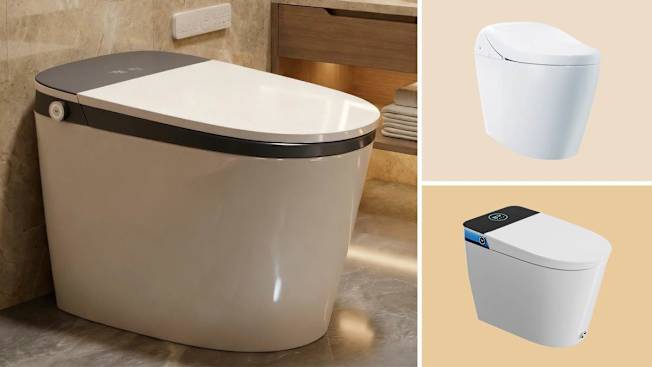
Are you ready for a smart toilet? We tested 11 to find the ones worth the investment.
Smart toilets offer features like bidets, heated seats, and automatic flushing, but they can be costly, depending on the model. Shown here, clockwise from left, are smart toilets from Eplo, Toto, and Horow.
By Pang-Chieh Ho
There are a few reasons you might want to upgrade to a smart toilet. Their built-in bidets mean you might use less toilet paper. (And let’s be frank, a bidet can also clean you better than toilet paper will.) Other amenities, like a heated seat and automated flushing, can add comfort, especially for older people or those with mobility issues.
But smart toilets are expensive. Models from established brands such as Toto, Kohler, and American Standard command a high price, retailing for $2,000 or more. At the other end of the spectrum are lower-priced online brands, such as Horow, Eplo, and Canest, that offer models for $1,500 or less. While these budget-friendly toilets might perform well initially, they often lack the robust customer service of established brands, says Cesar Carroll, a CR market analyst. In other words, you might have more difficulty fixing or replacing parts of your smart toilet if something breaks.
Below, we highlight the four smart toilets that perform the best in our lab tests. For more choices, check out our full ratings of smart toilets. And to help you shop, we also provide information on what you should know before buying a smart toilet.
Is a Smart Toilet for You?
It depends on your needs and budget. If you’re not sure whether you’re ready to invest in a smart toilet—or if it’s not in your budget right now—a bidet attachment is a great alternative, says Katy Halevah, who leads CR’s testing of toilets. A bidet attachment offers personal cleansing, but it won’t include premium features you’ll see on a smart toilet, such as a heated seat or a warm-air dryer. They’re easy to install on existing toilets and usually cost under $100, making them a budget-friendly and convenient way to experience the benefits of a bidet.
A step up from a bidet attachment is a bidet seat. Pricewise, it falls between a bidet attachment and a smart toilet. A bidet seat is a good choice if you want more upscale features without replacing your entire toilet. (You’ll still have to remove your toilet seat.) Depending on the model, bidet seats offer additional features such as heated seats, warm-air dryers, nightlights, and automatic lid opening and closing. They fall into two types: nonelectric and electric. Electric bidet seats typically have more features but require access to an electrical outlet and might require more installation effort than a nonelectric seat.
If you’re looking for the most luxe bathroom experience and you have more room in your budget, a smart toilet is the way to go. Compared with a bidet attachment or seat, it offers the most complete set of amenities: bidet, warm-air dryer, heated seat, deodorizers, nightlights, and automated functions, including auto-flush and automatic opening and closing of the toilet seat lid. Some models also dispense a liquid foam barrier that rests on the bowl water, designed to reduce splashing and trap odors, and feature self-cleaning functions for the bidet wand and toilet bowl. Smart toilets also offer more options for personalization. Different users can save, for instance, their preferred settings for water pressure or the heated seat’s temperature.
How to Shop for a Smart Toilet
Before you buy a smart toilet, make sure that your bathroom has the resources to support it. You’ll need access to a 125-volt ground-fault circuit interrupter (GFCI) outlet in your bathroom, says Bill Strang, president of corporate strategy, e-commerce, and retail at the toilet manufacturer Toto. (A GFCI outlet protects you from electric shocks and is required by code in bathrooms.)
It’s also important to measure your bathroom space before purchasing a smart toilet. In particular, make sure that the rough-in dimensions of your toilet and bathroom match, Strang says. (A toilet rough-in is the distance between the finished wall in your bathroom and the center of your toilet’s waste pipe opening.) While most standard bathrooms have a 12-inch rough-in, some older homes may have a 10-inch one, and a 12-inch smart toilet won’t fit in that smaller bathroom, Strang says.
Some smart toilets are tankless and require adequate pressure from your water supply to flush properly, according to guidelines from the online kitchen and bathroom fixtures brand Horow. If your home has low water pressure, your smart toilet might not deliver a strong, consistent flush that washes waste away. If the pressure is too high, parts of your smart toilet might wear out faster, and your toilet could leak.
Compared with a traditional toilet, a smart toilet also has more parts that will require regular maintenance. You’ll need to replace the bidet’s water filter and the deodorizer’s air filter periodically. Batteries for the remote control and the toilet’s backup flush system (if available) also need to be replaced. And if the smart toilet has a foam “shield” function, the cleaning solution that provides that barrier will need to be replenished.
Customer support is another important factor. Because smart toilets contain more electronic components, there are more potential points of failure. If a part malfunctions or wears out, you’ll probably need to work with the manufacturer to obtain replacement parts or a whole new toilet, Halevah says.
Best Smart Toilets
The best-performing smart toilets in our tests deliver strong flushes that effectively remove waste. Many also impressed us with their bidet functions. While one of the models is on the pricier side, costing around $3,000, we also have a top-scoring choice that’s under $1,000.
Horow Smart Toilet HRT38P
The Horow toilet has a strong flush that effectively removes solid waste, making clogs unlikely, and a bidet that cleans well. One of its biggest strengths is how relatively soundless it is; it flushes more quietly than the other smart toilets we’ve tested. Its bowl-cleaning ability, however, is middling, with some residue remaining after flushing. (It’s worth noting that this toilet uses cleaning foam to minimize stains on the bowl. But our testing evaluated only the toilet’s ability to clean the bowl through flushing and didn’t include this feature. When used with the foam shield function, the toilet may provide improved bowl-cleaning performance.)
The toilet’s bidet has multiple cleaning modes, including a gentler mode, a more powerful stream, an oscillating wash, and a massage setting that alternates between cold and warm water. It uses UV sterilization and a self-cleaning nozzle to keep the bidet clean. The heated seat and the warm air dryer have four adjustable temperature settings. Other features include an air deodorizer, a function that helps prevent stains and buildup, nightlights, and automatic flushing and lid operation.
The Horow features a battery backup that keeps the toilet functional during a power outage. (You’ll have to purchase the battery pack separately.) The model offers three flushing options: a sensor-based automatic flushing system, remote-control flushing, and a mechanical side-button flush to use during a power outage.
The toilet is WaterSense certified by the Environmental Protection Agency, meaning it meets specific performance and water-efficiency requirements. The toilet’s 17.5-inch height is ADA compliant (1.5 inches higher than a standard toilet), and the model comes with a two-year warranty, longer than the other smart toilets in this article.
Toto Washlet G5A Integrated Smart Toilet MS7631CEMFG
For an all-around solid performer, consider the Toto Washlet G5A Integrated Smart Toilet MS7631CEMFG. It earns favorable scores for solid waste removal and bowl cleaning, and nabs a top-notch rating for bidet cleaning. Compared with the Horow model, however, its flushes are on the louder side, earning it a middling noise score.
The toilet features a heated seat, an automatic air deodorizer, a warm-air dryer with three temperature settings, nightlights, automatic flushing, and automatic lid operation. During an outage, you can flush it manually.
The bidet can oscillate and pulse, and you can adjust its water temperature, water pressure, and spray position. It uses electrolyzed water to self-clean. The toilet mists the bowl to reduce stains and make the bowl easier to clean. The Toto toilet is WaterSense certified and ADA compliant. It comes with a one-year warranty.
Eplo Smart Toilet U8MAX
The Eplo smart toilet is excellent at removing solid waste and very good at keeping its bowl clean. It also earns a strong rating for how thoroughly the bidet cleans. It’s not the quietest model we’ve tested, however, and has a so-so rating for the loudness of its flushes.
Amenities include a bidet with a self-cleaning nozzle, a warm-air dryer, nightlights, an automatic air deodorizer, automatic flushing, automatic lid opening and closing, and a foam shield to reduce splash, trap odors, and prevent waste from sticking to the toilet bowl. It has a heated seat with six temperature settings and a protection mechanism that shuts off the heating after 10 minutes to prevent overheating and low-temperature burns.
The Eplo toilet has a dual-flush system (a full flush for solid waste and a half flush for liquids) to save water. During a power outage, you can use the built-in backup battery to flush. It has an ADA-compliant height of 17.41 inches and comes with a one-year warranty.
Canest Smart Toilet TC200GE
If you’re looking for a less expensive option, the dual-flush Canest Smart Toilet TC200GE is the most budget-friendly of our top-rated choices. It aces our tests for solid waste removal, and it’s better than the other models at keeping the toilet bowl clean. But it earns just a passable score for how well the bidet cleans waste and a mediocre score for how noisy its flushes are.
One of the nifty features of this toilet is that it automatically adjusts the seat temperature, the warm-air dryer, and the bidet stream based on the indoor temperature, so you don’t have to adjust them seasonally. The toilet has a bidet that self-cleans with UV light, a bowl that wets to ensure a cleaner flush, an automatic air deodorizer, nightlights, and sensors that automatically flush the toilet and open and close its lid.
The toilet offers three flushing options: automatic, remote-control, and manual (by pressing a knob). There’s a battery-powered backup flush that allows you to use the toilet during an outage. The toilet has a built-in water tank, is ADA compliant in height (17.7 inches), and has a one-year warranty.
How We Test Smart Toilets
In our evaluation of smart toilets, we consider a toilet’s ability to remove solid waste, clean the bowl, and flush quietly. We also assess how well the bidet cleans the user. An Overall Score is calculated based on a smart toilet’s performance in each category.
For solid waste removal, we gauge whether the automatic flushes of a smart toilet can deliver a flush strong enough to effectively evacuate solid waste from the bowl and into the drainage system. (We use marble-sized plastic beads, weighted sponges, and water-filled condoms to simulate waste.) High-scoring models can move these items effectively in one flush and are less likely to clog.
To assess how well the bidet cleans the user, we run each bidet on its highest setting for 30 seconds against a clear plexiglass panel spread with Nutella. (Quite a visual, we know.) Then we use a computer program to analyze how much Nutella (waste) the bidet stream removed.
We assess each smart toilet’s bowl-cleaning capability using two tests. For the first, we apply red water-based paint to the front bottom of the bowl just above the waterline and then flush it twice to see how much paint the flush removes. For the next test, we draw a line around the bowl about an inch under the rim with a water-soluble pen, then measure how much of the pen marking remains after a flush. The more paint and pen markings removed, the better a toilet scores for bowl cleaning.
Bowl cleaning shows how well a toilet’s flush removes waste from the bowl’s surface, leaving it free of residue. While some smart toilets might come with additional features, such as the foam “shield” described above, we don’t use these features in our bowl-cleaning tests, preferring to judge by the toilet’s flushes alone.
For noise, we put each smart toilet in a quiet chamber and use a decibel meter to measure how loud its flushes are. A high-scoring toilet is quieter and better suited for nighttime use, when noise can disrupt people’s sleep.
Consumer Reports is an independent, nonprofit organization that works side by side with consumers to create a fairer, safer, and healthier world. CR does not endorse products or services, and does not accept advertising. Copyright © 2026, Consumer Reports, Inc.