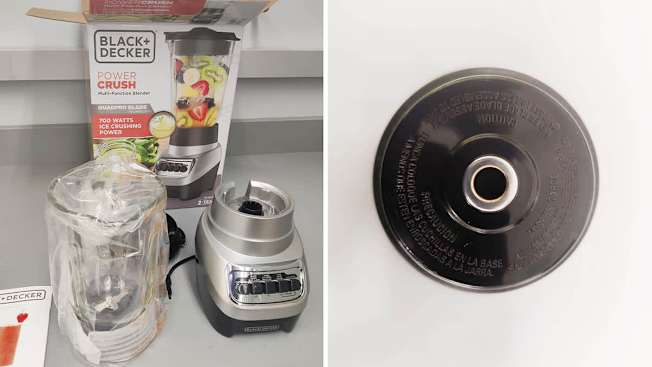
CR tests of the PowerCrush BL1230 find that a metal component that comes into contact with food contains high levels of lead
Consumer Reports tested Black & Decker Power Crush blenders for lead. At right, the metal ring in the base where we detected high levels of lead in two of the three blenders.
By Lauren Kirchner
In January 2026, the Consumer Product Safety Commission, the federal regulator that oversees the safety of thousands of home products, received an alarming report.
A 1-year-old baby had elevated blood lead levels, and the parent had reached out to a local health department lead risk assessor to try to identify the source of the heavy metal in the family’s home, according to an incident report published in the CPSC’s SaferProducts.gov public database.
The only lead hazard the assessor found was in a metal component in the base of a blender the parent was using to make baby food every day: the Black & Decker PowerCrush BL1230.
The report, submitted to the CPSC by a state official, suggested that the metal could have been shedding lead dust into food being made in the blender. The state agency also noted that some foods prepared in the family’s blender and then tested contained more than 3,000 parts per billion (ppb) of lead, according to the report. (However, the report did not say whether lead from the blender was proven to be the source of the baby’s elevated levels.) For reference, the Food and Drug Administration (FDA) has recommended lead levels as low as 10 ppb for baby food.
When Consumer Reports spotted the report, we quickly decided to buy the same Black & Decker blender model to test it for ourselves. (This model is not in our blender ratings.) We bought three of these blenders and tested multiple metal components for lead.
In two of the blenders, we found high levels of lead in a small metal ring in the blade assembly, which comes into contact with food. We did not detect any lead in the third blender.
One of these rings had 4,175 parts per million (ppm) lead (the metric commonly used for non-food products). The other contained 6,027 ppm lead. Our findings translate to over 4 million and 6 million ppb.
“No food contact material should ever contain lead,” said Ashita Kapoor, CR’s director of product safety and personal care. “Given the fact that many parents use blenders to purée food for babies or make smoothies for children, these findings are extremely concerning.”
CR reached out to Black & Decker to share our test results with them and ask for a comment, but they did not immediately respond. We also reached out to Spectrum Brands, which manufactures the blender, but we have not yet heard back. We will update the story with their responses if we hear from either company. The public version of the incident report did not include a company response, but it indicated that the CPSC did pass the report along, days after receiving it.
We reached out to the CPSC to ask whether they were investigating the family’s case, testing the blender themselves, or taking any other action in response. A few hours after we contacted them, the incident report that had previously been publicly available was no longer online. The CPSC told us that this issue falls under the jurisdiction of the FDA, not the CPSC, and that they have referred it to them. (The FDA has jurisdiction over products when they could potentially contaminate food.)
Screenshots of the incident report that was filed with the CPSC and later taken offline.
Source: CPSC
A spokesperson for the FDA confirmed that lead is not authorized for use on food-contact surfaces, but did not confirm receipt of this incident report.
We don’t know how many Black & Decker blenders or other Black & Decker products contain this particular metal part, so it’s not clear how widespread an issue this could be. But CR’s safety experts and advocates are advising people who own the Black & Decker PowerCrush blender, model number BL1230, to stop using it, and to contact Black & Decker to ask whether their blender may be affected by this issue. You can also contact Spectrum Brands directly at 800-321-9786.
“The high levels of lead detected in these Black & Decker blenders are dangerous and unacceptable,” said Gabe Knight, CR’s senior safety policy analyst. “There is no safe level of exposure for anyone to lead, and children are particularly vulnerable to its harmful effects, which include permanent brain and nervous system damage. The manufacturer, Spectrum Brands, should work promptly with regulators on an appropriate recall. For its part, the FDA should immediately investigate the scale of the problem and how long it’s been going on, and do everything possible to reach consumers who have an affected product.”
Consumer Reports is an independent, nonprofit organization that works side by side with consumers to create a fairer, safer, and healthier world. CR does not endorse products or services, and does not accept advertising. Copyright © 2026, Consumer Reports, Inc.