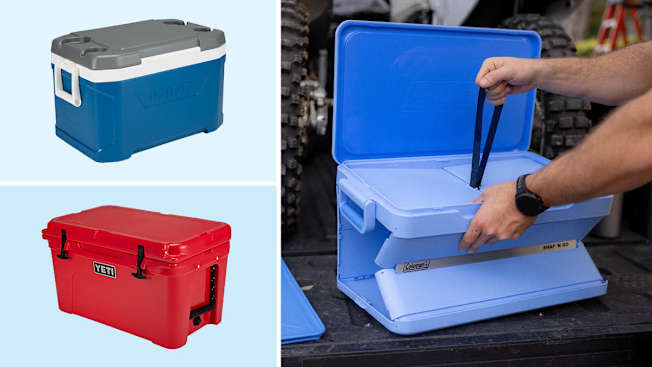
We tested coolers from Coleman, Igloo, and Yeti to find out which ones could keep drinks cold the longest in hot and humid conditions
Some cooler brands claim to stay cold for days, so we put that claim to the test in a heated chamber in our lab.
By Jodhaira Rodriguez
I’m not claiming to be the expert on all things weather-related, but summer is the best season of the year. Days spent in the backyard grilling hot dogs and veggies, or at the beach under the protection of a beach umbrella, sipping on an ice-cold soda. It is a delightful experience.
Keeping drinks and snacks cool in sweltering heat isn’t easy, and it’s especially important when you’re packing cold-cut sandwiches and other foods that need to remain at a safe, cool temperature. That’s why a good cooler is crucial for a successful beach day.
We tested three coolers in a temperature-controlled chamber in our labs to find out which one could keep things cold the longest, even in extreme conditions. The chamber temperature ranged from 91° to 118° F. We also noted how easy each cooler was to open, drain, and carry. Locks, handles, and any other additional features were also considered.
Sneak peek: The Coleman Snap ’N Go cooler we tested did not maintain cold temperatures the longest, but it has one unique feature that still makes the model worth considering. It folds down from a bulky, rectangular cooler to a thin, 4.5-inch (measured in our lab) flat item that can be easily stored in a small space between uses. Best of all, when you’re ready to take it on a trip, going from collapsed to expanded takes just a few seconds.
Chamber-Testing Video
We left our coolers in a hot chamber for three days. Check out how much ice remained in each.
Yeti Tundra 45 Hard Cooler
*According to the brand.
Performance: Yeti says this cooler “will keep your contents ice-cold even in sweltering conditions,” and our tests proved it. After 72 hours in a chamber with temperatures ranging from 91 to 118° F, this Yeti cooler was the only one still holding ice. Soda in a 12-ounce can remained just below 35° F throughout our test. It was also the only cooler whose internal temperature was not affected when the testing chamber reached 118° F and remained in the 100° F-plus range overnight.
The highest temperature recorded by our thermocouples inside this cooler was 49° F. It was the lowest maximum temperature among all the coolers we tested.
The size of this cooler is listed as “45”, which we assumed corresponded to the cooler’s capacity in quarts. The Coleman cooler we tested has a capacity of 45 quarts, too, but the interior space is larger than the Yeti’s. The volume of the Yeti, calculated from lab measurements, is 2193.75 cubic inches. The Coleman cooler has a volume of 2777.25 cubic inches. We emailed Yeti to confirm the capacity in quarts, but did not hear back from the company.
Seals on the interior of the lid also prevent the lid from closing properly if there is too much ice inside. To close and lock the lid properly, we could only add 30 pounds of ice and 10 12-ounce cans of soda. According to Yeti, this cooler can hold up to 37 pounds of ice (with nothing else inside).
No water leaked from the cooler during testing or during the model’s movement post-testing.
Ease of use: This is one heavy and bulky cooler. Even empty, it feels unwieldy and large in your hands. The rope handles allow for more flexibility in your hand’s position when lifting the cooler, but they felt a bit too long, so the cooler hit my shins as I walked with it. It is great for carrying with a friend’s help, though, as it allows more distance between the two people walking on either side. There is a second set of handles built into the sides of the cooler that can be used instead of the rope handles, making it much easier to lift solo.
The lid has two anchor-shaped locks that keep it secured until you lift the anchors from their locked position. There is one drainage hole with a twist-off cap on the bottom of the cooler. All the melted ice drained from the cooler without tipping or lifting.
The Yeti Tundra 45 is the only cooler we tested that is on the Interagency Grizzly Bear Committee’s list of bear-resistant products. One removable dry goods basket is included with the cooler.
Igloo Latitude 52 Quart Cooler
*According to the brand.
According to the product page on Igloo’s website, this cooler holds 76 cans, but a sticker on the cooler we received claimed a capacity of 85 cans. We chatted with a customer service representative on the Igloo site, who noted the mishap and confirmed its capacity is 76 cans.
Performance: According to Igloo, this cooler can retain ice for up to three days, but our testing didn’t confirm that. Even though all the ice inside this cooler had melted by the 72-hour mark, the water felt cool to the touch, and the soda was still satisfyingly cold at 45° F. Temperatures inside the cooler reached up to 74° F at the end of our testing period. We contacted the brand for comment on our findings, but did not hear back by publication time.
The effects of external temperature were clear in this model. Initially, the lowest temperature recorded inside this cooler was just below 50° F. It remained steady until the chamber temperature was increased to 118° F, at which point the internal temperature reached 76° F.
When the room’s temperature decreased, so did the temperature inside the cooler. The cooler’s internal temperature dropped to between 62 and 66° F, where it remained until the 66-hour mark. After that, it steadily increased, but never went over 74° F again.
No water leakage was noted during our testing.
Ease of use: This cooler was the lightest model we tested and could easily be lifted and moved when empty. A lot of condensation formed on the lid, and water pooled in the lid’s four cup holders while it sat in the hot chamber used for testing.
The lid has no locks and opens easily. Handles on each side are comfortable and fold down for storage.
There are no drainage holes on this cooler, so you have to tilt it over to empty its contents, which could get messy. It was not as easy to drain as the Yeti.
Coleman Snap ’N Go 45-Quart Collapsible Hard Cooler
*According to the brand.
Performance: Of the three we tested, this Coleman cooler was the least insulating model. No ice remained after 72 hours, and the soda in a can was 78° F. The air inside the cooler reached a whopping 88° F by the end of our test.
Even before the chamber’s temperature was increased to 100°-plus F, the cooler had reached temperatures of 60° F, and about half of the ice had melted. Once the cooler reached 75° F, the temperature did not drop further, regardless of the chamber’s temperature.
According to Coleman, the cooler should have kept “ice cold for two days”, but we could not prove this in our lab. Based on the temperature of the soda can placed in the center of this cooler, the Coleman Snap ’N Go can keep drinks cold for about 45 hours under extreme heat and humidity conditions. We contacted Coleman for comment on our findings, but did not hear back by the time of publishing.
At the end of our tests, all the coolers were removed from the temperature chamber by dragging them along the floor. During movement, a lot of water leaked from this cooler. As it sloshed near the lid, it escaped, leaving huge puddles on our lab floor.
Ease of use: The Coleman Snap ’N Go’s collapsible design sets it apart from the others we tested. It folds down flat, locks in place, and can be stored on a shelf like a book. The collapsing/expanding process is simple and takes just a few seconds to go from one position to the other. In the collapsed position, locking the handles in place keeps the cooler from expanding when you pick it up.
When empty, it’s light enough to be moved easily. The lid locks closed with a gentle push, and requires two hands to open—one to pull up on the lid and the other to push down on the body of the cooler.
There is no hole for draining water from the cooler. You have to lift the liner out or tip the cooler over to dump its contents.
How We Tested Coolers
To test their performance, we placed each cooler inside a temperature-controlled chamber for 72 hours with temperatures ranging from 91 to 118° F. Each cooler was pre-cooled with 24 pounds of ice for about 4 hours. Then we added 10 12-ounce cans of soda and another 16 pounds of ice (except for the Yeti, which could hold only an additional 6 pounds). Two temperature sensors monitored the temperature inside the left and right sides of the cooler, just above the ice. A third sensor measured the temperature inside a soda can placed in the center.
We also noted how easy each model was to open and close, how well it drained, its portability, and how comfortable its handles were.
Consumer Reports is an independent, nonprofit organization that works side by side with consumers to create a fairer, safer, and healthier world. CR does not endorse products or services, and does not accept advertising. Copyright © 2026, Consumer Reports, Inc.