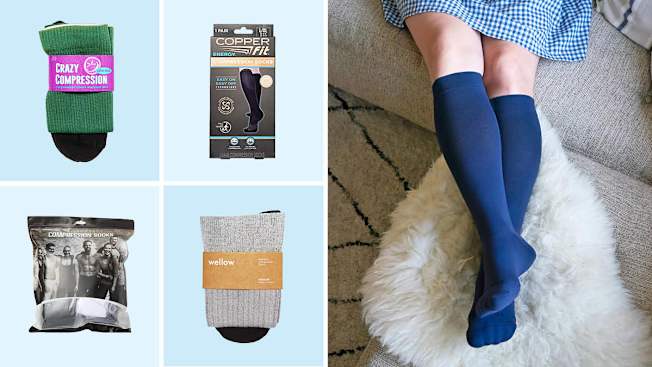
We battled the hard-to-put-on socks to find the best level of support from brands including Bombas and Crazy Compression. Plus, do you really need them for long flights?
Compression socks can help relieve leg and foot soreness at the end of a long day.
By Angela Lashbrook
If you’ve ever taken a long flight or drive, worked a full day on your feet, or been pregnant, chances are, you’ve considered—and possibly worn—compression socks. These tight, often knee-high socks are meant to increase circulation and thus decrease swelling and blood clots, and help your feet feel more comfortable.
Comfort is key, and as we discovered in our tests, not every pair wins that particular distinction. Whether itchy, too tight, too loose (and thus not compressive), or poorly fitting, a lot can go wrong.
We purchased and tested eight pairs of compression socks that didn’t require a prescription to find the ones that manage both comfort and support.
Sneak peek: Some testers enjoyed the graduated compression socks by the popular brand Bombas, but one tester had issues with the level of compression. Read on to find our winners and the products we recommend skipping.
The Evaluators
• Erica Sherman is 5 feet, 10 inches, with a medium build, and wears a size 10 shoe. She’s an avid walker and weight lifter, so she wanted to find socks that improve circulation, reduce muscle fatigue during long walks, and provide good calf support and support recovery after strength training sessions.
• Elizabeth L. is 5 feet, 4 inches, and wears size 12/14 pants and 8.5/9 wide shoes. She was hoping to find socks that were supportive yet comfortable enough to wear daily.
• And me. I’m 5 feet tall and wear size 2 pants and size 6 shoes. I was looking for compression socks that fit well on a small person without cutting into the legs or gapping at the toes.
Crazy Compression Compression Socks
Crazy Compression Compression Socks are remarkable in large part because of the enormous array of colors and patterns. If you want basic black, Crazy Compression has that, yes. But if you want purple and black “wizard stripes,” purple neon unicorn print, or a medical theme (for all you nurses, doctors, and other medical professionals who are on your feet all day), the company has you covered.
Most importantly, though, Crazy Compression socks are comfortable. “The fabric feels soft against the skin and doesn’t pinch or rub during daily activities. I had no issues wearing them for extended periods,” said Sherman, a CR staffer. She particularly appreciated how easy these socks are to take on and off, even after a long day of wear, and that they came out of the wash as good as new. Elizabeth, another CR staffer, said, “This sock has the best blend of compression and everyday comfort wearability.”
Crazy Compression recommends machine-washing the socks separately in cold water and hanging them to dry.
Bombas Women’s Everyday Compression Knee High Socks (15-20mmHg)
Bombas Everyday Compression socks are soft yet gently compressive. Elizabeth and I loved these mostly cotton socks, finding them cozy, easy to slip on and off, and fitting perfectly around the heels and toes with no fabric bunching. Washing improved them, according to Elizabeth, who said: “Washing improved the fit and the compression comfort. Before washing, they felt a little uncomfortably tight.”
Though Elizabeth and I were enthusiastic about the Bombas, Erica, who washed her socks before wearing them, was not. “The compression felt minimal and didn’t provide the snug, supportive sensation I expect from compression socks,” she said, despite the fact that Bombas says its socks provide “medium” compression. “The material was noticeably thick and bulky, making them less comfortable than expected.” These socks are absolutely on the thick side, and while some people (like Elizabeth and me) will find this cozy, others may find it suffocating.
Bombas recommends washing the socks in a cold, gentle cycle and drying them on low. Bombas says it donates one pair of socks for every pair you buy.
(These are also available in men’s sizes, although we didn’t test them.)
Wellow Compression Socks
Like the Bombas, Wellow Compression Socks are wildly soft and almost fluffy: They’re softer, in fact, than the Bombas. They felt only lightly compressive, although Wellow claims that its compression is moderate at 18-25 mmHg, and that they’re antimicrobial (which we didn’t attempt to test). “These have very nice material,” Elizabeth said. “The material is thicker than some of the others. Feels more like a winter sock. I don’t think these would be comfortable in hot weather.” I, likewise, wouldn’t wear these socks in July, but at the time of testing, New England and the Mid-Atlantic were assaulted by two monumental snowstorms, which made me feel particularly warm toward the Wellows.
Sizing, however, seems to be somewhat inconsistent. I’m petite, so I ordered the small size and found them to fit perfectly, reaching just below my knee and with no extra material around the toes. Elizabeth bought them in a medium size and found them to be a bit too big. Erica, who purchased a large size, wrote: “The fit is off. The socks feel too long, and there’s excess room at the heel. The toe box doesn’t align as cleanly with the heel as it should, which contributes to the overall sloppy feel and lack of support.”
Comrad Knee-High Compression Socks
Comrad socks felt more compressive than the three pairs above. The company claims the compression is “strongest at the ankle and gently decreases up the leg to encourage healthy blood flow.” They require some effort to put on, and they seemed tight. Erica said: “The socks were slightly tight around the top of the calf, creating a visible indentation under sweatpants at the gym. I was conscious of wearing them, which bothered me because I prefer a more seamless experience. However, the material felt supportive and well-made.” Elizabeth noted that the socks were made from a “luxurious type material” and said she could wear them every day, although they were a bit long for her.
I found the fit to be perfect around the toes and heels, though they were a bit more compressive than I would like, which I think made them feel a bit itchy for me.
Comrad instructs wearers to wash the socks in cold water, then hang them to dry to prevent shrinkage.
Copper Fit Energy Compression Socks
These socks from Copper Fit were, according to Elizabeth, among the most compressive-feeling of the bunch. “I appreciated that Copper Fit came with detailed instructions on how to put them on,” she said. “I also like the distinct foot arch compression and support on the Copper Fit.” Erica likewise said the Copper Fits “took some effort to pull them up properly, and I found myself putting my thumb through the top band to help adjust and position them. Once on, they stayed in place well, but putting them on required a bit of patience.” She wore them for 10 hours and found the firm compression contributed “to an overall sense of stability and mild leg fatigue relief,” though “the upper edge began to feel slightly restrictive after prolonged wear.”
Though Elizabeth found them to go up a bit high on her 5-foot-4-inch frame, it wasn’t to the point of cutting off circulation or causing discomfort. Erica, at 5 feet, 10 inches, found the fit to be generally good. “The heel pocket aligned correctly, and the toe box was well-shaped without bunching or extra fabric,” she said.
The company recommends machine-washing the socks in cold water and letting them tumble-dry on low.
Charmking Compression Socks
These socks are remarkably inexpensive at around $4 a pair, but not the most effective if you’re looking for strong compression. Both Elizabeth and Erica found them comfortable, but among the least compressive socks we tested. “These socks are very comfortable to wear,” Erica said. “The fabric feels soft against the skin and doesn’t pinch or rub during daily activities. I had no issues wearing them for extended periods. However, they resembled thin trouser socks more than genuine compression gear and lacked the firm support I anticipated.” They were easy to put on and take off—unsurprisingly, since they don’t feel especially tight—and fit all three of us well, despite our diverse sizes. I found them comfortable but a bit loose around the toes.
Charmking instructs wearers to wash the socks inside out in a cold cycle and line-dry them or, if that isn’t possible, dry them on low heat.
Other Compression Socks We Tried
PhysFlex Compression Socks
The PhysFlex socks were incredibly divisive among the evaluators. Both Elizabeth and I found them to be too long—Elizabeth folded them down, but I had to take them off before the end of the day because of the discomfort around my knees. Erica, however, found them to fit perfectly. “These socks were incredibly comfortable—so much so that I forgot I was wearing them,” she said. “They felt soft and supportive without being overly tight. I didn’t experience any constriction at the top band or around the ankle, and they remained comfortable all day.”
These socks come in black or tan, with a variety of colorways around the heels and ankles. The company recommends placing the socks in a lingerie bag to prevent snagging before washing on a gentle cycle, and avoiding machine drying. It also recommends replacing the socks every six to nine months.
Pro Compression Marathon Compression Socks
Elizabeth and I found these socks to be quite uncomfortable. Although I’m only 5 feet tall, my Pro Compression socks (which I ordered in black) didn’t come all the way up to my knees but stopped about an inch short. The toe box was too wide and bunched in my shoe, and they felt itchy and sweaty. Elizabeth, who purchased a printed colorway, said the socks were uncomfortable and scratchy: “Very uncomfortable; leaves bad impression marks on my skin,” she wrote. “I ordered a checkered pattern design, which has a lot of extra seams throughout the sock, which I think are the culprit for the discomfort. Plus, when on my leg, the design stretches and is unattractive looking.”
Erica didn’t mind them, though. She found them snug but comfortable, although difficult to put on and take off. They also fit her well, with no extra room at the toe.
Pro Compression advises either hand-washing or machine-washing on cold and line-drying.
The Pro Compression socks left deep, uncomfortable indents on Elizabeth’s legs.
Photo: Elizabeth Lucy/Consumer Reports
How We Tested
Erica, Elizabeth, and I wore each pair of socks for a full day at a minimum. We evaluated the socks according to the following criteria:
• How comfortable are the socks?
• How easy are they to put on and take off?
• How compressive/supportive do the socks feel?
• How well do the socks fit?
What Do Compression Socks Actually Do?
Compression socks squeeze, or compress, the blood vessels in your legs, helping improve blood flow. This helps encourage blood flow to return to the heart rather than pooling in the legs, reducing swelling and possibly helping to prevent blood clots.
Should You Wear Compression Socks?
Most people don’t need compression socks. There’s very little data to support their use on flights among otherwise healthy people who want to prevent blood clots, nor is there much convincing data indicating that compression socks can shorten recovery time and reduce soreness post-workout, whether you’re running or doing another form of exercise.
They’re not shown to prevent varicose veins, either, according to Faisal Aziz, MD, the chief of vascular surgery at Penn State Health, though once you have them, “the first-line treatment is leg elevation and compression stockings for at least a few months.”
According to the American Heart Association, folks who may benefit from compression socks include obese people, older folks, or smokers. Those who have had blood clots or leg injuries in the past may also benefit. (Obviously, if your doctor recommends compression socks and you don’t fall into one of those categories, you could benefit from wearing them.)
Wearing compression socks may help prevent swelling if you work on your feet all day, as nurses, restaurant servers, and teachers often do. “There is a theoretical benefit for compression stockings” in such cases, says Natalie Sridharan, MD, chief of vascular surgery at University of Pittsburgh Medical Center Mercy. “However, the evidence for preventative effects is quite limited.”
And there’s some evidence that they could be helpful for pregnant people. “Pregnant persons have an increased blood volume, which can strain the veins,” says Chloe Powell, MD, a vascular surgeon at The Ohio State University Wexner Medical Center. “Hormonal changes also relax and dilate the vessels, which can lead to valves not functioning as efficiently. Wearing compression during pregnancy can alleviate some of the discomfort that accompanies swollen feet and legs.”
Feel free to wear them, even if you don’t fall into one of the above categories. According to some experts, there’s nothing wrong with wearing them if they’re comfortable or help your feet ache less at the end of a long day.
But experts say that people with peripheral arterial disease (PAD), in which narrowed or blocked blood vessels reduce blood flow to the arms or legs, shouldn’t wear compression socks, and that those who use a wheelchair or are bedridden should talk with a doctor before wearing them. And people with sensitive skin might find them uncomfortable. “I’ve seen people who have allergic reactions to the fabric of the stocking,” Aziz says.
A note about compression levels: Companies that sell non-medical compression socks don’t verify compression levels with the Food & Drug Administration. That means the information on a product’s package might not be 100 percent accurate.
If you have a specific compression level in mind when shopping, consider the stated compression levels, but keep in mind you might not get that exact level. If you need specific compression, talk to your doctor about a prescription.
Consumer Reports is an independent, nonprofit organization that works side by side with consumers to create a fairer, safer, and healthier world. CR does not endorse products or services, and does not accept advertising. Copyright © 2026, Consumer Reports, Inc.