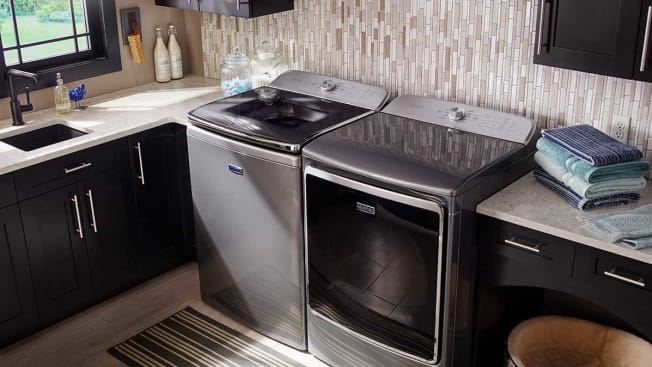
This type of washer can be wallet-friendly, but don’t expect perfect performance
If you have room for side-by-side laundry machines, a top-load washer with an agitator can be an economical choice.
By Keith Flamer
Additional reporting by Quentyn Kennemer
Top-load agitator washers are generally cheaper to buy and can finish a load faster than other types of washing machines. But our tests show they don’t deliver the best washing performance and can sometimes be rough on fabric.
That’s because, unlike high-efficiency (HE) top-loaders and front-load washers, top-load agitator washing machines have a rapidly twisting column in the center of the wash tub to—ahem—agitate the clothes. That center post churns the laundry, so items rub against one another to work out dirt and stains.
That said, top-load agitators remain popular because people prefer their speed and relative affordability compared with other types of washing machines. If you’re wondering whether this particular type of washer is right for you, read about the five things you need to know about top-load agitator machines. To learn about other types of machines, check out our washing machine buying guide and our list of the best washing machines from each category.
As you’re shopping, make sure you can fit the new machine in your laundry space (and through your doorframes) by noting the model’s dimensions in our washing machine ratings.
Best Top-Load Agitator Washers
These nine top-load agitator washers have the highest ratings in our tests. They all come with features such as automatic temperature control, automatic detergent and fabric softener dispensers, and stainless steel tubs.
LG WT8405CW
The LG WT8405CW is the top-rated top-load agitator washer in our ratings—and the cheapest to operate, costing only an estimated $33 annually. Don’t be put off by its long 90-minute wash cycle. It offers excellent cleaning performance and water efficiency, and a very good energy-efficiency rating. But like many top-load agitators, this model isn’t terribly gentle on clothes. It’s also a tad noisy, but thanks to its excellent vibration score, you won’t feel it rumble. It has a 5.3-cubic-foot capacity that easily handles large loads. It features a stainless steel tub, auto detergent dispensers, an extra rinse cycle, and WiFi connectivity, allowing you to track the progress of your loads from anywhere.
LG WT7005CW
The next two equally rated LG top-loaders will get the job done, too—one impressively, the other quietly. The LG WT7005CW rates near the top for washing performance, water efficiency, and energy efficiency in our tests. It’s not very gentle on clothes, but it will get them clean in a jiffy, with a 70-minute normal/heavy wash cycle. And with great test results in our labs for vibration and noise, you’ll barely notice its 4.3-cubic-foot drum running. That capacity is slightly smaller than that of other higher-rated agitators, so washing large bedding is a tight squeeze in this model.
Although it’s 2 inches shorter, the LG WT8205CW should be able to handle large comforters in its 4.8 cubic foot stainless steel tub. It isn’t particularly quiet or gentle on clothes, but it makes up for it with performance and efficiency. It aced our cleaning and vibration tests, and has excellent energy-efficiency and very good water-efficiency scores. You’ll appreciate these efficiency features because this washer tied for the longest wash cycle of all the agitator models we’ve tested—105 minutes. It features auto dispensers, an extra rinse cycle, and WiFi.
LG WT7155CW
The LG WT7155CW is a CR Recommended winner in so many ways, and we expect it to perform comparably to its cousin, the LG WT7305CW. That model’s washing and water efficiency are both top-notch. It’s also highly energy-efficient; its 70-minute wash speed extracts more water from clothes, reducing time spent in the dryer. With a fairly roomy claimed capacity of 4.8 cubic feet, it can handle relatively large loads. Additionally, it features auto detergent and fabric softener dispensers, auto temperature control, and a stainless steel tub. It’s not the quietest machine, though, with middling noise levels, and it’s pretty rough on clothes, testing below par for gentleness.
Samsung WA44A3205AW
If you’re looking for a budget-friendly option, you might consider the CR Recommended Samsung WA44A3205AW, which we expect to perform similarly to the tested Samsung WA44A3405AW. While its washing performance and fabric gentleness are middle of the road, it’s both water- and energy-efficient. What’s more, it’s very light on vibration and pretty quiet. This washer has a claimed capacity of 4.4 cubic feet and a quick cycle time of 70 minutes. It features auto temperature control, an auto detergent dispenser, and a stainless steel tub.
Samsung WA46CG3505AW
The CR Recommended Samsung WA46CG3505AW has excellent water-efficiency and vibration test results, which means it uses less water than comparable machines to wash an 8-pound load and produces minimal vibration. (It’s very quiet, too.) That said, its washing performance and gentleness were both just okay. It offers 4.6 cubic feet of claimed capacity and a very fast normal/heavy cycle of 65 minutes. It also features auto dispensers and WiFi remote access. At 46 inches high, this washer is the tallest agitator in our ratings.
Insignia NS-WMT41WA5
Insignia is an exclusive Best Buy brand whose budget-friendly washers nab an impressive reliability rating in our surveys. This high-performing Insignia NS-WMT41WA5 offers solid washing performance, water efficiency, and gentle fabric care, with middle-of-the-road energy and noise ratings. Its price spiked $100, but it’s still one of the least expensive top-load agitators in our ratings—about $1,000 less than the lower-rated Speed Queen TC5003WN. But this washer’s annual operating cost ($45) and water-efficiency rating are just middling, and Insignia’s unfavorable owner satisfaction score (indicating Consumer Reports members are unlikely to recommend this brand to family and friends) is a red flag.
Samsung WA54CG7105AD
Like the other Samsung top-load agitators here, the Samsung WA54CG7105AD does a decent job of getting laundry clean, and does so with impressive scores for energy and water efficiency. Like many other agitator models, it’s pretty rough on fabrics, but our tests show it’s quiet and barely vibrates. You’ll be able to fit large loads in its 5.4-cubic-foot stainless tub and keep track from afar via WiFi if you choose. It also comes with automatic temperature control and automatic bleach and detergent dispensers.
GE Profile PTW705BSTWS
The CR Recommended GE Profile PTW705BSTWS nabbed excellent marks in our washing performance and vibration tests, and a very good energy efficiency score. But it doesn’t fare as well for water efficiency, noise, or gentleness. Despite the agitator spindle, its large 5.3-cubic-foot tub can easily handle large loads. It might keep you waiting, though, with a long normal/heavy cycle time of 105 minutes.
Worst Top-Load Agitator Washers
When it comes to top-load agitators, don’t be tempted by attractive prices. Some budget-friendly washers may be duds. These three agitator top-loaders fall short in washing performance and rank lowest in our tests.
Frigidaire FLVW7000AW
The Frigidaire FLVW7000AW may be the best of the worst, but that’s not saying much. This washer is noisy, an energy hog, and a water waster. It failed our water-efficiency test, guzzling a staggering 40 gallons of water, and it costs $93 annually to operate, nearly three times as much as the top-rated LG. This washer’s performance is passable; it’s quite gentle on clothes, and it won’t vibrate. But that’s not enough to overcome its flaws, which include a dismal owner satisfaction score. CR doesn’t recommend this washer.
Midea MLTW41A1BWW
Unlike the Frigidaire above, the Midea MLTW41A1BWW is water- and energy-efficient, has a decent 4.1-cubic-foot capacity, and is remarkably gentle on clothes. In fact, it’s the gentlest top-load agitator in our ratings. But that might mean the machine doesn’t agitate aggressively enough to clean clothes effectively, which would explain its rock-bottom washing performance score in our tests.
Insignia NS-TWM35W1
Not to be confused with the highly rated Insignia NS-WMT41WA5 above, the budget Insignia NS-TWM35W1 falls well short of our standards for washing performance, earning a failing score in our tests for its 50-minute normal/heavy cycle. Its small 3.7-cubic-foot drum doesn’t help; it’s not quite big enough for family-sized loads. We found it to have above-average energy efficiency, water efficiency, and gentleness. But that’s a negligible benefit if you find yourself rewashing laundry that didn’t get clean the first time.
Why Choose a Top-Load Agitator Washer?
You might think of the various types of washers in the same way you view cars. Traditionally, agitator washers were the no-frills station wagons of the laundry aisle. At the same time, high-efficiency top-loaders and front-loaders raced in the muscle car and luxury lanes, loaded with shiny, sleek designs and advanced technology. So why are so many agitators still being sold? Let’s pop the hood on that.
Top-load agitator washers are positioned as wallet-friendly alternatives to the aforementioned more expensive varieties. But in recent years, manufacturers have upgraded them with more features, which can increase their prices. That’s why you’ll see agitator top-loaders in our ratings with stylish details, such as a stainless steel finish or a glass lid. Some models may have jumbo capacities, allowing you to do more laundry at once. But if you’re looking for a less expensive washer, there are still basic agitator machines that cost less than other types of washers.
Their downsides? Performance, for one. Until recently, they washed fewer clothes per load. They can also be water hogs, typically using 20 gallons or more per load. And if you value the longevity of your threads, be aware that top-load agitators tend to be rougher on fabric than other types of washers.
How CR Tests Washers
To evaluate how well a washing machine cleans clothes, CR’s lab engineers use fabric swatches stained with red wine, cocoa, carbon (similar to soot), and other hard-to-remove stains. They analyze each swatch with a spectrocolorimeter before and after washing. The lighter the stain after laundering, the higher the machine’s washing performance score.
We also evaluate how gentle a washer is on fabric and record how much water and energy each machine uses. And we record the energy needed to dry the laundry we just washed. Washers that extract more water shorten dryer time and score higher in our energy-efficiency tests.
Our testers also measure the amount of vibration the washer transmits to a wood floor, and evaluate the washer’s noise levels during the fill, agitate/tumble, drain, and spin cycles.
Consumer Reports is an independent, nonprofit organization that works side by side with consumers to create a fairer, safer, and healthier world. CR does not endorse products or services, and does not accept advertising. Copyright © 2026, Consumer Reports, Inc.