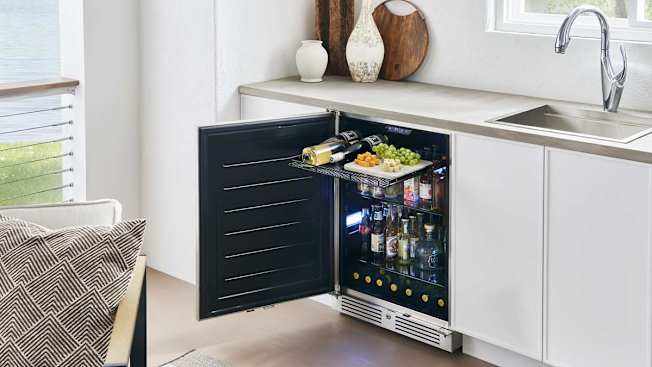
We stress-test outdoor fridges. Here are great options from Blaze, Bull, Coyote, and Zephyr.
Outdoor fridges add convenience to backyard kitchens, but they can be expensive to run.
By Daniel Wroclawski
If you have an outdoor kitchen or simply want more convenient food storage by your grill, an outdoor refrigerator can be a great addition to your backyard setup. These specialized fridges are designed to withstand extreme temperature changes, and some are even water-resistant.
Our lab testing shows that outdoor refrigerators tend to be noisier and less energy-efficient than their indoor counterparts. Noise isn’t likely to be too much of a concern since these fridges live outdoors, where there is more ambient noise. But given that these small fridges can cost significantly more than full-sized refrigerators, you’ll want to make sure you choose one that works well and won’t ratchet your electric bill too high.
All of the fridges listed below survived our 110° F stress test—normally used to test garage fridges and freezers—proving they are capable of keeping cool outside on the hottest summer days.
Most outdoor fridges are built to fit standard 24-inch-wide spaces within cabinetry, but 15- and 21-inch fridges are also common. We focused our testing on 24-inch and 21-inch models. If you already have an outdoor kitchen, you’ll want to measure your space to make sure you pick a fridge that fits.
Below are the best outdoor fridges from our lab tests, made by Blaze, Bull, Coyote, and Zephyr. All of the fridges have stainless steel finishes, LED interior lights, and reversible doors (to change which direction they open). The annual usage cost is an estimate based on a CR formula that uses average U.S. electricity rates.
Best Outdoor Fridges From Our Tests
Here are the five top performers from our tests, along with their usable storage capacity and estimated annual usage cost. To see all of our tested models, head over to our outdoor refrigerator ratings.
Coyote 24-Inch (C124R-S)
Usable storage capacity: 6.7 cubic feet
Annual usage cost: $47
The Coyote C124R-S is the best outdoor refrigerator in our ratings. It aces almost all of our tests, turning in excellent scores for thermostat control, temperature uniformity, and energy efficiency. It receives an unfavorable rating for noise, a common issue with outdoor fridges. This model lacks door bins and a door lock—a safety measure for young children and important for keeping critters out—but it features a door open alarm. It has digital temperature controls.
Blaze 24-Inch (BLZ-SSRF-5.5)
Usable storage capacity: 4.8 cubic feet
Annual usage cost: $51
The Blaze BLZ-SSRF-5.5 is a good option overall, but its performance in CR’s testing is varied. The fridge receives an excellent score for thermostat performance, a very good score for temperature uniformity, and just a midlevel score for energy efficiency. Then, it receives a subpar score for noise, a common issue among refrigerators of this type. It features a door lock and digital temperature controls, but it lacks both a door open alarm and door bins.
Zephyr Presrv 24-Inch (PRB24C01AS-OD)
Usable storage capacity: 5.1 cubic feet
Annual usage cost: $45
The Zephyr PRB24C01AS-OD performs almost identically to the Blaze model above in our tests. But it’s less expensive, both to purchase and run annually. The fridge receives an excellent score for thermostat performance, a very good score for temperature uniformity, a midlevel score for energy efficiency, and a subpar score for noise output. It features a door lock, a door open alarm, and digital temperature controls, but it lacks door bins. This model also has an IPX4 water resistance rating, meaning it’s protected against splashing water.
Bull Outdoor Premium Series II (13700)
Usable storage capacity: 4.5 cubic feet
Annual usage cost: $57
The Bull Outdoor 13700 is the most expensive outdoor fridge in our ratings, and the most expensive to run, with an estimated annual cost of $57. It receives an excellent score for thermostat performance, a very good score for temperature uniformity, and a decent score for energy efficiency, but an unfavorable score for noise output. It features a door lock, a door open alarm, and digital temperature controls, but it lacks door bins.
Blaze 20 Inch (BLZ-SSRF126)
Usable storage capacity: 3.6 cubic feet
Annual usage cost: $55
Despite its name, the Blaze BLZ-SSRF126 is actually 21 inches wide and the best performer we tested in that size. It’s also the least expensive model in our ratings. It receives an excellent score for temperature uniformity, a very good score for thermostat performance, and a midlevel score for noise output. But it receives a poor score for energy efficiency: It’s one of the most expensive outdoor fridges to run despite offering less storage space than most other models in our ratings. The fridge features a door lock and door bins, but it lacks a door open alarm and precise digital temperature controls.
How CR Tests Outdoor Refrigerators
We run outdoor refrigerators through many of the same tests we conduct on full-sized refrigerators, rating them for thermostat performance, temperature uniformity, energy efficiency, and noise output.
We wire them up with thermocouples, which are highly precise temperature sensors, and monitor them for more than a month in one of three temperature-controlled test chambers. The results tell us how well a refrigerator maintains a set temperature and how temperature varies in different areas of the fridge. This helps us determine which models will keep your food fresh the longest.
CR test technician Kyaw Naning places thermocouples inside an outdoor fridge in our climate-controlled test chamber.
Photo: Scott Meadows/Consumer Reports
Our testers measure the noise when the compressor starts up and the steady hum while the fridge is running. We also measure the usable storage capacity of every refrigerator, accounting for space taken up by shelving, lights, vents, and more.
Finally, we subject every fridge (and stand-alone freezer) that enters our labs to an extreme heat stress test. We set fridges to their coldest settings and place them in a 110° F test chamber for at least four days. This test can help us judge how well fridges and freezers will work in a hot garage or outside on hot summer days.
Get more information on CR’s refrigerator tests.
Consumer Reports is an independent, nonprofit organization that works side by side with consumers to create a fairer, safer, and healthier world. CR does not endorse products or services, and does not accept advertising. Copyright © 2026, Consumer Reports, Inc.