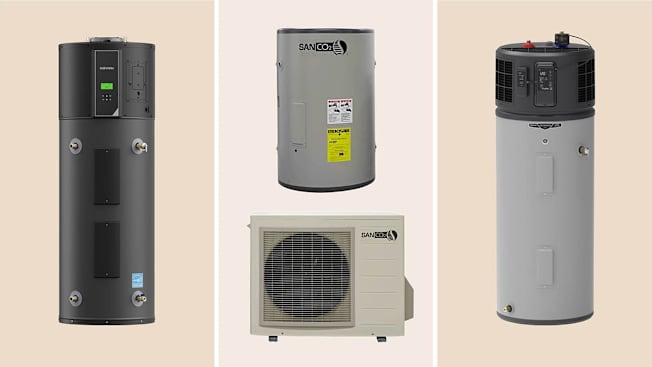
These water heaters are far more energy-efficient than conventional options. We tried models from A.O. Smith, GE, Sanden, and other brands. Here are the best.
Heat pump water heaters look like traditional water heaters, but they draw heat from the surrounding air, using less energy to heat.
By Yasmeen Khan
Heat pump water heaters have been around for decades, but they’re becoming more popular as a go-to for their energy efficiency. More households are opting for heat pump water heaters than ever before, in part thanks to incentives from federal and state governments, and higher energy costs, which make the savings that much more appealing. Manufacturers are expanding their product offerings, too.
As a group, heat pump water heaters are two to three times more energy-efficient than conventional electric water heaters, according to the Department of Energy. They do not generate heat directly, unlike conventional water heaters. Instead, heat pump models take heat from the air, raise the temperature of their refrigerant using a compressor, and then transfer the heat from the air and refrigerant to the water inside the storage tank. It’s exactly the way refrigerators and air conditioners work, but in reverse. That process means that you’ll use far less electricity to heat a tank of water.
We offer more details below on what to consider if you are thinking about switching to a heat pump water heater, including the space it requires for optimal efficiency and whether it will supply enough hot water for your needs. Of course, determining whether a heat pump water heater will work for you largely depends on which model you choose. If you’re not sure which type of water heater to buy, you can also see our advice on choosing the best water heater for your home.
Best Heat Pump Water Heaters
Consumer Reports has tested 15 heat pump water heaters, focusing on how quickly they heat cold water and how energy-efficient they are.
The majority of the water heaters we tested were hybrid models. That is, they were designed to operate in either heat pump mode (the most energy-efficient mode) or as a conventional water heater with built-in resistance heating elements. In a real-world setting, a hybrid model would utilize the heat pump until it sensed it was not keeping up with demand and maintaining the desired hot water temperature. That’s when the electric resistance heaters would kick on. For our ratings, we tested water heaters exclusively in heat pump mode. We also considered whether the model had a user-friendly control panel to switch between settings.
Sanden SanCO 2
This split-unit model from Sanden heats water quickly, is highly efficient, and comes with a 15-year warranty. It does not have a hybrid mode, but it’s unique in that the heat pump unit is separate and designed to be kept outside or in another space. Sanden promises that it can heat water even with outdoor temperatures as low as -20° F. It has a smaller tank, at 43 gallons, but its efficiency more than offsets the drawback, and it still has an impressive first hour rating of 69 gallons. Its superb functionality and efficiency come at a high price, though; it’s more than twice the cost of some alternatives.
GE Profile Geospring PH50S10BPY
This GE Profile Geospring PH50S10BPY has the highest energy efficiency of all the models we tested. It has a 50-gallon tank, it can operate in hybrid mode, and it comes with a 10-year warranty. The GE gets midrange scores for heating speed in heat pump mode, though it has the highest first-hour rating (meaning it can deliver more hot water in an hour, starting from a full tank of heated water) in hybrid mode. The GE Profile also comes with a wireless sensor (called a “puck”) to detect leaks. The puck is placed on the floor, adjacent to the heater, and if a leak is detected, the water heater will shut off automatically. One thing to note about this model is its height—at more than 70 inches, it is one of the tallest models in our ratings.
Navien NWP500-50
The Navien NWP500-50 gets top scores for energy efficiency in our tests and midrange scores for heating speed. It has a 50-gallon tank, operates in hybrid mode, and connects to WiFi. This model’s air inlet and outlet ports come with flanges that can be easily used with ducting, allowing installation in smaller areas with limited air circulation. It comes with a 10-year warranty.
A.O. Smith ProLine XE® Voltex® HPTS-50 200
A.O. Smith is a well-known water heater brand, and our tests found this hybrid model to be highly efficient and quite decent at heating water quickly while in heat pump mode. It has a 50-gallon storage tank and can operate in hybrid mode. It has side and top plumbing connections, which is convenient because it allows the unit to be installed in different configurations, like a tight spot in a basement or an attached garage. It can also connect to WiFi and can automatically alert you (and shut off) if the unit detects a leak. It has a first-hour rating of 65 gallons and a 10-year warranty.
A.O. Smith Signature 900 HPS10-50H45DV
Like the unit above, this A.O. Smith model is highly efficient and good at heating water quickly while in heat pump mode. It can operate in hybrid mode and connect to WiFi, and has side and top plumbing connections. This unit has a 50-gallon storage tank and is on the tall side, at 68 inches. It has a first-hour rating of 65 gallons and a 10-year warranty.
Is a Heat Pump Water Heater Worth It?
These models cost more up front than traditional water heaters. The units we tested range in price from about $1,500 to more than $5,000 (with most models costing $2,500 or less). If you have sticker shock, we get it. You can get a conventional electric water heater for under $1,000.
But if you have an electric water heater that needs replacing, switching to a heat pump version could offer you significant savings over time. The Environmental Protection Agency’s Energy Star program estimates that a family of four can save approximately $550 per year with a heat pump water heater that has an Energy Star rating, compared with a standard electric water heater. Those savings would offset the higher cost of the heat pump water heater in as little as three years.
Many states and even utility companies are also offering rebates as an incentive to choose a heat pump unit. Plus, heat pump water heaters tend to last a bit longer. While a traditional water heater has a lifespan of about 10 to 12 years, a heat pump water heater is expected to last 13 to 15 years.
Lastly, when you’re considering whether it’s worth it to go with a heat pump, part of the equation is considering what you currently have. If you have a traditional electric water heater, more than likely you’ll be able to convert easily to a heat pump model because both water heaters have the same electrical requirement of a dedicated 240-volt line.
Switching from a gas model to a heat pump is also a possibility, but that may require electrical upgrades, which can eat into any potential savings. There are also heat pump models that run on 120 volts and can plug right into existing wiring. A 120-volt model may be a good alternative if you’re looking to switch from a gas water heater, as long as you’re aware that the lower-voltage model may take longer to heat a tank full of water.
How to Know if a Heat Pump Water Heater Is a Good Fit for You
Heat pumps generally take longer to heat water than conventional electric water heaters, an important consideration. But that doesn’t mean that a heat pump can’t get the job done in your home.
“Just as you can have a big air conditioner or a small air conditioner or a big refrigerator or a small refrigerator, there are different sized heat pumps,” says Bernie Deitrick, who leads Consumer Reports’ testing of heat pump water heaters. “So the size of a heat pump water heater (along with its efficiency) will determine how quickly the water inside the storage tank will heat.”
To see how fast a water heater is, you can look at its first-hour rating (how much hot water it can supply in 1 hour, starting from a full tank of hot water and replenishing itself). The models we tested had first-hour ratings ranging from 50 gallons to 76 while in hybrid mode.
To extend your hot water supply, you can take advantage of hybrid models, which will help during those periods when you expect to use a lot of hot water, Deitrick says, and need it replenished faster—think kids coming home from college or having a houseful of guests. Or you can get what’s known as a mixing or blending valve, says Deitrick. These devices automatically mix hot and cold water to ensure you get the right temperature at the faucet. They also let you jack up the temperature on your water heater and compensate by mixing in more cold water. That allows you to keep the water in your tank much hotter, so you’ll use less of it and be less likely to run out during periods of high demand.
What to Know Before You Switch to a Heat Pump Water Heater
Because of the way heat pump water heaters work, by moving air instead of heating water directly, they have a few distinct characteristics to be aware of.
They need extra space. Heat pump water heaters should be installed in a large enough room to allow for proper venting. Specifications for just how large can be found in the water heater’s installation guide. In most cases, they can be installed where you would typically place a conventional water heater, like a basement or garage. For instance, A.O. Smith, which makes two of the recommended models from our tests, says its hybrid electric heat pump water heaters should be installed in a room that is at least 450 cubic feet. Some models can also connect to ductwork to use air from a different area, allowing them to be installed in smaller rooms.
Heat pumps like warm air (but they still work in winter). Keep in mind that these water heaters operate more efficiently in warmer spaces—which makes perfect sense because they utilize the heat in the air to warm up the water in the tank. So installing a heat pump water heater in a room with a furnace or boiler, where there’s excess heat, would help increase its efficiency. These water heaters will work in a room with a minimum air temperature of 40° F. But if you have a hybrid model and the room with the water heater gets too cold for the heat pump to work, the heating elements will kick in.
They can be tall. Many models are taller than a typical storage tank water heater. That’s because you have a water heater in two parts: a heat pump and a water storage tank. So the all-in-one models, where the heat pump sits on top of the storage tank, give it extra height. There are also split-type models, such as the Sanden that came out on top in our ratings. The Sanden has an indoor storage tank and a compressor that can be placed outdoors.
You’ll need to address condensation. Heat pump water heaters produce condensation as part of the process of transferring heat because they cool the air of the room that they’re in. The water that’s created needs to be routed to a drain, or you’ll need to install a condensate pump to remove the water. The amount of water produced could be significant: up to a couple of gallons per day, depending on the humidity and your hot water use. The condensate that’s collected is just water, though, so you can dump it down any drain or set it aside for your plants.
How CR Tests Heat Pump Water Heaters
To come up with our heat pump water heater ratings, we tested all models in heat pump mode only. We filled each water heater tank with cold water of the same temperature and then set them to reach a desired temperature of 120° F.
We measured how long it took for each model to reach the desired temperature, and we determined how much energy each model used by measuring the wattage.
Consumer Reports is an independent, nonprofit organization that works side by side with consumers to create a fairer, safer, and healthier world. CR does not endorse products or services, and does not accept advertising. Copyright © 2026, Consumer Reports, Inc.