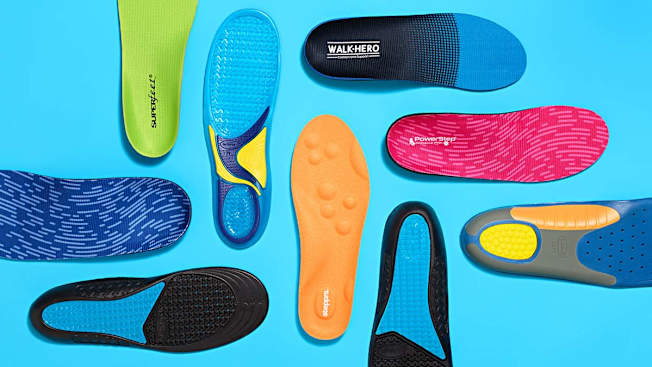
We tested Dr. Scholl’s, PowerStep, Stepprs, and other shoe inserts on our tired, achy feet. Four insoles offered the most comfort and stability.
Four people with different foot issues tested eight OTC orthotics for comfort, stability, and ease of use.
By Lisa Fogarty
If your shoes never feel comfortable, or you’re burdened with foot pain or conditions such as flat feet, plantar fasciitis, or high arches, orthotics could be the product standing between you and a pain-free walk in the park.
Orthotics are devices you wear to relieve pain associated with foot and ankle conditions. These also include inserts and insoles. In this case, we’re using the terms interchangeably to describe pieces of material you slip into your shoes to provide cushioning, even out pressure, and control abnormal motion that could be causing you discomfort or pain.
A podiatrist can create custom-molded prescription orthotics, but if you think your foot issues don’t warrant medical intervention, or you don’t want to incur the cost, nonprescription shoe inserts are usually less expensive and come in a variety of styles and sizes. In most cases, you can order the exact size you need and trim them if necessary.
To test the comfort, support, and ease of use of eight shoe inserts, we relied on four testers with different foot issues and lifestyles.
David Schipper: David, who’s an associate director at CR, has suffered stress fractures in his right foot, bad plantar fasciitis, and a significant bone bruise that caused him to wear a boot for months. He says he has flat feet, with barely an arch.
Anna Maria Cupido: Anna Maria has a neutral arch and suffers from bunions and hammertoes. She is 76 years old and works at an airport, where she stands on her feet for 8 hours a day.
Sharon Seidl: Sharon, a senior user experience visual designer at CR, is a breast cancer survivor who takes medication that has given her arthritis and osteoporosis. Her feet are the most affected by this. She says that she has higher arches, but that they aren’t too high.
Me: I have a neutral arch and a bunion on one foot that makes wearing certain shoes uncomfortable. My hope was that shoe inserts would provide a more comfortable experience.
When a version of the same shoe insert was available for men and women, we tested both options.
Sneak peek: We tested four OTC orthotics by Dr. Scholl’s, and the company’s Work All-Day Insoles were a standout. They cost less than $15 and delivered a comfy walking and standing experience—though we had other thoughts on their overall support.
Keep reading to find out our top picks and how the rest of the insoles performed. We also talked with Alison Bell, MD, at To Healthy Feet Podiatry and Jeffrey S. Rich of the U.S Orthotic Center about who can benefit most from orthotics and when you should consider seeing a podiatrist for a custom-made pair.
PowerStep Pinnacle Insoles
The PowerStep Pinnacle was our Top Pick for overall comfort, ease of fit, and stability. This insole features dual-layer cushioning and an odor-control top fabric, and comes in men’s and women’s shoe sizes. (David tested a similar PowerStep insole, which comes in men’s sizes 3 to 16 and women’s sizes 5 to 11.5.)
David called these a “well-made product” and said he felt noticeably steadier on his feet and stood “straighter and taller.” Even his wife noticed a difference. But there was a breaking-in period for him. “At first, the arch support was very pronounced and a bit uncomfortable, like there was a walnut under my foot,” David said. “But as I wore them, they became more and more comfortable.”
You can trim these to fit your shoe better, but David said that wasn’t necessary for him and that the insert in his size glided right into his shoe and didn’t curl at the toes.
Our female testers unanimously voted these as their favorite among all the shoe inserts. “The part where the arch is seemed softer than the others, some of which had a stiff arch,” Anna Maria said. After standing for hours at work, she reported much less discomfort in her feet than usual when wearing these insoles. “It gave the most support of all of the inserts,” she said
Sharon and I also found these to offer maximum structure, support, and stability. They were simple to insert into our shoes and didn’t require trimming. “They just hold your feet in all the right ways,” Sharon said. “I love these so much.”
Stepprs Massage Insoles
Stepprs’ Massage Insoles were our runner-up choice. Its massage-bump design may not be everyone’s cup of tea, though we found it to be a soothing treat for our tired feet. “It’s a unique feeling, but once you start wearing them, they really do feel like they are massaging your feet,” Sharon said. “I love these and put them in the slippers I wear around the house. These are amazing, and I would buy these as gifts for all my friends and family—they are that fun.”
David agreed and said the bumps were placed in just the right places, providing nice stability, massage, and feel. The memory foam inserts slid right into our shoes without needing to be trimmed (which you can do easily), and the company claims they should last over 12 months and can be hand-washed.
Anna Maria and I preferred the PowerStep to these insoles for addressing our bunion issues. We weren’t sure if the massaging bumps were causing the insole to lift more around the forefoot, but we noticed a tighter fit in this area. We both got used to these insoles after wearing them for a few hours, but they weren’t our first choice for bunions.
WalkHero Inserts
The WalkHero inserts featured a noticeably higher arch (3.5 centimeters of arch support), which is something to factor in because that could be uncomfortable if you have flat feet or don’t want rigid arch support. Our testers were split on this one. Sharon, who has high arches, said that the inserts were “perfect from the first step” and helped with her usual unsteadiness, and that heel and arch support were “in the right spots.“
David, who has flat feet, considered them functional and better than stock insoles. But he said they lacked the strong arch support and stability he prefers.
Anna Maria and I felt like our feet were positioned too high when wearing these inserts, and the effect irritated our bunions. “Unfortunately, I had a hard time getting it into the shoe,” Anna Maria said. “I had to cut the insert to fit better. It did feel better after that, maybe because it didn’t lift my foot too much.”
Dr. Scholl’s Work All-Day Insoles
We didn’t all agree on these inserts, which are available in men’s and women’s sizes. For starters, we all found them more difficult to insert into our shoes. “The Dr. Scholl models are more flimsy than others, so they are tougher to insert into the shoe without it crumpling up or under,” David said. “Because they are flimsier/thinner, they also have a harder time getting and staying flat once in the shoe.”
Sharon, Anna Maria, and I all took scissors to these to help them fit in their shoes better. “The toe where you cut is flimsy, and it took cutting it a few times to make it sit comfortably,” Sharon said. “It did fit and lie flat, but it felt loose in the toe. It didn’t exactly curl up, but it didn’t feel secure.”
Once we got the inserts in, we appreciated their massaging gel, but we didn’t find them supportive enough. But David had a different experience. “In terms of just comfort, these are the most cushiony versions I’ve tried,” he said. “Very soft and plush, like a pillow for my feet. Pretty impressive, because they don’t physically feel as substantial as an insole, but the material and cushioning characteristics are tops.”
Other Shoe Inserts We Tested
Some shoe inserts left our poor feet feeling like we just ran a marathon. Here are three we don’t recommend.
Dr. Scholl’s Men’s Heavy Duty Support Insole
The intention behind Dr. Scholl’s Heavy Duty Support Insoles is good: They’re designed to provide a comfortable experience for men who are tall, weigh 200 pounds or more, or have wide feet. But the execution leaves a lot to be desired, according to David.
“This didn’t fit well,” he said. “They were awkward to insert as the insole is super-floppy and not rigid, like the best performers. It wouldn’t lie flat under the toes and kept rippling.” David also noted that these insoles didn’t provide much more comfort or stability than the stock insoles already in his shoes.
If you’re searching for a pair of less expensive Dr. Scholl’s insoles, all of our testers preferred Dr. Scholl’s Work All Day Insoles to these.
Dr. Scholl’s Women’s Energizing Comfort Everyday Insoles
We’re sticking by Dr. Scholl’s Work All Day insoles as our budget favorite, because we kept finding discrepancies in how other inserts from this brand felt. The Energizing Comfort Everyday Insoles didn’t impress us for a few reasons. Anna Maria said they were difficult to place in her shoes, and the gel kept pulling on her socks and dragging them down.
“These were my least favorite of all of the insoles,” she said. “They made it impossible to walk comfortably.”
I had a similar experience. I found them difficult to insert into my shoes, and they lacked meaningful support. They also made my shoes feel so tight that my bunion bothered me more than usual.
Sharon’s report after wearing them sealed the deal for us. “The toe kept curling up on me,” she said. “The toe where you cut is flimsy, and it took cutting it a few times to make it sit comfortably. These did not offer support in the area of the heel and arch. They only offer some cushioning, no real support.” And although the other inserts didn’t make our feet sweat, Sharon noted that these weren’t as breathable as the others.
Superfeet All Purpose Support High Arch
Superfeet All-Purpose Support High Arch wasn’t our least favorite insert, but for $55, we expected to feel some kind of love for them, and we didn’t. It’s important to note that these have a high arch, which will affect their comfort for some folks.
“I had to take them out of my shoes while shopping at Costco because my feet were slipping out,” Anna Maria said. “It took too much space inside the shoe, so as I was walking, my foot was slipping out. I felt like it bothered my bunions; it was more obvious. Even though the shoe felt tight, the back of my heel kept slipping out of the shoe as I walked.” Anna Maria does not have a high arch, which may be why these just didn’t work for her feet.
I had the same experience (dare I say, because of my bunion?). Sharon (who has high arches) said she felt the inserts were comfortable at first, but because the material is harder, it didn’t offer as much cushioning support as other insoles. And David (who has flat feet) said that he found it difficult to insert these into his shoes, and that the toe side curled up on his first attempt. “Once I took additional steps to flatten the insole, it stayed exactly in the right position,” he said. “I would score these a 3 [out of 5], very average. Not bad, but not sure it provided too much benefit when compared to the Nike insole my shoes came with.”
Who Benefits From Orthotics?
Good news if you’re wondering whether adding a shoe insert may help your feet feel better: The answer is most likely yes. In fact, according to Alison Bell, MD, at To Healthy Feet Podiatry, she has yet to see anyone who can’t benefit from orthotics. And you don’t have to suffer from a chronic foot, joint, or bone issue to gain comfort from them. “Most commonly, we see a vast variety of foot types that benefit from orthotics, especially those with congenital deformities such as flat feet, pronated foot type, and cavus [high arch] foot type,” she says. “Inserts can also be helpful for those coming off a sports-related injury, such as shin splints or ankle sprains, resulting in instability. I also make them for my dancers who have sesamoiditis, etc.”
Although Jeffrey S. Rich of the U.S Orthotic Center agrees that insoles can address a range of foot and joint issues, including in the ankles, knees, hips, and back, he says some people need to be careful when purchasing over-the-counter products. “For example, if you have a very flat foot, some over-the-counter insoles can provide too much support and cause pain,” he says.
What Do Orthotics Do?
Insoles change pressure distribution by supporting the arch and stabilizing the foot, allowing pressure to be more evenly distributed across the entire foot, Rich says. If you’re a newbie to shoe inserts like me, you might have also assumed that the more cushioning and memory foam, the better. Comfort equals cushioning, right? But Rich says that’s not always the case.
“When you look at insoles people tend to like, such as Dr. Scholl’s, cushioning is a big reason; they feel very soothing to the foot,” Rich says. “However, cushioning alone can be ill-conceived. It’s similar to sleeping on a mattress that’s too soft; you may wake up with a backache. Cushioning combined with support is key. Too much cushioning without support is not necessarily helpful.”
Rich adds that materials like memory foam don’t recover quickly enough. “By the time you finish a step, the foam hasn’t rebounded,” he says. “I consider memory foam more of a high-perceived-comfort material. It feels good, but it’s not always what the foot actually needs. Gel, on the other hand, I like quite a bit. Gel absorbs shock well and still provides sufficient support, so it doesn’t bottom out as memory foam can.”
Should You Go to a Podiatrist for Orthotics?
Short answer: It depends.
“I absolutely swear by a pair of custom orthotics,” Bell says. “When comparing them to an off-the-shelf brand, the biggest difference is the ability to build in what you want. I share this with my patients daily. An OTC orthotic is generic and generalized, but a custom orthotic can be made custom to the patient’s foot type, custom to the various shoe types, and custom to the pathology.”
Still, Rich says over-the-counter insoles are probably appropriate for about 70 percent of the population. The remaining 30 percent require a custom or more supportive solution. “People with very high arches often don’t get enough support from over-the-counter insoles,” he says. “Conversely, people with very flat feet may find that over-the-counter insoles provide too much support for their foot type, causing pressure in inappropriate areas. These two groups definitely benefit from custom orthotics.”
Will Orthotics Help Metatarsalgia?
People who often need something custom are those with metatarsalgia, Rich says, which is essentially a bruising or pain in the ball of the foot caused by excessive pressure. “Most over-the-counter insoles do not include a metatarsal pad,” he says. “Aetrex is one company that offers a metatarsal pad in its over-the-counter insoles, but most companies do not, or position it in the wrong area. If you have a forefoot problem, over-the-counter insoles are unlikely to do the job.”
How Much Do Orthotics Usually Cost?
Depending on your needs and whether you purchase them off the shelf or have them custom-made, prices can vary widely. We purchased standard inserts from a drugstore, the manufacturer’s website, or Amazon for $13 to $55. The American Orthopaedic Foot & Ankle Society says that more advanced orthotics cost $150 to $200, semi-custom ones range from $60 to $300, and custom orthotics can cost $300 to $800.
How CR Tested Orthotics
To test shoe inserts, each of us wore them for at least two days and evaluated how they felt while walking, standing, and in some cases, working out. Each tester had a unique foot issue to address, and paid attention to ease of use (including how easy the inserts were to put in and remove from shoes), comfort, support, stability, ease of trimming them (when necessary), and breathability. We wore the same pair of shoes while testing each insert.
Consumer Reports is an independent, nonprofit organization that works side by side with consumers to create a fairer, safer, and healthier world. CR does not endorse products or services, and does not accept advertising. Copyright © 2026, Consumer Reports, Inc.