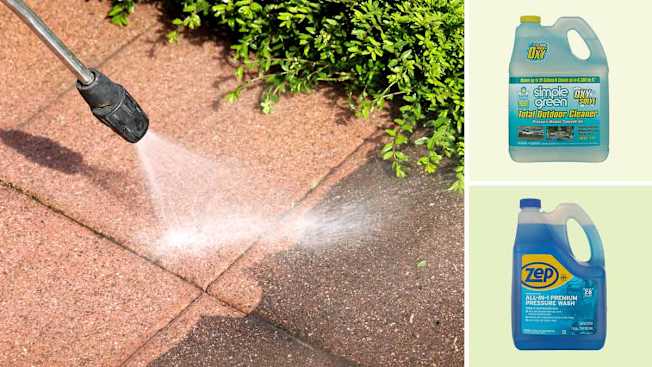
Our winning pressure washer soap uses a common household ingredient as its primary cleaning agent, which helped us make quick work of the boat, roof, pavement, and tractor we cleaned
We tested four pressure washer soaps to remove grease from a tractor, spent hydrocarbons on a metal roof, mildew, and more, to find out which ones made the job easier.
By Michael Frank
Every season seems to be a good time for de-mildewing, as black or green fungi seem to attach to just about every surface around our homes, from siding to porches, to roofing to patios.
If you have a garage and a grill it’s also (always) the season for degreasing. Unfortunately, if you live near major roadways, you might also find a combination of spent hydrocarbons—a broad term that describes any used petroleum substances such as engine oil, which can collect on some surfaces—and mildew building up on your home’s siding and rooftop, especially if you have a metal roof, where there’s more visible evidence than on asphalt shingles.
The “cure” for this icky grime could just be spraying with a pressure washer. Though—caution!—using such an instrument could damage a wooden deck if not used properly, says David Trezza, who leads pressure washer testing at Consumer Reports. Pressure washers can also pierce skin and protective gear, such as boots.
However, pressure washer detergents promise to hasten around-the-home deep cleaning, which is why we tried out four of these soaps on multiple surfaces, from painted wood siding to metal roofing. “Pressure washers—especially with detergent—can remove that dark grime on concrete (assuming that is spent hydrocarbons),” says Trezza, so we tried it on concrete, too. We also spot-sprayed them onto a garage floor with grease stains and onto a highly mildew-penetrated fabric barbecue grill cover.
How Do Pressure Washer Soaps Work?
Preparing the soaps for use is the same for all the products we tested: Follow the manufacturer’s instructions to dilute with water (they’ll provide the ratio). Then spray on a quantity of the detergent at low or no pressure, allow the solution to soak in, then rinse at high pressure. At least one formula can be used without dilution.
You may not need a pressure washer at all. Especially when fighting mildew, just using a little pressure washer cleaning solution by spritzing on the solution with a simple spray bottle—then applying elbow grease and rinsing with a garden hose—yielded great results.
In some cases, pressure washing alone did the trick. During testing, especially on mildewed concrete walks and metal roofing, high-pressure water with zero soap proved nearly as effective, but slower. If you already have a pressure washer, try cleaning the surface with plain water first. The suds definitely killed mildew faster, and this was especially true on both metal and concrete walks.
Caution: Two of these products list eye irritation as a warning, and two warn that they can cause irreversible blindness. So wear protection, not just glasses, but safety goggles, that will prevent overspray from getting into your peepers. Also, wear gauntlet-style rubber gloves and heavy boots, because all of these products can cause skin irritation, and it’s difficult, if not impossible, to prevent spray from hitting your hands, feet, and arms.
Siding Test
The pressure washer detergents each performed pretty well in cleaning the siding on a house.
Photos: Michael Frank
Simple Green Oxy Solve Total Outdoor Cleaner
Effectiveness: Better than other contenders on both mildew and grease
I tried the Simple Green Oxy Solve Total Outdoor Cleaner on all of the surfaces where it made sense and it was recommended, such as on metal, concrete, roofing, siding, and to de-grease. While it’s slightly pricier than the runner-up from Zep, and both were effective at destroying mildew on roofing, siding, and a fabric grill cover, the Simple Green solution was a lot better at degreasing.
I tested the latter on my friend’s giant tractor, where I spot-sprayed sections where grease fittings had leaked oil onto the painted surface and grit clung to the metal. As with all of the cleaners here, I waited the recommended time between application and spraying off, and the Simple Green proved just a bit better than its next-closest rivals, the Simpson solution and the Zep, at cutting through the slime.
The Simple Green soap did a great job cleaning gunk and grease from a tractor.
Photos: Michael Frank
As with all the products here, I also tested Simple Green Oxy Solve, mixed in a small spray bottle from the hardware store. That way, I could brew a smaller batch and spot apply it more manageably on surfaces that shouldn’t be pressure-washed, like wood siding. It is also advisable to be sure it won’t stain the surface—important not just with the Simple Green solution, which contains hydrogen peroxide, but also with the other sprays I tested.
Zep All-in-1 Premium Pressure Wash
Warning: As mentioned above, you should wear safety gear, including safety goggles while using pressure washer soaps. Zep says that small amounts of their concentrate splashed into eyes can cause irreversible tissue damage and blindness.
Effectiveness: Reasonably strong at fighting mildew and grease
Definitely read the cautions about using this product and suit up! That means when you’re pouring it out of the container to dilute it as well as during application. In both instances you want to avoid any eye contact, which can be highly toxic. Zep also says you should not inhale.
That said, Zep’s solution rivaled Simple Green for cleaning mildew, though I had to use a bit more scrubbing effort/more time with the high-pressure washer to get the same results. It’s not quite as effective at cutting through grease, however, and as with the other products here (save the Simpson) Zep advises against using it without diluting the mix, so whether a stronger concentrate would have stood up to oils better isn’t something I tested.
When using, Zep recommends avoiding letting the product dry on the surface to prevent staining. Zep provides this tip for avoiding streaks on vertical surfaces: Apply cleaner from bottom to top, then rinse from the top down. To help protect nearby vegetation, the company recommends saturating plants, shrubs and grass with water before and after cleaning.
Simpson Pressure Washer Heavy-Duty Cleaner
Effectiveness: Worked better on grease than mildew.
Simpson says its non-butyl formula is good at degreasing, and we found that to be true. The Simpson Pressure Washer Heavy Duty Cleaner seems like a real bargain, because it starts out cheaper and the manufacturer says you can dilute it at a ratio of up to one-half ounce of cleaner/gallon of water. However, we found that a bit more cleaner was needed (1 part cleaner to five parts water) to start to become productive. At that stronger mix, it attacked grease decently and stood up fine to mildew, too, if only matching alternatives. However, obviously that means you’re using more of it than the less noxious Simple Green, so the Simpson yields less bang for the buck.
Simpson says its cleaner can also be used directly from the bottle.
One More Cleaner We Evaluated
The Karcher formula did not perform as well as the picks above.
Kärcher Multipurpose Cleaner
Effectiveness: Worked well enough against mildew but wasn’t great at fighting grease.
The Kärcher soap is about as cost-effective as either the Zep or Simple Green. It proved the equal of the rest of the soaps here at tackling mildew, though it did require more scrubbing/spraying to remove fungus from metal surfaces. It was less effective than the others at cutting through heavy grease.
How We Evaluated Pressure Washer Detergents
Our home is our castle. Well, it’s kind of a grungy castle, actually, or at least it has lots of mildew buildup. And luckily, that’s what all of these cleaners excel at. So I tried all four of them on removing fungal residue from siding, our metal roof, the fabric cover of our grill, and I even went after some bee poop (from carpenter bees, yay!) on a section of windows and siding. I also applied the cleaner to a friend’s metal boat that had black mildew on the hull, tried to degrease sections of his giant tractor with the soaps, and sprayed it onto a different friend’s sidewalk and front walk/driveway.
All of these cleaners work in roughly the same fashion: You mist all of these mixtures on at low pressure using a pressure washer (or just a home spray bottle), then rinse off at high pressure. Note, however, that on sensitive siding, high pressure can strip paint and destroy wood, so use caution.
Further, during my evaluation all of the products worked just as well if not better via a simple spritz on/hose off or scrub-off method. On siding, a hose alone didn’t quite do the job, but one quick pass with a light-duty scrub brush cleaned up the paint pretty easily. A high-pressure washer was more effective for the toughest grime, like my friend’s very greasy tractor and sections of sidewalk, but if you don’t own a pressure washer and aren’t trying to sanitize a large area, you can save money and skip renting or purchasing one.
Also, note that the ratios listed above are a good starting point. The Simpson product can be used in a massive range from 1:256 to 1:5, but only in the latter, relatively concentrated form did I find that it cleaned as well as peers on siding, roofing, and other surfaces. Your experience may vary.
Finally, definitely consider some of the downsides of the more toxic products, because they can be harmful to skin and eyes and require more prep before use.
Consumer Reports is an independent, nonprofit organization that works side by side with consumers to create a fairer, safer, and healthier world. CR does not endorse products or services, and does not accept advertising. Copyright © 2026, Consumer Reports, Inc.